
Record stories before loss because once someone is gone, their voice is gone too — and no photograph or written note carries the same weight as hearing a person laugh, pause, or choose their own words. Start right now: open your phone's voice memo app and record a 15-minute conversation with your loved one today.
Three benefits make this worth doing immediately:
- Emotional healing for the storyteller. Telling life stories reinforces identity and reduces isolation, particularly for older adults.
- A living legacy for descendants. Future grandchildren will hear the actual voice, not a paraphrase of it.
- Practical family history. Names, dates, and places that exist nowhere else get captured before they disappear.
The single best first step: ask one open question ("Tell me about the house you grew up in") and let the recording run.
Table of Contents
- Why recording stories now matters more than you think
- What the research says about how fast family stories disappear
- What to capture first when you start preserving family stories
- Audio, video, or writing: which format should you choose?
- How to make recording conversations feel natural
- Consent, privacy, and family agreements before you hit record
- What to do after you record: preserve, transcribe, and share
- How families use recordings later
- A one-page recording checklist you can use right now
- Key Takeaways
- The moment I realized how much a voice can hold
- Senarra: when you want more than a folder of audio files
- Useful sources and further reading
Why recording stories now matters more than you think
The most immediate benefit of recording stories is what it does for the person telling them. Sharing memories out loud reinforces a sense of self, reduces feelings of isolation, and gives older adults a clear sense that their life has mattered to someone. That effect is not anecdotal — it aligns with reminiscence therapy research showing mood and self-esteem improvements for older adults who revisit their personal histories in structured conversations.
For the family listening, the impact is different but equally real. Gerontology specialists note that recording is therapeutic for both the storyteller and the people around them: it reinforces identity for the older adult and provides meaning and comfort to relatives. The regret families describe when a loved one dies unrecorded is specific and lasting. It is not "I wish I knew more about her." It is "I can't remember exactly how her voice sounded."
"Older adults are living, breathing history books. When they're gone, that voice — the cadence, the accent, the way they told a joke — is gone forever. Even when families have photos and letters, they almost always wish they had recorded the voice."
A short illustrative picture: imagine a family that spent years scanning old photographs and organizing them into albums. After their grandmother died, they had hundreds of images but no recording of her voice. The photographs showed her face at every age. None of them could tell her grandchildren what she sounded like when she laughed. That gap is what recording closes.
Pro Tip: Instead of asking "Do you remember when...?" — which puts pressure on recall and can feel like a test — try "Tell me about a time when..." or "What did it smell like in your grandmother's kitchen?" Sensory and emotion-based prompts open memory far more reliably than fact-based questions.
What the research says about how fast family stories disappear
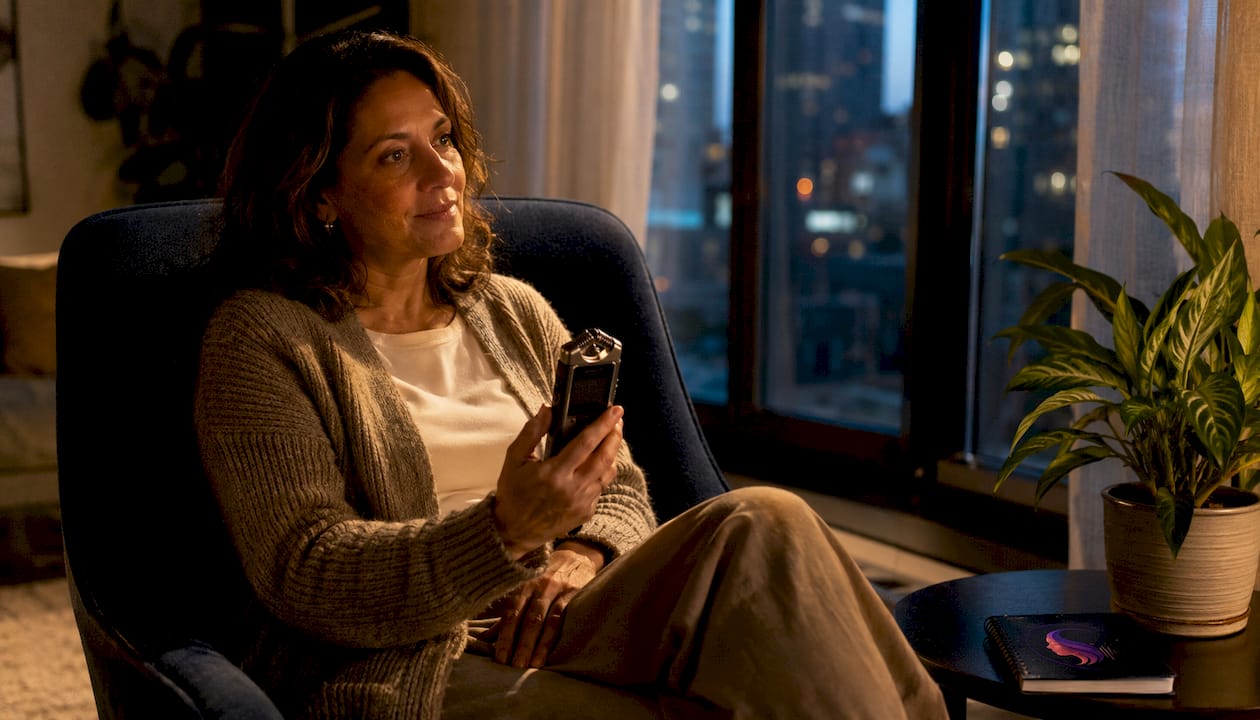
The preservation window is shorter than most families expect. About 90% of family stories disappear within three generations. That means the stories your grandparents told your parents are likely already lost if no one wrote or recorded them. Reminiscence therapy research adds another layer of urgency. Structured storytelling sessions can reduce depressive symptoms and temporarily improve autobiographical recall in older adults — which means recording is not just archival work, it is also a form of care. The act of sitting down and asking someone to tell their story is itself a gift.
What this means practically: waiting for a "good time" or a "proper setup" is how families lose the window. Cognitive decline, illness, and death do not schedule themselves around your readiness. The importance of recording stories for identity and resilience in descendants is well documented — but only if the recording actually happens. Three short sessions now beats one elaborate project planned for later.
What to capture first when you start preserving family stories
Prioritize voice, emotional anchor stories, and the phrases or songs that are uniquely theirs. A person's vocal timbre and cadence preserve personality in ways that text simply cannot replicate. Start there, then build outward.
The highest-value items to capture, roughly in order:
- Voice samples and natural speech. Record them telling any story — the content matters less than capturing how they sound.
- Origin stories. Where they were born, what their parents were like, what the neighborhood felt like.
- Proudest moments. A job they loved, a child they raised, something they built or survived.
- Signature phrases and expressions. The specific words or sayings that are distinctly theirs.
- Recipes and rituals. Not just the ingredients — the way they described making the dish, who taught them.
- Lullabies and songs. Music memory often outlasts other recall, especially with cognitive decline.
- Courtship and early marriage stories. How they met, what they noticed first, what the early years were like.
- Regrets and hard lessons. These are often the most honest and the most useful for descendants.
Starter prompts aligned to these priorities:
- Voice samples: "Just talk to me about your week — what did you do yesterday?"
- Origin stories: "Describe the street you grew up on. What did it look like in summer?"
- Proudest moments: "What's something you did that you still feel good about?"
- Signature phrases: "What's something your mother or father always used to say?"
Capturing emotional memories like childhood, proud moments, and songs tends to yield richer, longer-lasting material than focusing on recent factual details. That is where to spend your first few sessions.
Audio, video, or writing: which format should you choose?
Voice and audio deliver the core value — timbre, cadence, laughter, the catch in someone's throat — that no written transcript can replicate. Video adds nonverbal cues like gestures and facial expressions. Writing is the most portable and searchable but the least emotionally immediate. The right choice depends on what you have available and what you most want to preserve.
The emotional impact of human narration versus text-based records is significant: listeners process voice differently than they read words, and that difference is felt most sharply in grief.
| Format | Legacy value | Ease for older adults | File size | Approximate cost |
|---|---|---|---|---|
| Audio (phone) | High (voice, cadence) | Easy | Small | $0 (phone mic) |
| Audio (external mic) | Very high | Easy | Small–medium | $30–$80 |
| Video (phone) | Very high (voice + face) | Moderate | Large | $0 (phone only) |
| Video (home kit) | Highest | Moderate | Very large | $100–$300 |
| Written transcript | Moderate (searchable) | Varies | Minimal | $0–$1.50/min (transcription) |
Three equipment tiers:
- Phone only ($0). The built-in microphone on any modern smartphone records usable audio. Sit within three feet of the storyteller, minimize background noise, and use the native voice memo app. This is good enough to start.
- Inexpensive external mic ($30–$80). A small clip-on (lavalier) mic like the Rode SmartLav+ or a compact USB mic like the Blue Snowball plugs directly into a phone or laptop and noticeably improves clarity. Worth it if you plan more than two or three sessions.
- Modest home kit ($100–$300). A USB condenser mic, a simple ring light, and a phone tripod. This setup produces recordings that can be edited, shared, and archived with minimal quality loss over decades.
A 15-minute voice session can produce roughly 2,000 words of transcript — far more raw material than the same time spent typing. That alone is a strong argument for starting with audio even if you eventually want a written record.
How to make recording conversations feel natural
Focus on short, sensory, and emotion-based prompts rather than quizzing for facts. The goal is a conversation, not an interview. When someone feels tested on their memory, they tighten up. When they feel invited to tell a story, they open up.
Sample question bank by life chapter
Childhood:
- What was your bedroom like as a kid?
- What did your family do on Sunday mornings?
- Who was your best friend growing up, and what did you do together?
Work and career: 4. What was the first job you ever got paid for? 5. What's the hardest thing you ever had to do at work? 6. Who taught you the most about how to do your job well?
Courtship and partnership: 7. Where were you the first time you saw [partner's name]? 8. What did you think of them at first? 9. What was your wedding day actually like — not the photos, the feeling?
Parenting and family: 10. What surprised you most about becoming a parent? 11. What do you hope your kids remember about growing up?
Proudest moments: 12. What's something you did that you still feel proud of? 13. What's the hardest thing you ever got through?
Dos and don'ts for a good session
- Do let silence sit for a few seconds before jumping in — the best details often come after a pause.
- Do record verbal consent at the start of every session (more on this below).
- Do follow their lead; if they drift to a different story, let them go.
- Don't correct factual errors mid-story — it breaks the flow and can cause embarrassment.
- Don't ask yes/no questions; they close conversations down.
- Don't schedule sessions longer than 20 minutes, especially at first.
Working with memory loss or cognitive decline
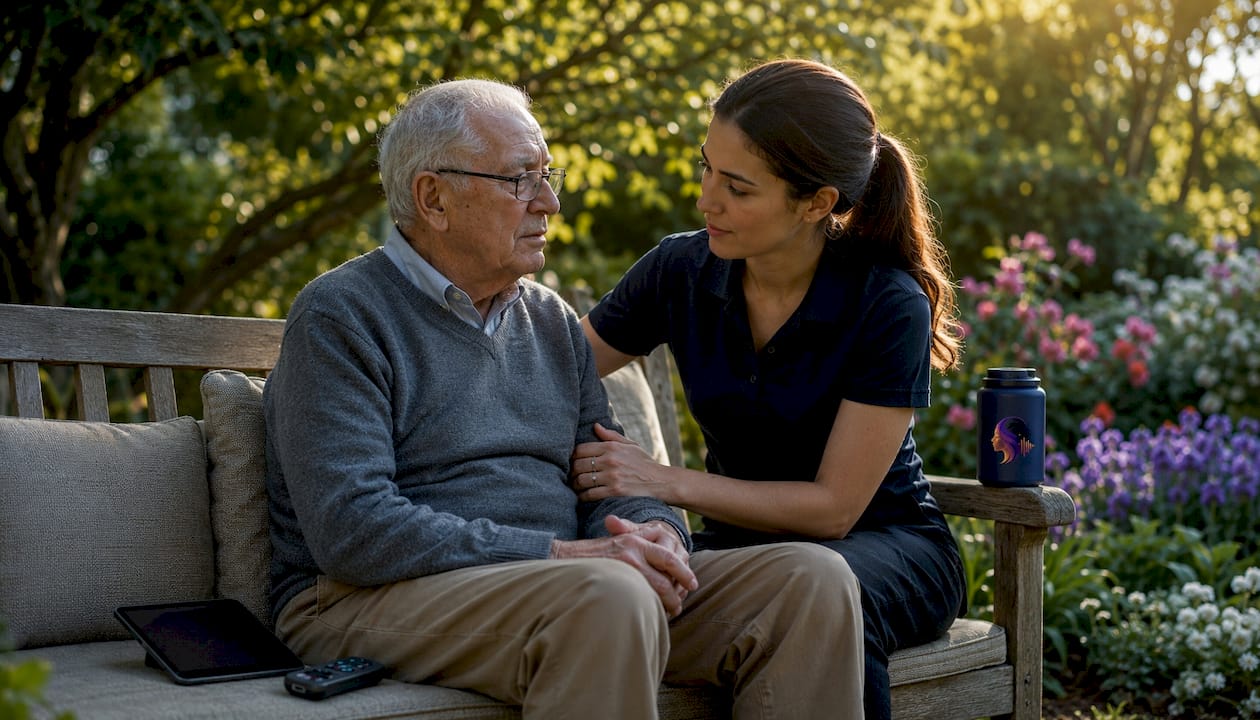
Short sessions of 10–20 minutes, scheduled in the morning when clarity tends to be sharpest, work best for people with dementia or early cognitive decline. Bring a photograph or play a piece of music from their youth before you start — sensory cues open memory pathways that direct questions cannot reach. Accept fragments. A half-remembered story told in their own voice is worth more than a complete story paraphrased by someone else. For deeper guidance on recording during cognitive decline, the techniques differ meaningfully from standard interviewing.
Consent, privacy, and family agreements before you hit record
Get clear, recorded consent early while the person has full capacity to understand what they are agreeing to. This protects everyone and removes ambiguity later when family members may disagree about how recordings are used or shared.
Consent checklist
Before recording, explain and confirm:
- Who will have access to the recordings (immediate family only, extended family, public archive?)
- Whether the recordings can be shared online or only kept private
- Whether transcripts or edited clips can be made from the originals
- What happens to the recordings after the storyteller dies
- Whether any topics are off-limits
Pro Tip: Record the consent conversation itself as the first few minutes of your session. Say something like: "Before we start, I want to make sure you're comfortable with this. I'm recording our conversation to preserve your stories for [family members]. Is that okay with you?" Then let them answer in their own words. That recorded exchange becomes part of the archive and removes any future uncertainty.
A plain-language release you can adapt and record:
Storage and access: Keep recordings on at least two separate storage locations (one local, one cloud). Decide in advance who holds the "master" copy and who can grant access to others. Revisit these agreements if family circumstances change — a divorce, an estrangement, or a new grandchild can all shift what feels right. The National Archives offers practical guidance on long-term stewardship of personal and family records.
What to do after you record: preserve, transcribe, and share
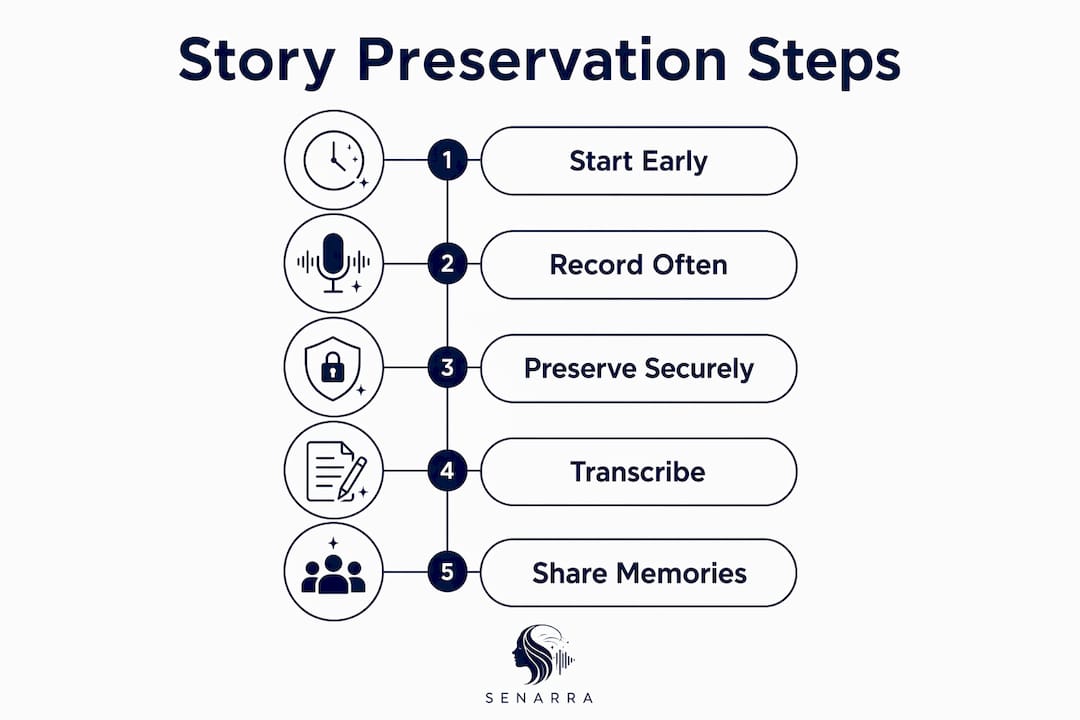
The three post-recording priorities are: preserve the file (back it up immediately), make it accessible (transcribe and index it), and share or curate it (turn it into something the family will actually use).
File naming and backup steps:
- Name every file with a consistent format:
YYYY-MM-DD_FirstnameLastname_Topic.mp3(e.g.,2026-03-15_EleanorHayes_ChildhoodNeighborhood.mp3) - Back up to at least two locations: one local (external hard drive) and one cloud (Google Drive, iCloud, or Dropbox)
- Add basic metadata in a shared document: date recorded, storyteller's name, topics covered, any names or places mentioned
- Store a printed summary or transcript alongside digital files — physical copies survive format obsolescence
Transcription options:
- DIY (free): Otter.ai and Google Docs voice typing both produce rough transcripts quickly. Expect to spend 20–30 minutes cleaning up a 15-minute recording.
- Paid AI transcription ($0.25–$1.00/minute): Services like Rev or Descript produce cleaner output with speaker labels. A 15-minute session costs roughly $4–$15.
- Human transcription ($1.50–$3.00/minute): Worth it for recordings with heavy accents, multiple speakers, or poor audio quality. A 15-minute session runs $22–$45.
Transcripts matter most when you want to search the archive, create a printed memoir, or share excerpts with family members who prefer reading to listening. For storing stories in accessible formats, the combination of audio file plus plain-text transcript is the most durable pairing.
| Storage option | Durability | Accessibility | Cost | Best for |
|---|---|---|---|---|
| External hard drive | 5–10 years (hardware) | High (local) | $30–$80 one-time | Primary local backup |
| Cloud storage | Ongoing (subscription) | Very high (anywhere) | $0–$10/month | Secondary backup, sharing |
| Printed transcript/book | decades | High (physical) | $20–$80 per book | Gifts, memorials, archives |
| USB drive | 10–20 years | Moderate | $10–$20 | Sharing with family members |
Families who record and share stories during a loved one's lifetime report more replays and deeper engagement — and relatives often contribute additional memories, growing the archive organically. Sharing early is not premature. It is how archives grow.
How families use recordings later
Recordings serve memorials, family books, education, therapy, and everyday connection long after the original session. The material you capture in a 15-minute conversation can be repurposed in more ways than most families anticipate.
Common uses:
- Memorial services. A short audio clip played at a funeral or celebration of life is often the most remembered moment of the service.
- Chaptered memoirs. Transcripts from multiple sessions can be organized into a printed book — a meaningful gift for birthdays, anniversaries, or holidays.
- Audio highlights for grandchildren. A two-minute clip of a grandparent telling a funny story or singing a song becomes a keepsake that grandchildren will return to for decades.
- Family history research. Names, dates, and migration stories captured in recordings fill gaps that official records never address.
- Therapy and grief support. Hearing a loved one's voice after loss can be a comfort during grief — and a resource for therapists working with bereaved family members.
- Educational projects. School and community oral history projects benefit from recordings that connect students to living history.
The difference between a short clip and a full chapter matters in practice. A two-minute audio excerpt of a grandmother describing her first day in America works beautifully at a wedding toast or a school project. A full 45-minute chaptered transcript works as a printed memoir chapter or a research document. Both come from the same raw recording. The digital storytelling approach to preserving family narratives makes both formats possible from a single session.
A one-page recording checklist you can use right now
The goal of this checklist is simple: get your first recording done within 15 minutes of reading this. Overplanning is the most common reason families never start.
Before the session:
- Choose a quiet room with the door closed
- Charge your phone or device fully
- Open your voice memo app and do a 30-second test recording
- Pick two starter questions (see below)
- Tell the storyteller what you're doing and get their verbal consent
During the session:
- Record consent at the start ("Is it okay if I record our conversation?")
- Ask your first question and stay quiet
- Let silences breathe — don't rush to fill them
- Keep the session to 15 minutes maximum
- End by asking: "Is there anything else you want to make sure I know?"
After the session:
- Rename the file immediately:
YYYY-MM-DD_Name_Topic - Copy it to one backup location (cloud or external drive)
- Write three bullet notes about what was covered
- Schedule your next session within two weeks
Starter questions for your first session:
- "Tell me about the house you grew up in — what did it look like, and what did it smell like?"
- "What's something you did as a kid that you'd never let your own kids do?"
- "Who was the most interesting person you ever met?"
Five 15-minute sessions produce richer material than a single long session — so schedule the next one before you close your calendar.
Key Takeaways
Recording stories before loss is the single most effective way to preserve a person's voice, identity, and emotional legacy for future generations.
| Point | Details |
|---|---|
| Start before the window closes | About 90% of family stories are lost within three generations; waiting is how families lose them permanently. |
| Voice carries what text cannot | Timbre, cadence, and laughter preserve personality in ways no written record replicates. |
| Short sessions work best | Five 15-minute sessions produce richer archives than one long recording; schedule three sessions within two weeks to start. |
| Consent and backup are non-optional | Record verbal consent at the start of every session and back up files to at least two locations immediately after. |
| Senarra extends what DIY recording starts | Senarra's voice-focused preservation features, including voice cloning and a phone-accessible memory line, add a layer of personalization and durability beyond a simple audio file. |
The moment I realized how much a voice can hold
The thing that pushed me to start recording wasn't a death. It was a birthday party — watching an older relative tell the same story she'd told a dozen times, and realizing for the first time that I was actually listening. Not to the plot of the story, which I knew, but to the way she told it: the pause before the punchline, the specific word she always used, the laugh that came out before she finished the sentence. I thought: I will not remember this exactly. I need to.
That realization is what most families arrive at too late. The story itself is rarely the point. The voice is the point. And the voice is what disappears first.
If you are reading this and someone comes to mind — a parent, a grandparent, an aunt, a neighbor who knew your family before you were born — that feeling is the signal. Not next month. This week. Ask one question, press record, and let them talk. You do not need a plan. You need 15 minutes and a charged phone.
Senarra: when you want more than a folder of audio files
DIY recording gets you started, and everything in this guide works with nothing more than a smartphone. But for families who want their recordings to be truly durable, searchable, and emotionally alive years from now, Senarra offers something a cloud folder cannot.
Senarra is built specifically around voice preservation and personal storytelling. Where a standard backup keeps a file, Senarra captures the person: voice cloning, a memory line accessible by phone, and a personalized archive that lets family members connect with recorded conversations whenever they need to. The difference from a simple cloud backup is that the recordings stay interactive and accessible, not buried in a folder no one opens. Privacy controls let families decide exactly who has access and when.
If you have already started recording, Senarra is a natural next step for organizing and preserving what you've captured. If you haven't started yet, it gives you a structured way to begin. Visit Senarra to see how it works and start preserving the voices that matter most.
Useful sources and further reading
These are authoritative, practical sources for anyone who wants to go deeper on preservation technique, storage standards, or interview methodology. Use them for templates, prompts, and technical recommendations.
Preservation urgency and oral history:
- National Archives: Family Archives Preservation — practical guidance on long-term stewardship of personal records
- Library of Congress: Care and Handling of Recorded Sound Materials — authoritative standards for audio file preservation
- Digital Preservation Coalition (digitalpreservation.gov) — personal archiving best practices for digital files
Interview technique and memory loss:
- How to Preserve Family Stories Before Dementia (OverBiscuits) — stage-by-stage guide for working with cognitive decline
- How to Preserve a Parent's Stories After a Dementia Diagnosis (Memory Murals) — session design, consent, and sensory prompting
- Preserving Family Memories: Tips for Recording Your Life Story (Live at the Birches) — approachable first-session guidance
Storage and archiving:
- How to Preserve Family Stories Before It's Too Late (Tell Me Your Story) — practical overview including the 90% generational loss statistic
- Preserving History: Importance of Recording Older Loved Ones' Stories (Aging Untold) — community reporting on regret and cultural value
- Oral History Preservation: A Practical Step-by-Step Guide (Senarra Blog) — methodology and nonprofit tools for recording and conserving oral histories
- How to Create a Family Oral History Archive (Senarra Blog) — archive-building workflow, tagging, and indexing tips