

Family stories are the foundational narratives that give future generations their sense of identity, emotional resilience, and belonging. Research proves that children and teenagers who know their family history show measurably better mental health outcomes than those who do not. The importance of family stories goes far beyond nostalgia. These narratives shape how young people understand themselves, handle adversity, and connect to something larger than their own experience. Tools like Senarra now make preserving those stories easier than ever, so no voice has to be lost.
Why future generations need family stories: the core case
Family stories are defined as the shared oral or written accounts of a family’s experiences, values, struggles, and achievements passed across generations. Psychologists and genealogists now recognize them as a primary tool for identity formation and emotional development. The legacy of family storytelling is not a soft cultural tradition. It is a documented psychological resource.
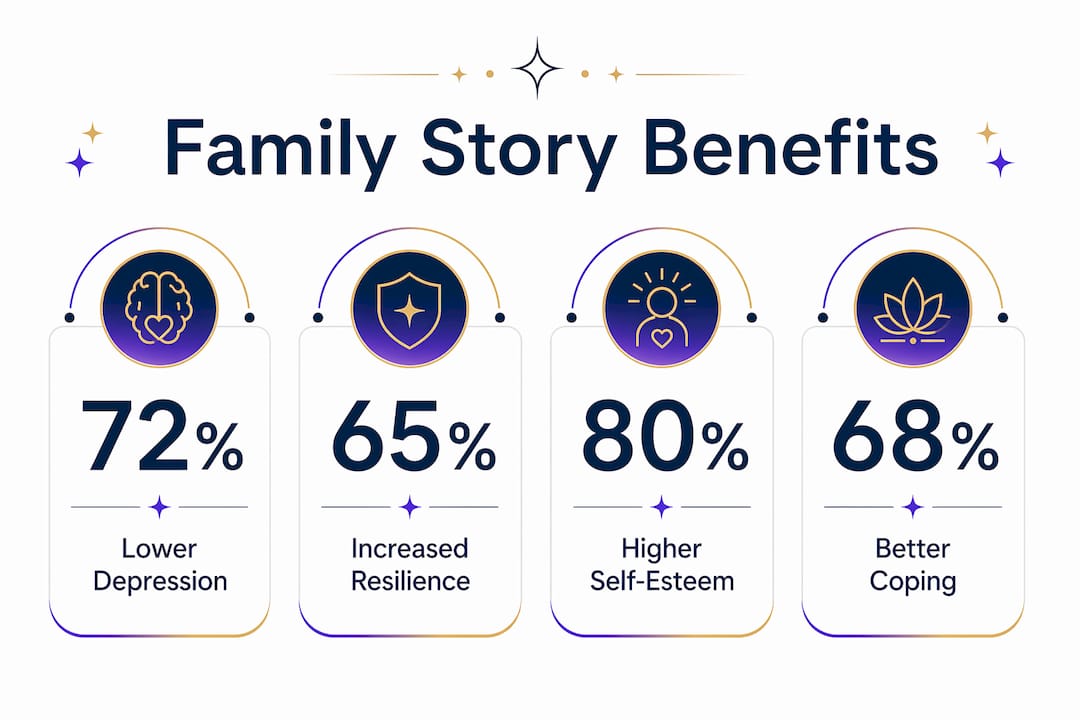
A longitudinal study by researchers Fivush, Bohanek, and Zaman tracked children from toddlerhood through age 21. Teenagers who knew rich family narratives showed lower rates of depression and anxiety and higher self-esteem than peers who did not. That finding held across socioeconomic backgrounds and family structures. Knowing where you come from gives you a stronger foundation for facing where you are going.

The impact of family narratives also extends to collective identity. Families that share stories frequently show better communication and stronger bonds than those that do not. Storytelling is not a passive act. It is an active investment in the people who will carry your family’s values forward.
What psychological benefits do family stories give children?
The psychological case for sharing family history is grounded in decades of peer-reviewed research, not parenting folklore. Children who grow up hearing family stories develop a stronger internal narrative about who they are and where they fit in the world.
“When children understand that their family has faced hardship and survived, they internalize a model for their own resilience.” — Fivush, Bohanek, and Zaman (2011)
Researchers Marin, Bohanek, and Fivush found that open discussion of hardships in family stories improves adolescent coping skills and emotional maturity. Families that talk honestly about failures, losses, and difficult decisions raise children who are better equipped to process their own setbacks. Sanitizing family history into a highlight reel actually weakens the psychological benefit.
Emory University research linked family history knowledge to self-esteem and resilience in children. Kids who understood that their ancestors succeeded after failure were better at handling stress in their own lives. That connection between ancestral struggle and personal strength is one of the most underused parenting tools available.
Family storytelling also fosters psychological endurance by helping children integrate difficulties into meaningful narratives rather than isolated traumatic events. A child who hears that their grandmother rebuilt her life after losing everything processes hardship differently than one who has no such reference point. The story becomes a template for survival.
Pro Tip: Start with one specific story, not a full family history. A single account of how a grandparent overcame a job loss or health crisis carries more psychological weight than a general summary of “tough times.”
How do family stories shape identity across generations?
Family stories are the primary mechanism through which identity is transmitted across generations. They answer the questions every person eventually asks: Who am I? Where do I come from? What do I stand for?
The benefits of sharing family history are especially visible in immigrant families. Psychology Today research shows that immigrant youth build identity and belonging through stories that connect past sacrifices and hopes to their current challenges. A teenager navigating two cultures finds stability in knowing that their grandparents navigated something harder. The story does not erase the tension. It gives the teenager a framework for holding it.
Genealogy plays a specific role in this process. A Deseret News interview with genealogy experts in March 2026 found that genealogy helps elders gain purpose by controlling their own narrative and leaving a legacy. The process benefits both the elder sharing the story and the descendant receiving it. That bidirectional value is what makes family storytelling different from other forms of memory preservation.
Here is what family stories specifically provide for identity formation:
-
A sense of continuity. Children understand themselves as part of an ongoing story, not an isolated individual.
-
Cultural heritage. Stories carry language, values, traditions, and beliefs that formal education rarely transmits.
-
Moral frameworks. Accounts of how ancestors made difficult decisions give younger generations concrete models for their own choices.
-
Belonging. Knowing your family’s history creates a felt connection to people you may never have met.
-
Self-discovery. Understanding ancestors’ struggles and achievements helps individuals recognize patterns and strengths in themselves.
Studying family history is a personally transformative process, according to Psychreg research on digital genealogy. It benefits not only descendants but also the elders who share their stories. The act of narrating your own life gives it shape and meaning.
What are the best ways to capture family stories today?
Family storytelling is a cost-effective parenting tool that requires no special software and costs effectively nothing to start. The barrier is not technology or money. It is simply starting.
Here are practical methods ranked from simplest to most structured:
-
Start at the dinner table. Ask one specific question per week: “What was the hardest year of your life?” or “What did your parents teach you that you still use?” Specific questions produce specific stories.
-
Record a voice memo. Every smartphone has a voice recorder. A 10-minute conversation with a grandparent captured today is irreplaceable in 10 years.
-
Create a memory book. Printed photo books with handwritten captions or typed stories give younger family members a physical artifact they can return to.
-
Build a visual family tree. Tools like MyHeritage allow families to map relationships and attach photos, documents, and stories to individual profiles.
-
Use a dedicated memory app. Senarra captures conversations in a loved one’s authentic voice, preserving not just the words but the tone and personality behind them. Its voice cloning feature and memory line mean future generations can hear a grandparent’s voice long after that person is gone.
Pro Tip: Do not wait for a major family event to start recording. The most valuable stories come from ordinary conversations, not formal interviews. A casual Sunday call with your grandmother often yields more than a scheduled “oral history session.”
Digital storytelling modernizes how families present and share their history, making it easier to collaborate across distances and generations. A family in three different states can contribute to the same shared archive. That accessibility removes one of the biggest obstacles to legacy preservation.
How do family stories build resilience for future challenges?
The forward-facing value of family stories is their most underappreciated benefit. Stories from the past are not just historical records. They are instruction manuals for handling future adversity.
Children who learn that their great-grandparents survived the Great Depression, immigration, illness, or war carry a specific kind of confidence into their own difficulties. They know, at a felt level, that their family has faced worse and come through. That knowledge functions as a psychological buffer against hopelessness.
Empathy is another direct outcome. Hearing about an ancestor’s experience of discrimination, grief, or financial collapse builds perspective-taking skills in young listeners. They develop the ability to hold someone else’s reality alongside their own. That capacity is foundational to emotional intelligence and healthy relationships.
Family stories also reinforce values-based decision-making. When a teenager knows that their grandfather refused to compromise his integrity even when it cost him professionally, that story becomes a reference point. Abstract values like honesty or courage become concrete through narrative.
| Benefit | How Family Stories Deliver It |
|---|---|
| Resilience | Stories of ancestors overcoming failure give children a model for handling their own setbacks |
| Empathy | Hearing about hardship builds perspective-taking and emotional intelligence |
| Values clarity | Specific stories about moral decisions give abstract values concrete meaning |
| Coping skills | Open discussion of family hardships improves adolescent emotional maturity |
| Sense of purpose | Understanding family legacy connects individuals to goals larger than themselves |
Key takeaways
Family stories are the single most cost-effective tool for building identity, resilience, and emotional health across generations.
| Point | Details |
|---|---|
| Psychological health | Teenagers who know family history show lower depression, lower anxiety, and higher self-esteem. |
| Identity formation | Stories provide belonging, cultural heritage, and moral frameworks that formal education does not. |
| Resilience building | Ancestral stories of overcoming failure give children a concrete model for their own challenges. |
| Start simple | A single dinner table question or voice memo costs nothing and creates lasting value. |
| Preserve the voice | Tools like Senarra capture authentic voices so future generations hear, not just read, family stories. |
Why i think we underestimate the stories we already have
I have spent years watching families scramble to preserve memories after a loss, and the pattern is almost always the same. The urgency arrives too late. Someone passes, and suddenly everyone wishes they had asked more questions, recorded more conversations, written more down.
What strikes me most is not the grief. It is the realization that the stories were always there. They were at every holiday dinner, every Sunday phone call, every drive to the airport. We just did not treat them as the irreplaceable assets they are.
The research from Fivush, Bohanek, and Zaman is compelling precisely because it quantifies something most of us feel intuitively. Knowing your family’s story makes you more resilient, more grounded, and more capable of handling difficulty. That is not a soft claim. It is a measurable outcome tracked across two decades of a child’s development.
What I find most encouraging is that this does not require a professional archivist or a genealogy subscription. It requires a willingness to ask and to listen. The families I have seen benefit most from storytelling are not the ones with the most elaborate family trees. They are the ones who made storytelling a regular, unremarkable part of how they spend time together.
Start before you think you need to. The story your grandmother tells you today is the story your grandchildren will need in 30 years.
— Bryan
Preserve the stories that define your family
Every family has stories worth keeping. The challenge is capturing them before time makes that impossible. Senarra was built specifically for this moment. It records loved ones’ voices and memories in their own words, creating a living archive that future generations can return to whenever they need to feel connected.
Senarra’s voice cloning and memory line features mean your children and grandchildren will not just read about the people who shaped your family. They will hear them. Whether you want to preserve a loved one’s voice or document your own story for the people who come after you, Senarra makes the process personal, private, and lasting. The stories are already there. Senarra helps you keep them.
FAQ
Why do family stories matter for children’s mental health?
Research by Fivush, Bohanek, and Zaman shows that teenagers who know rich family narratives have lower rates of depression and anxiety and higher self-esteem than peers who do not. Knowing your family’s history gives you a stronger psychological foundation.
How do family stories help build resilience?
Emory University research found that children who learn about ancestors overcoming failure handle stress better and develop stronger resilience. The stories function as a model for survival that children internalize and apply to their own challenges.
What is the easiest way to start preserving family stories?
Family storytelling costs effectively nothing to start. A single specific question at dinner or a voice memo recorded on a smartphone is enough to capture a story that would otherwise be lost.
How do family stories shape identity in immigrant families?
Psychology Today research shows that immigrant youth build identity and belonging through stories connecting their family’s past sacrifices to their current challenges. Those narratives give teenagers a stable framework for navigating two cultures at once.
Can digital tools help with family story preservation?
Digital storytelling tools, including Senarra and platforms like MyHeritage, make it possible to capture, organize, and share family stories across distances. Senarra specifically preserves authentic voices, so future generations hear the person behind the story, not just a written record.