
Digital storytelling is the practice of combining narrative, voice, photos, and video to preserve family memories in a form that holds meaning across generations. Understanding how digital storytelling preserves families matters now more than ever, because 57% of people cannot name a single great-grandparent. That number signals a quiet crisis in family memory. Without a structured approach, the stories that define who we are disappear within two generations. Platforms like Senarra, techniques like elaborative reminiscing, and AI-powered narrative tools are changing that outcome in measurable ways.
How digital storytelling preserves families through emotional connection
The psychological case for family storytelling is stronger than most families realize. Four short storytelling coaching sessions produced improvements in children's mental health that persisted for 19 years, with oxytocin levels doubling and cortisol decreasing. That is not a minor wellness benefit. That is a biological shift with long-term consequences for how children handle stress, relationships, and loss.

The storytelling style matters as much as the act itself. Elaborative reminiscing, which uses open-ended questions and emotional context rather than simple recall, produces the strongest results. Children whose parents use elaborative reminiscing develop stronger personal narratives, better emotional regulation, and more resilient identities. A parent who asks "How do you think Grandma felt when she left her hometown?" builds more than a memory. They build a child's capacity to understand and process emotion.
Digital storytelling extends these benefits beyond the living room. Research in pediatric palliative care found that narrative-led digital approaches reduced emotional distress and strengthened family bonds even in the most difficult circumstances. Families facing illness or loss used recorded stories, photo timelines, and voice messages to maintain connection and create something lasting. The shift from static keepsakes to flexible, multi-generational storytelling models reduces distress and strengthens bonds during change.
- Oxytocin increase: Storytelling sessions measurably raise bonding hormones in children.
- Resilience building: Children who hear family stories develop stronger coping skills.
- Elaborative reminiscing: Open-ended, emotionally rich questions produce the deepest narrative benefits.
- Loss and transition: Digital stories provide comfort and continuity during grief or family change.
Pro Tip: Ask "What was the hardest part of that time for you?" instead of "What happened?" The first question invites emotion and context. The second invites a list of facts.
What technology does for structured family storytelling
The biggest problem with digital memories is not volume. It is silence. Digital photos and audio clips without an attached narrative are effectively mute. A folder of 3,000 vacation photos tells no story. A voice memo with no label loses its meaning within a decade. Without narrative context, digital fragments become noise rather than legacy.
AI and structured frameworks solve this by building coherent timelines from scattered content. They link metadata, dates, locations, and spoken context into a single readable narrative. The result is a family story that future generations can actually follow, rather than a hard drive full of unnamed files.
| Approach | What it preserves | Best for |
|---|---|---|
| Voice recording with narrative | Tone, personality, exact words | Capturing elder stories before they are lost |
| AI-organized photo timelines | Visual chronology with context | Families with large unstructured photo libraries |
| Multimedia digital books | Combined media in one durable format | Creating shareable legacy documents |
| Structured interview frameworks | Emotional depth and elaborative detail | Families new to storytelling |
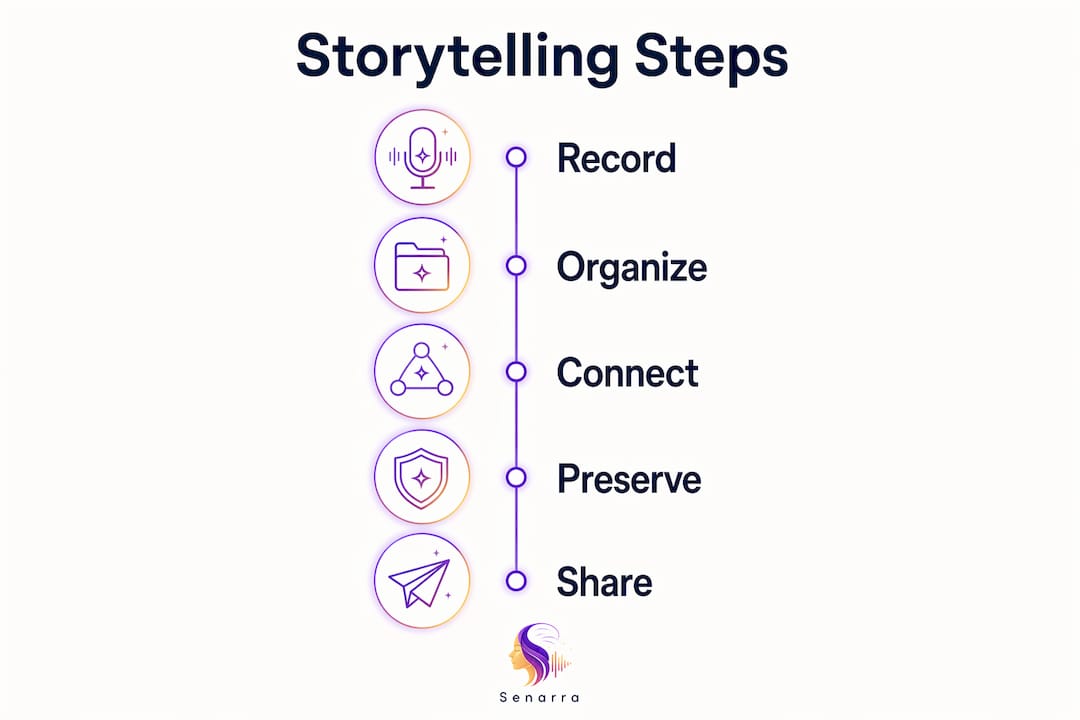
Combining varied media into a single narrative protects legacy far better than isolated photos or messages alone. A digital family history that weaves together voice recordings, letters, and photographs preserves voices, personalities, and emotions in a way that a photo album simply cannot. Narrative curation also cuts redundancy, reveals themes, and protects privacy by controlling tone and context.
Senarra applies this principle directly. Its AI companion captures conversations in a person's authentic voice, then organizes those recordings into a structured memory line that families can access by phone. That combination of voice cloning and narrative organization addresses both the emotional and the archival problem at once.
Practical ways to start preserving your family stories digitally
Starting a digital family archive does not require technical expertise. The most important step is deciding to begin before the stories are gone. Preserving family history through digital methods works best when families treat it as an ongoing practice rather than a one-time project.
- Record interviews with older relatives. Use a smartphone to capture 20-minute conversations focused on one era or event. Ask about feelings, not just facts.
- Organize photos with written captions. Every photo needs a name, a date, and one sentence of context. Without that, the image loses meaning within a generation.
- Create a shared digital folder or platform. Invite multiple family members to contribute. Collaborative archives grow faster and capture more perspectives.
- Include multilingual members. 15% of early U.S. learners are multilingual, and digital platforms that support multiple languages preserve stories that would otherwise stay untold.
- Update the archive regularly. A living archive captures ongoing family life, not just the past. Add new stories, photos, and recordings at least twice a year.
- Use voice as the primary medium. Written summaries lose personality. A recorded voice carries humor, accent, and emotion that text cannot replicate.
Pro Tip: Schedule a 30-minute "story session" on the first Sunday of each month. Consistency builds an archive faster than any single marathon recording session.
The types of digital keepsakes available in 2026 range from simple voice memos to AI-organized memory timelines. Families who combine multiple formats create the most durable and emotionally resonant archives. The goal is not perfection. The goal is preservation.
How do you overcome common challenges in digital story preservation?
Privacy is the most common reason families hesitate to document their stories. Not every memory belongs in a shared archive. Structured curation solves this by separating personal records from shared family narratives. Families can maintain a private layer for sensitive stories and a shared layer for the legacy they want future generations to access.
- Emotional difficulty: Some stories are painful to tell. Approach sensitive topics gradually, and let the storyteller set the pace. A partial story preserved is better than no story at all.
- Data loss: Cloud storage and multiple backups protect against device failure. Choose platforms with long-term stability rather than consumer apps that may disappear.
- Fragmented participation: Not every family member will engage at the same level. Assign a single "family archivist" to collect and organize contributions without pressuring others.
- Tone control: Curated narrative adds coherence and balances privacy through selective context. A professional or structured framework can help families decide what to include and how to frame difficult material.
The families who succeed at long-term digital preservation treat the archive as a living document. They revisit it, add to it, and share it. A static archive becomes a museum. A living archive becomes a relationship. The impact of digital narratives on future generations depends entirely on whether those narratives stay accessible and emotionally alive.
Key Takeaways
Digital storytelling preserves families by converting scattered memories into structured, emotionally rich narratives that strengthen bonds, build resilience, and create legacies that outlast any single generation.
| Point | Details |
|---|---|
| Start with voice | Recorded conversations preserve personality and emotion better than photos or text alone. |
| Use elaborative reminiscing | Open-ended, emotionally focused questions produce deeper stories and stronger child development outcomes. |
| Structure prevents silence | Digital fragments without narrative context lose meaning. AI tools and curation frameworks solve this. |
| Consistency beats volume | Regular short sessions build a more complete archive than infrequent marathon efforts. |
| Privacy requires curation | Separate sensitive stories from shared legacy content to protect family members while preserving history. |
Why I think most families wait too long to start
I have watched families sit down to record a grandparent's story and realize, mid-conversation, that they have never asked these questions before. The grandparent is 84. The family has been together for decades. And this is the first time anyone asked about the year they almost did not survive.
That gap is not indifference. It is assumption. Families assume the stories will always be there, that there will be a better time, that someone else is handling it. Nobody is handling it. AI-powered tools now make it easier than ever to capture elder narratives before they are lost, but the technology only works if someone decides to use it.
The research on elaborative reminiscing changed how I think about family conversations entirely. The goal is not to document facts. It is to draw out the emotional truth of an experience. That shift in approach produces stories that children actually remember and carry forward. A list of dates and names is a genealogy record. A story about how your grandmother felt the morning she left her country forever is a legacy.
My honest advice: do not wait for a milestone event to start. Do not wait for a reunion, a birthday, or a diagnosis. Record one conversation this week. Ask one question you have never asked before. The archive starts with a single session, and that session is always worth more than you expect.
— Bryan
Senarra and the stories worth keeping
Families who want a structured, personal approach to memory preservation have a direct option in Senarra.

Senarra captures conversations in a loved one's authentic voice, organizes them into a memory line accessible by phone, and uses AI to build a coherent personal narrative that families can return to at any time. It works for grandparents sharing decades of history, for parents documenting their own stories for their children, and for families honoring someone they have lost. The voice cloning feature means the personality behind the story stays intact, not just the words. Explore Senarra to see how it turns everyday conversations into a lasting family legacy.
FAQ
What is digital storytelling for families?
Digital storytelling for families is the practice of using recorded voice, photos, video, and written narrative to preserve and share family memories in a structured, lasting format.
How does elaborative reminiscing improve family storytelling?
Elaborative reminiscing uses open-ended questions and emotional context to draw out richer stories. Children whose parents use this style develop stronger emotional regulation and more resilient personal identities.
Why do digital photos alone fail to preserve family history?
Digital photos without narrative context lose meaning over time. Linking images to names, dates, and personal stories transforms them from silent files into a coherent family record.
How often should families update their digital archive?
Families who update their archive at least twice a year maintain a living record rather than a static one. Regular short sessions produce more complete and emotionally resonant archives than infrequent large efforts.
Can digital storytelling help families cope with loss?
Research in pediatric palliative care shows that narrative-led digital approaches reduce emotional distress and strengthen family bonds during illness and grief, making them a practical tool for families navigating loss.