
AI captures elder narratives by combining automatic transcription, speaker identification, and narrative structuring to turn spoken memories into organized, searchable life stories. This process, formally called automated oral history preservation, goes far beyond simple audio recording. Platforms like EverMemory, LifeWritr, and Senarra now give families and caregivers real tools to document a grandparent's voice before it is gone. The result is a permanent, readable record that future generations can actually find, read, and feel connected to.
How AI captures elder narratives through transcription and story structure
Transcribing elder speech is harder than transcribing a business meeting. Older adults often tell stories in fragments, circle back to earlier events, mix timelines, and shift between languages mid-sentence. Regional accents and immigrant languages add another layer of complexity that standard speech recognition models were not built to handle. The result is a raw transcript full of gaps, misheard words, and broken threads.
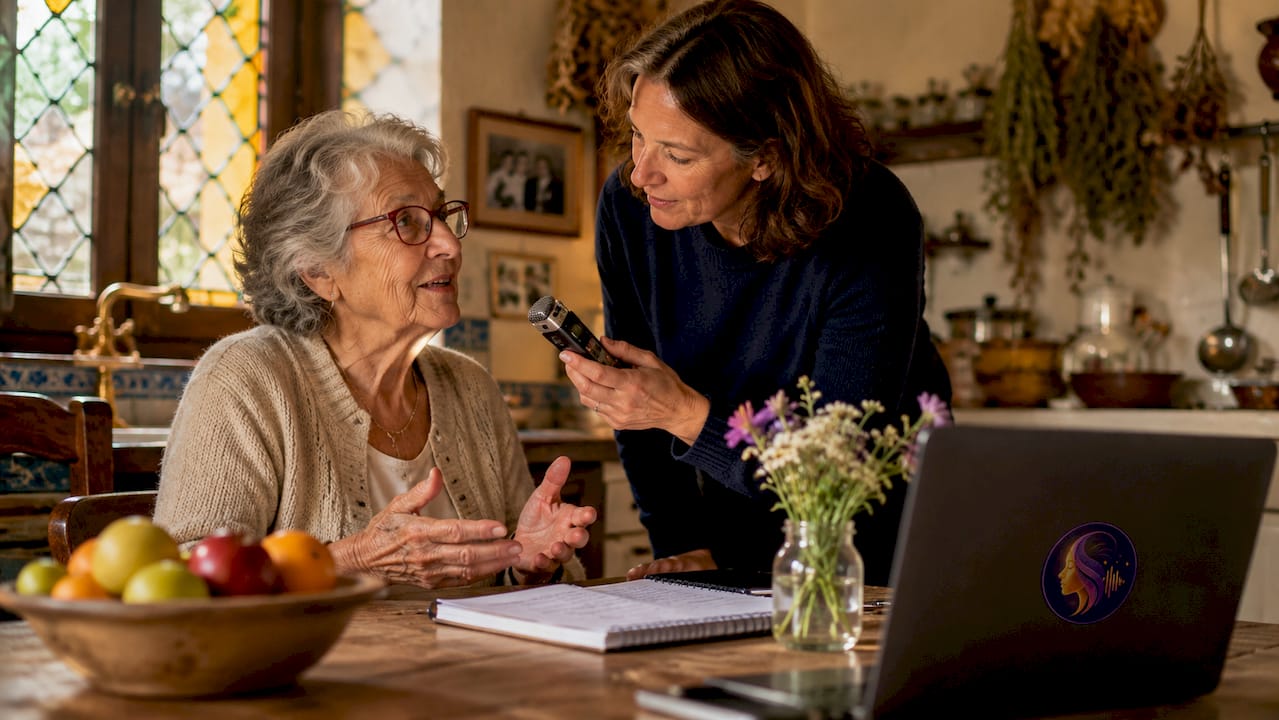
AI narrative structuring solves a different problem than transcription does. AI systems like CARE-ET automatically extract event elements from fragmented elder speech and reorganize them into coherent life stories. That means the AI reads the raw transcript, identifies named events, people, and time periods, and then rebuilds the story in a logical sequence. A grandmother who jumps from her 1962 wedding to a childhood memory of her mother's kitchen gets a final narrative that flows from birth to present day.
This two-step process matters because families often confuse transcription with preservation. A raw transcript is not a story. It is a word-for-word record of everything said, including false starts, repeated phrases, and tangents. Narrative structuring is the editorial layer that turns that raw material into something a grandchild will actually read. AI narrative structuring is separate from transcription; it reorganizes and clarifies fragmented elder speech into meaningful stories.
Key challenges AI must handle in elder speech transcription:
- Fragmented timelines: Elders often narrate non-chronologically, requiring event extraction to reorder events.
- Code-switching: Mixing English with a heritage language mid-sentence confuses standard ASR (automatic speech recognition) models.
- Overlapping speech: Family members who prompt or interrupt create multi-speaker audio that needs separation before structuring.
- Low-frequency vocabulary: Place names, family surnames, and historical terms rarely appear in AI training data, leading to substitution errors.
Pro Tip: After AI transcription, search the transcript for proper nouns first. Names of people, towns, and historical events are where ASR errors cluster most densely, and fixing them early prevents downstream structuring errors.
What role does speaker diarization play in preserving accurate elder narratives?
Speaker diarization is the process of labeling audio by answering one question: who spoke when? Diarization uses voice embeddings and clustering to assign each speech segment to a specific speaker, then smooths the boundaries between segments for a clean, labeled transcript. Without diarization, a family interview with three people produces a single undifferentiated wall of text.
The practical impact for families is significant. When a caregiver records a conversation between a grandmother, her daughter, and a grandchild, diarization ensures each person's words are labeled correctly. That matters for accuracy, but it also matters for emotional resonance. A grandchild reading the transcript years later needs to know which voice said what. Misattribution turns a precious record into a confusing document.
Zoom processes over 300 million meetings daily using diarization with x-vector embeddings. That scale proves the technology is mature and reliable enough for everyday use. Families do not need specialized hardware to benefit from it. Apps like LifeWritr and Senarra apply the same class of diarization technology to personal recordings on a smartphone.
Benefits of accurate diarization in elder storytelling sessions:
- Correct attribution: Each quote is tied to the right speaker, making the final narrative trustworthy.
- Searchability: Families can search for everything a specific person said across multiple sessions.
- Emotional accuracy: The elder's voice is preserved as distinct from the interviewer's prompts.
- Editorial efficiency: Editors reviewing the transcript know immediately which segments need correction.
Diarization errors and pronoun ambiguity are the most common reasons a transcript becomes unusable for family archives. Editing speaker labels is not optional. It is a required step in any serious preservation workflow.
How to plan elder storytelling sessions for best AI transcription quality
Session length is the single most controllable variable in transcription quality. Oral history best practices recommend 30–90 minute sessions, with 60 minutes as the preferred target. Fatigue after 90 minutes lowers recall and produces rambling, harder-to-structure audio. Shorter sessions also give the elder time to reflect between recordings, which often surfaces richer memories in the next session.
A structured session plan produces better results than an open-ended conversation. Here is a practical workflow:
- Choose a quiet room. Background noise is the leading cause of ASR errors. A closed room with soft furnishings absorbs echo.
- Set a topic in advance. Tell the elder the session will focus on one period, such as childhood or early career. Focused prompts produce denser, more coherent narratives.
- Record in short segments. Break a 60-minute session into three 20-minute blocks with short breaks. Each block becomes a separate audio file, which is easier to transcribe and review.
- Review the transcript within 48 hours. Memory of the conversation fades quickly. Reviewing while the session is fresh makes error correction faster and more accurate.
- Log corrections in a shared document. If multiple family members are involved, a shared log prevents duplicate edits and tracks what has been verified.
Human review of AI-generated transcripts is not a backup plan. It is the standard. BrassTranscripts recommends spending 30–45 minutes verifying each hour of transcript. That time investment is what separates a usable family archive from a file that sits unread on a hard drive.
Pro Tip: Ask the elder to spell unusual names or places out loud during the recording. A simple "That's S-T-A-N-I-S-L-A-W" takes five seconds and saves 20 minutes of guesswork during transcript review.
What AI tools and workflows do families use to preserve elder stories?
The market for AI storytelling for seniors has matured quickly. Three platforms represent the current range of approaches families can take.
| Platform | Core approach | Output format |
|---|---|---|
| EverMemory | Voice-first AI with multiple recording modes | Hardcover life-story book from 5–10 hours of recordings |
| LifeWritr | Conversational AI that interviews elders and remembers past sessions | Polished autobiography via mobile app |
| Senarra | Voice cloning, memory line, and guided conversation capture | Preserved voice and story accessible by phone or app |
EverMemory converts recordings into narrative prose, not Q&A transcripts. That distinction matters because narrative prose is what families actually read and share. A hardcover book from 5–10 hours of recordings is a tangible artifact that outlasts any app or platform.
LifeWritr uses conversational Voice AI to actively interview elders, remember what was discussed in previous sessions, and layer that context into follow-up questions. The AI manages voice recognition, interview strategy, and narrative structuring simultaneously. That approach reduces the burden on family members who may not know how to conduct a good oral history interview.
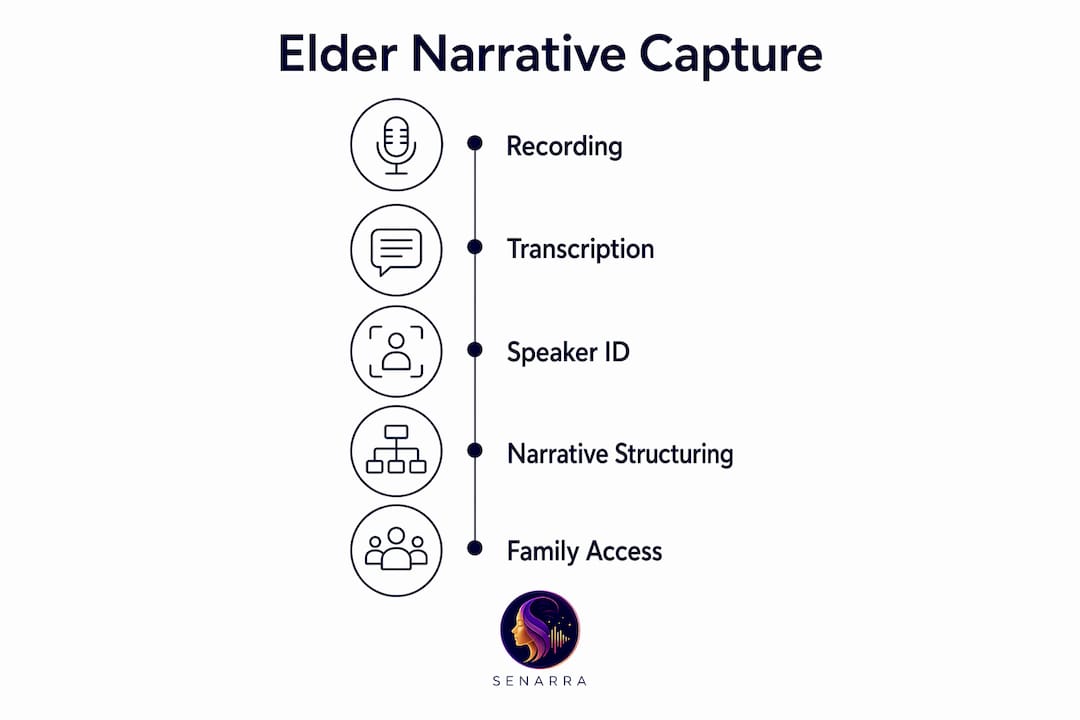
AI voice agents increase capture convenience by providing smart prompts, real-time transcription, diarization, and tagging for easy archiving. The full workflow for families looks like this:
- Record using a guided AI voice agent or a smartphone app.
- Auto-transcribe the audio with speaker diarization applied.
- Edit the transcript to correct names, places, and speaker labels.
- Tag segments by theme, date, or person for searchability.
- Archive the final narrative with photos, documents, and audio clips attached.
Senarra adds a feature that other platforms do not offer: a memory line accessible by phone, so family members can call in and hear a loved one's preserved voice at any time. That feature shifts the experience from passive archive to active connection. Preserving a voice is not the same as preserving a text file. The voice carries tone, humor, and emotion that no transcript fully captures.
Key Takeaways
AI captures elder narratives most effectively when transcription, speaker diarization, and narrative structuring work together as a single editorial workflow rather than separate steps.
| Point | Details |
|---|---|
| Transcription alone is not preservation | Raw transcripts need narrative structuring to become readable, shareable life stories. |
| Speaker diarization prevents misattribution | Labeling who spoke when is required for accurate, searchable family archives. |
| Session length controls quality | Keep recordings to 60 minutes to avoid fatigue and maintain narrative coherence. |
| Human review is non-negotiable | Spend 30–45 minutes reviewing each hour of AI-generated transcript to fix names and speaker labels. |
| Platform choice shapes the final product | EverMemory, LifeWritr, and Senarra each produce different outputs suited to different family goals. |
Why I think most families wait too long to use these tools
Families tend to treat elder storytelling as something they will get to eventually. I have seen this pattern repeatedly. The technology is available, the elder is willing, and the family keeps postponing because the process feels complicated or intrusive. By the time they act, the window has narrowed.
What changed my thinking was realizing that AI does not require a perfect recording. It works with what you have. A 45-minute conversation recorded on a smartphone in a moderately quiet kitchen is enough raw material for a structured narrative. The tools have lowered the barrier far enough that the main obstacle is no longer technical. It is emotional.
The harder truth is that families underestimate how much context disappears with the voice itself. A transcript of what someone said is useful. Hearing them say it is irreplaceable. Platforms like Senarra that preserve the actual voice alongside the story are doing something qualitatively different from platforms that produce only text. That distinction will matter more to families in ten years than it does today.
My practical advice: start with one 45-minute session this month. Do not wait for the right equipment, the right questions, or the right moment. The value of documenting elder narratives is not abstract. It is the specific sound of a person's laugh, the way they pause before a punchline, and the stories they only told once.
— Bryan
Senarra: AI memory preservation built for families
Families who want to preserve an elder's voice and story now have a purpose-built tool for exactly that. Senarra captures conversations in the elder's authentic voice, applies transcription and narrative structuring, and makes those memories accessible whenever family members want to reconnect with them.
Senarra's voice cloning feature preserves not just words but the sound of the person who spoke them. The memory line lets family members call in and hear a loved one's voice on demand. For families thinking about preserving a personal voice legacy, Senarra offers a direct path from conversation to lasting memory. Visit Senarra to see how the platform works and start capturing the stories that matter most.
FAQ
What is the difference between transcription and narrative structuring?
Transcription converts spoken audio into text word for word. Narrative structuring reorganizes that text into a coherent, chronological life story using AI methods like CARE-ET.
How long should an elder storytelling session be?
The Library of Congress Veterans History Project recommends 30–90 minute sessions, with 60 minutes as the ideal length to avoid fatigue and maintain narrative quality.
Why does speaker diarization matter for family recordings?
Diarization labels each speech segment by speaker, preventing misattribution and making the transcript searchable by individual voice. Without it, multi-speaker recordings become difficult to use as accurate family archives.
Do families need to review AI-generated transcripts?
Yes. BrassTranscripts recommends 30–45 minutes of human review per hour of transcript to correct errors in names, places, and speaker labels that AI consistently misses.
What makes Senarra different from other memory preservation apps?
Senarra preserves the elder's actual voice through voice cloning and offers a memory line accessible by phone, giving families an active connection to the person rather than a static text archive.