
Memory curation is the active process of selecting, organizing, and preserving memories based on emotional significance rather than sheer volume. Most people assume saving everything is the safest approach. It is not. Uncurated memory accumulation creates a paradox of perfect recall, where systems and minds become so flooded with data that nothing meaningful surfaces when you need it most. For families preserving the stories of loved ones and pets, understanding what memory curation means is the difference between a living legacy and a forgotten hard drive.
What does memory curation mean in practice?
Memory curation is defined as the active management of personal or digital information to prioritize signal over noise. It is not the same as storage. Storage is passive. Curation is a deliberate act of choosing what stays, what gets reorganized, and what gets released.
In practice, curation involves four core operations. These map closely to what memory researchers and AI engineers call forgetting as a design decision:
- Demote: Lower the priority of memories that are no longer relevant, without deleting them entirely.
- Invalidate: Mark outdated information so it no longer surfaces as current truth.
- Consolidate: Merge similar memories into a single, richer record. Ten blurry photos of the same birthday become one clear, captioned moment.
- Delete: Permanently remove content that adds no emotional or narrative value.
These four operations prevent what engineers call "context rot," the slow degradation of a memory system under the weight of unfiltered accumulation. The same principle applies to a family photo library or a box of old letters.
The goal of curation is not minimalism for its own sake. The goal is ease of access, meaningful storytelling, and emotional weight management. A well-curated memory collection lets you find the right story at the right moment, whether that is a grandparent's voice recording or a pet's first day home.
Pro Tip: Think of memory curation like editing a book manuscript. A first draft contains everything. A published book contains only what serves the reader. Your memory collection deserves the same discipline.
Why is memory curation important for individuals and families?
Memory curation matters because uncurated memory degrades recall quality. More data does not mean better memory. It means harder retrieval. When a family photo library holds 40,000 untagged images, the photo of grandma's last garden actually becomes harder to find, not easier.
"AI without human-directed curation treats every piece of context equally, resulting in agents that know everything and understand nothing." — unite.ai
That principle applies directly to personal memory keeping. A shoebox of 500 unsorted photos tells no story. A curated album of 30 labeled, sequenced images tells a life.
The benefits of intentional memory curation include:
- Emotional well-being: Curated memories reduce the anxiety of overwhelm and make reflection genuinely restorative.
- Legacy clarity: Families who curate create stories that future generations can actually engage with, not just inherit.
- Grief support: For those coping with loss, a curated collection of a loved one's voice, stories, and images provides comfort without chaos.
- Pet memory preservation: Pets leave shorter timelines. Curated photos, videos, and voice notes capture their personality in a way that raw footage cannot.
Memory curation is intensely personal and requires emotional sensitivity. Automated resurfacing of memories can cause distress if mistimed. This is why human judgment must always lead the process, with technology playing a supporting role.
How do modern tools and AI assist with memory curation?
AI assists with memory curation by surfacing moments people may want to revisit. It does not define meaning for users. That distinction matters enormously. Success in AI-assisted curation comes from respecting emotional weight rather than optimizing for technical efficiency alone.
Here is how a practical AI-assisted curation workflow looks for a family:
- Capture broadly first. Record conversations, take photos, save voice messages. Do not filter at this stage.
- Review weekly. Experts recommend a 10-minute weekly maintenance cycle to assess what is worth keeping. Anything not reviewed within 7 days gets deprioritized.
- Tag by emotional significance. Label memories by person, event, and emotional tone, not just date.
- Prune duplicates. Remove blurry photos, repeated clips, and redundant notes. Reducing a large collection to a focused set of high-signal entries dramatically improves relevance when you search for a specific memory later.
- Archive, do not delete, uncertain items. Move borderline content to a secondary folder before permanent deletion.
The table below shows how curated versus uncurated memory systems compare in practical terms:
| Factor | Curated memory | Uncurated memory |
|---|---|---|
| Retrieval speed | Fast, targeted | Slow, scattered |
| Emotional impact | Intentional, resonant | Random, sometimes distressing |
| Storage efficiency | High | Low |
| Storytelling quality | Coherent narrative | Fragmented data |
Human domain judgment is what separates a useful memory system from an overwhelming one. AI tools can flag duplicates and suggest organization, but only you know which photo of your dog actually captures who she was.
Pro Tip: Set a recurring calendar reminder once a week for 10 minutes labeled "memory review." Treat it like a bill payment. Consistency matters more than perfection.
What are practical memory curation techniques for families?
The most effective memory curation techniques combine regular review cycles with clear organizational principles. Sporadic, large-scale sorting sessions feel overwhelming and rarely happen. Small, consistent habits work.
Organize by theme and emotion, not just date. Chronological order is useful for timelines, but emotional categories, such as "funny moments," "last trips together," or "everyday routines," make memories easier to find and more meaningful to revisit. A folder labeled "Dad's laugh" is more powerful than "2019 photos."

Build narratives, not archives. The difference between a memory archive and a curated legacy is story. Take 5 to 10 related photos or recordings and write a short caption or paragraph connecting them. This is how a collection of pet photos becomes the story of a life well lived.
Balance digital and physical methods. Digital tools offer search and scale. Physical albums, printed photos, and handwritten notes offer permanence and tactile connection. The best family memory collections use both. Print the 10 photos that matter most from each year. Keep the rest digital and organized.
Apply the deletion discipline. In healthy memory systems, deletion frequency should match new data writes. For families, this means that for every new batch of photos you add, you remove a comparable number of low-value images. This keeps the collection alive rather than stagnant.
The comparison below shows two common approaches families take:
| Approach | What it looks like | Result |
|---|---|---|
| Passive collection | Save everything, sort nothing | Overwhelm, lost memories |
| Active curation | Weekly review, theme folders, narrative captions | Accessible, meaningful legacy |
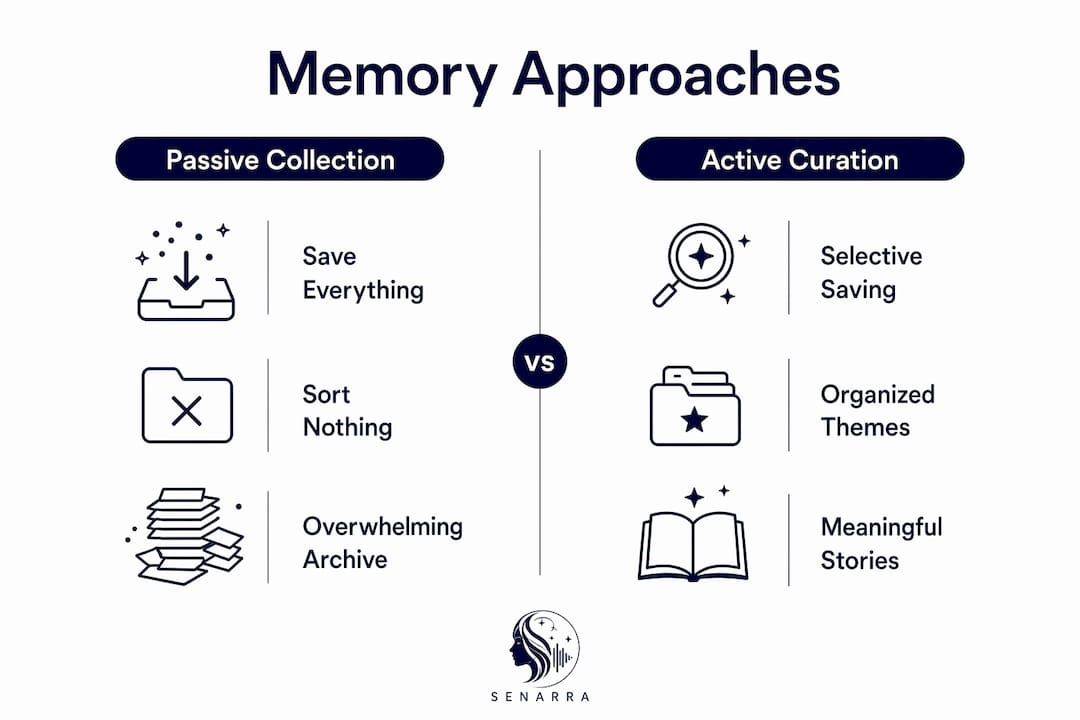
The passive approach feels safer in the moment. The active approach is what actually preserves the memories you care about.
Key Takeaways
Memory curation is the ongoing, human-led practice of selecting and organizing memories by emotional significance, and it is the only reliable way to build a legacy that future generations can actually use and feel.
| Point | Details |
|---|---|
| Curation is not storage | Active selection and organization define curation; passive saving leads to overwhelm. |
| Four core operations | Demote, Invalidate, Consolidate, and Delete keep any memory system healthy and meaningful. |
| Weekly review cycles | A 10-minute weekly habit prevents accumulation and keeps your collection relevant. |
| Human judgment leads | AI surfaces moments, but only personal emotional context determines what truly matters. |
| Narrative beats archive | Connecting memories into stories creates legacies; unsorted data creates digital clutter. |
Why I think most families get memory curation backwards
Most families I have spoken with treat memory keeping as a future project. They plan to organize the photos "someday." They save every video "just in case." The result is a hard drive with 60,000 files and no story.
The emotional trap is real. Deleting a photo of someone you love feels like losing them a second time. But keeping every blurry, duplicate, or context-free image does not honor them. It buries them.
The families who actually preserve meaningful legacies are the ones who treat curation as an ongoing act of love, not a one-time task. They review regularly. They write captions. They make deliberate choices about what represents the person or pet they are preserving. That discipline is what transforms a collection into a story someone will actually want to read in 20 years.
Technology helps, but it does not replace this judgment. The most thoughtful memory systems I have seen combine AI tools for organization with deeply personal human decisions about meaning. Neither works well without the other. Start small. Pick one person or one pet. Spend 10 minutes this week. That is how every meaningful legacy begins.
— Bryan
How Senarra helps you preserve the memories that matter most

Senarra is built for exactly this kind of intentional memory preservation. The platform captures the voices and stories of loved ones and pets in their authentic form, so the memories you curate feel real, not reconstructed. Features like voice cloning and a memory line accessible by phone mean you can connect with a preserved voice whenever you need it, not just when you happen to open an app. Senarra also approaches memory preservation with genuine emotional care, as detailed in its ethical framework. For families ready to move from passive saving to active, meaningful curation, Senarra is the place to start.
FAQ
What is the definition of memory curation?
Memory curation is the active process of selecting, organizing, and prioritizing memories based on emotional significance rather than volume. It involves deliberate decisions about what to keep, consolidate, archive, or remove.
Why does memory curation matter for families?
Curated memory collections are easier to navigate, more emotionally resonant, and far more useful for storytelling and legacy building than unsorted archives. Uncurated collections make meaningful memories harder to find, not easier.
What are the best memory curation techniques to start with?
A weekly 10-minute review cycle is the most practical starting point. Pair it with theme-based organization and short narrative captions to transform raw files into a coherent, accessible family story.
What is digital memory curation?
Digital memory curation is the practice of managing photos, videos, voice recordings, and written notes stored on devices or cloud platforms. It applies the same principles of selection and organization as physical memory keeping, with the added benefit of search and scale.
How does AI help with memory curation?
AI assists by flagging duplicates, suggesting organization structures, and surfacing moments worth revisiting. Human judgment remains essential for deciding which memories carry emotional weight and deserve a permanent place in a family's legacy.