
What is oral history preservation?
Oral history preservation is the professional practice of managing, storing, and protecting original interview recordings and their supporting documentation so they remain accessible and authentic for future generations. According to the Oral History Association, it bridges gaps in traditional records by capturing eyewitness accounts and cultural nuances rarely documented anywhere else. Think of it as the difference between a photograph and a living conversation: written records tell you what happened, but a preserved oral history tells you what it felt like, in the narrator's own voice.
The core components of any oral history preservation project include:
- Original recordings in audio or video format, kept in their unedited form
- Transcripts that render speech as searchable, readable text
- Consent forms and legal release agreements that authorize archival use
- Metadata documenting interview date, location, participants, and technical details
- Supporting materials such as photographs, correspondence, and research notes
The Oral History Association sets the professional standards that guide this work in the United States, and its guidelines shape how institutions from university libraries to community archives approach the field.
Why oral history matters beyond the written record
Oral history captures what official documents almost never do: the texture of lived experience. Public records, census data, and newspaper archives tell you the outline of events. An oral history interview fills in the interior, the fear, the humor, the contradictions, the details a narrator would never think to write down but will absolutely tell you if you ask.
Baylor University's oral history resources put it plainly: oral history provides a fuller, more accurate picture of the past by augmenting public records, statistical data, photographs, and letters. Eyewitnesses contribute viewpoints that fill gaps in documented history, sometimes correcting or even contradicting the written record. At times, an interview serves as the only available source of information about a specific place, event, or person.
What makes oral history trustworthy is the collaborative relationship between interviewer and narrator. The Smithsonian Institution Archives describes oral history as a technique for generating and preserving original, historically interesting primary source material through planned recorded interviews. That word "planned" carries real weight. A well-conducted interview is not a casual chat; it is a structured conversation designed to elicit specific memories while leaving room for the narrator to speak freely.
Key reasons the importance of oral history extends beyond academic research:
- It preserves perspectives from communities whose stories are underrepresented in formal archives
- It captures cultural nuances, dialects, and emotional context that written summaries strip away
- It creates primary source material that future historians, educators, and family members can access directly
- It honors narrators by preserving their voices, not just a paraphrase of their words
How to plan and conduct effective oral history interviews
The standard lifecycle of an oral history project in the United States runs through eight stages: preparation, interviewing, securing legal releases, transcription, editing, narrator review, final corrections, and archival placement. The single most common mistake is treating preservation as the last step. NPS oral history guidance is direct on this point: failing to plan for preservation at the project's start leads to corrupted files, poor audio quality, or missing legal consent that makes materials impossible to archive ethically.

Before you record a single word, decide where the finished collection will live. Selecting a repository, whether a university library, a public archive, or a community organization, shapes every technical and legal decision that follows. Different archives have different format requirements, metadata standards, and access policies. Aligning with your repository early prevents rework later.
For the interview itself, preparation centers on three things:
- Research the narrator's background thoroughly so your questions build on what you already know, not what you could have looked up
- Draft open-ended questions that invite storytelling rather than yes-or-no answers ("Tell me about the day you arrived" beats "Did you arrive in the morning?")
- Secure a signed legal release agreement before or immediately after the interview; without clear consent, archives cannot ethically or legally accept the materials
Building trust with the narrator is not a soft skill. It is the technical foundation of a good recording. Narrators who feel safe give longer, richer answers. They correct themselves, add context, and share details they would otherwise keep private.
Post-interview processing and archiving your materials
Once the recording is done, the real archival work begins. Transcription comes first: converting audio to text verbatim, preserving the narrator's voice rather than cleaning it into standard prose. The key principle, as oral history practitioners consistently emphasize, is that the transcript renders what the narrator actually said, not what a transcriber thinks they meant to say.
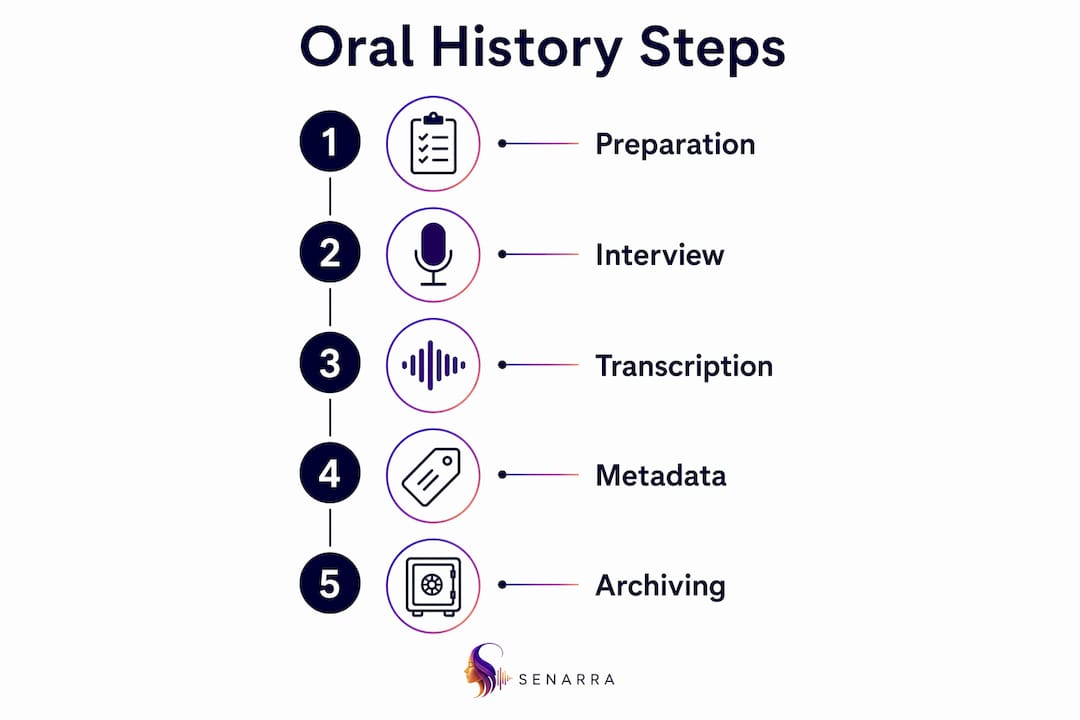
After transcription, the narrator reviews the text for factual accuracy and confirms their consent remains valid. This step protects both the narrator and the archive. Some narrators request that specific passages be sealed for a period of years; those restrictions must be documented clearly and honored.
Organizing supporting materials is where many personal and community projects fall short. Every collection needs:
- Descriptive metadata: names, dates, locations, and a summary of topics covered
- Technical metadata: recording equipment used, file format, bit rate, and storage location
- Administrative metadata: consent form status, access restrictions, and rights information
- Preservation metadata: migration history and any format changes made over time
Good metadata supports discovery and maintains the long-term research value of oral histories. Without it, a recording becomes an orphaned file: audible but unidentifiable, accessible but meaningless to anyone who did not create it.
Depositing the finished collection in a professional archive or library gives it the institutional support that individual storage cannot provide. For families working on personal projects, a family oral history archive can serve as a meaningful starting point before transferring materials to a larger institution.
Best practices for long-term preservation of oral histories
Preservation is an active process, not a one-time event. Duke University's digital preservation guidance makes this clear: simply storing files without migration risks loss as codecs become obsolete and media degrades. A recording saved in a proprietary format from 2005 may be unplayable by 2030 without deliberate intervention.
The foundational strategy for durable oral history archives is the 3-2-1 rule: keep at least three copies of every file, on two different media types, with one copy stored off-site. This protects against hardware failure, fire, flood, and the slow data decay known as bit rot.
For file formats, open standards consistently outlast proprietary ones. WAV and FLAC for audio, MP4 with H.264 for video, and PDF/A for documents are widely accepted by professional archives because they do not depend on a single company's continued support.
Cloud storage is convenient but insufficient on its own. Physical backups on external drives, combined with cloud copies and periodic manual refreshing, create the redundancy that genuine preservation requires. Cloud services change their terms, raise prices, or shut down; a hard drive in a fireproof box does not.
Ongoing preservation actions to schedule regularly:
- File integrity checks to detect silent corruption before it spreads
- Format migration when a codec or container approaches obsolescence
- Media refreshing by copying files to new drives every three to five years
- Metadata audits to catch missing or inaccurate documentation
For families and individuals thinking about digital legacy planning, these same principles apply whether you are managing a single grandmother's interview or a collection of fifty community recordings.
Pro Tip: Build your legal and ethical review into the same schedule as your technical migration. Consent agreements signed in 2010 may not cover uses that exist today, such as AI-assisted transcription or online streaming. Revisit permissions whenever you update your formats.
Interview techniques and question formulation
The structure of your questions determines the quality of what you get back. The UCLA Center for Oral History Research recommends organizing interviews chronologically, which lets narrators show how their experiences and ideas developed over time and gives the conversation a natural arc. That said, memory does not follow a strict timeline, and some of the richest material comes when a narrator jumps between periods to draw connections.
Open-ended questions are the core tool. Prompts that begin with "Tell me about..." or "Can you describe..." invite narrators to generate their own story rather than simply confirm or deny a fact. Think of each major topic as an inverted pyramid: start broad, then follow up with specific questions that draw out detail.
A few techniques that consistently produce better recordings:
- Silence is productive. After a narrator finishes a thought, wait a few seconds before speaking. Many of the most revealing additions come in that pause.
- Ask for specifics before analysis. Get the concrete experience first ("What did you see when you walked in?") before asking the narrator to evaluate or interpret it.
- Follow the narrator's language. If they use a term or phrase you did not expect, ask them to explain it rather than substituting your own vocabulary.
- Avoid leading questions. "That must have been frightening" closes down a response; "How did you feel?" opens it up.
For families capturing stories from aging relatives, the audio recording guide from Senarra's blog covers these techniques in a personal-project context.
Recording equipment and technical suggestions
Audio quality is not a luxury. A recording that is difficult to hear is difficult to transcribe, difficult to archive, and difficult for future listeners to trust. The Utah Historical Society's oral history toolkit puts it directly: oral historians should use the best recording equipment available within their financial limits.
For most personal and community projects, a dedicated digital audio recorder with an external microphone outperforms a smartphone in almost every condition. Cardioid condenser microphones capture voice clearly while reducing ambient noise. If you are recording video, a lapel microphone on the narrator eliminates the distance problem that built-in camera microphones create.
Practical technical checklist before every session:
- Test your equipment in the actual recording space at least 30 minutes before the interview
- Record in an uncompressed or lossless format (WAV at 48kHz/24-bit is the professional standard for audio)
- Monitor levels to keep the narrator's voice in the upper-middle range without peaking
- Eliminate background noise sources: HVAC systems, refrigerators, phones, and outdoor traffic
- Back up the raw file immediately after the session, before any editing begins
Remote interviews introduce additional variables. Connection quality, platform compression, and background noise on both ends all affect the final recording. When recording remotely, use a local recording on each participant's end and sync the tracks in post-production rather than relying on the platform's compressed output.
Ethical considerations beyond legal consent
Signing a release form is the floor, not the ceiling, of ethical oral history practice. Legal consent covers what you are permitted to do with a recording. Ethics covers what you should do, and the two do not always overlap.
Cultural sensitivity is the most frequently underestimated dimension. Some communities have protocols around who may speak about certain topics, when those topics may be discussed, or how recordings may be shared. Indigenous oral traditions, in particular, carry specific cultural authority and restrictions that a standard release form does not address. Before beginning any project involving a community whose norms differ from your own, consult with community members and, where appropriate, with tribal or cultural authorities.
Privacy considerations extend beyond the narrator. Interviews often include information about third parties who never consented to being recorded. Standard practice is to flag these passages during the narrator review stage and discuss whether they should be restricted or redacted.
Additional ethical commitments that professional oral historians maintain:
- Transparency about purpose: narrators should understand clearly how the recording will be used and who will have access to it
- Ongoing consent: narrators retain the right to withdraw or modify their consent within the terms of the agreement
- Accurate representation: transcripts and summaries must reflect what the narrator actually said, not a cleaned-up version that removes complexity or contradiction
- Community benefit: projects that draw on a community's stories should return value to that community, through access, copies, or direct collaboration
Community engagement and collaboration in oral history projects
The most durable oral history projects are built with communities, not about them. When community members help shape the questions, identify narrators, and review materials, the resulting collection reflects genuine priorities rather than an outsider's assumptions about what matters.
Collaborative projects also produce better interviews. Narrators are more candid with interviewers they trust, and trust builds faster when the project has visible community backing. Local libraries, historical societies, schools, and cultural organizations are natural partners for this work. They bring existing relationships, physical space, and often some institutional infrastructure for storage and access.
Practical ways to build community into a preservation project:
- Hold a community listening session before designing the interview guide, so the questions reflect what community members actually want documented
- Train community members as interviewers rather than relying solely on outside researchers; peer interviews often surface stories that would not emerge with a stranger
- Share results publicly through exhibitions, community screenings, or accessible online archives so the people who contributed can see and use the finished work
- Establish a community advisory group to guide decisions about access, restrictions, and future use of the collection
For families working on smaller-scale projects, the same principle applies. Involving cousins, siblings, and younger generations in planning a family recording session produces richer material and builds the shared investment that keeps a collection alive across generations. Senarra's platform supports exactly this kind of ongoing, collaborative memory preservation, letting families preserve family conversations in the narrator's authentic voice rather than a summary someone else wrote later.
Senarra was built for exactly the moments oral history preservation is designed to protect: the stories that live only in one person's voice, the memories that will be gone when that person is gone. Through voice cloning and a memory line you can call by phone, Senarra lets families capture and revisit those conversations in the narrator's own voice, long after the original recording was made. Whether you are starting a community archive or simply want to preserve a grandparent's stories, Senarra gives you a way to make those voices last.
Key takeaways
Oral history preservation requires active, ongoing management of recordings, transcripts, metadata, and legal documentation from the very first day of a project, not as an afterthought once interviews are complete.
| Point | Details |
|---|---|
| Plan preservation from day one | Delaying preservation planning leads to corrupted files, poor quality, and missing legal consent. |
| Apply the 3-2-1 rule | Keep three copies of every file, on two media types, with one stored off-site to prevent loss. |
| Metadata prevents orphaned files | Document interview date, location, participants, and technical details so recordings retain research value over time. |
| Migration keeps recordings accessible | Migrate files to current open formats regularly; stored files in obsolete codecs become unplayable. |
| Ethics extend beyond consent forms | Cultural sensitivity, privacy for third parties, and ongoing narrator rights all require attention beyond the signed release. |