
A voice-based life archive is a structured digital collection of recorded speech, transcripts, and indexed memories that you can later search, replay, or query in natural language — turning spoken moments into what practitioners call "askable memory." Instead of a folder of audio files no one opens, the archive becomes something you can actually ask: "What did Dad say about his first job?" or "How did I feel the week after the move?" For families, the value is immediate: voices are preserved in their authentic form, stories stay retrievable across generations, and grief has something real to return to.
TL;DR:
- Preserve a loved one's voice and stories before they're gone
- Replay or query specific memories by topic, person, or emotion
- Find comfort during grief with recordings that feel genuinely present
Table of Contents
- What is a voice-based life archive, and how does it work?
- Who benefits most from a personal voice archive?
- Privacy, consent, and ethical risks you need to understand
- How to create a voice archive that's actually useful
- What to look for in a voice archive provider
- How Senarra approaches voice-based life archiving
- Key Takeaways
- Why voice archives matter more than most people realize
- Senarra makes it easy to start preserving voices today
- Useful sources and further reading
What is a voice-based life archive, and how does it work?
The pipeline runs in five stages: capture, transcription, timestamping, semantic indexing, and conversational retrieval. Each stage builds on the last, and skipping one breaks the chain.
Core components:
- Recording capture: voice memos, phone calls, or dedicated app sessions
- Transcription and timestamps: speech converted to text with time markers so you can jump to exact moments
- Semantic indexing: entries tagged by people, places, emotions, and themes so search returns meaning, not just keywords
- Voice model (optional): a cloned voice representation that lets the archive respond in the speaker's own voice
- Conversational interface: a chat or phone-based layer where you ask questions and get answers grounded in actual entries
- Export controls: JSON or CSV downloads plus raw audio so the archive is portable
Pro Tip: On-device processing keeps audio off third-party servers entirely, which matters most for sensitive family recordings. Cloud processing unlocks richer semantic indexing but requires explicit contractual protections. If a provider can't tell you which path your audio takes, that's your answer.

Who benefits most from a personal voice archive?
The clearest use cases are elder narrative capture, milestone documentation, caregiver handoffs, grief support, and accessibility for users with low vision or motor impairments.
- Elder narratives: grandparents recording childhood stories, immigration journeys, or life lessons before memory fades. AI-captured elder narratives show how families structure these sessions effectively.
- Milestone recording: births, graduations, anniversaries — short voice notes attached to the moment rather than a photo caption
- Caregiver handoffs: a running voice log of a parent's preferences, routines, and medical observations that a new caregiver can query rather than read through
- Grief and comfort: replaying a voice, asking what someone said about a favorite place, or hearing a laugh again — these aren't morbid uses, they're how families actually cope
- Accessibility: voice-first logging removes the barrier for users who can't type comfortably
Building a meaningful archive takes time. Consistent short recordings over months yield far more than a single long interview session. The benefits of audio memory preservation compound with regularity, not volume.
Privacy, consent, and ethical risks you need to understand
The core tradeoff is straightforward: the more a platform processes your voice to make it "askable," the more exposure your data has. Here's where that exposure lives:
- Voice cloning and deepfakes: a cloned voice model can be misused if account security fails or if the vendor's terms allow broad reuse
- Data ownership: who owns the recordings after you upload them? Read the terms, not the marketing page
- Model training policy: does the vendor use your voice to improve their AI? Platforms like Supalog explicitly state that data is never used to train external models — that's the standard to hold others to
- Retention and deletion: can you delete everything, including derived data and voice models, in one step?
- Access controls and legacy planning: who gets access after you die? Without explicit legacy contacts and export tokens, an archive can become legally inaccessible
- Minors and third parties: recording a child or a conversation partner without consent creates legal exposure under state wiretapping laws and, for children under 13, COPPA
Pro Tip: Ask any vendor one question: "If I delete my account, what happens to my voice model and any derived embeddings?" A confident, specific answer is a green flag. Vague language about "anonymized data" is not.
Privacy note: Loquo processes speech entirely on-device using Apple's framework, so audio never leaves the phone. That's the gold standard for capture-only tools, though it limits advanced semantic indexing.
How to create a voice archive that's actually useful
Start this week with five short voice notes and an exported backup. That's it. The rest is structure.
- Plan your scope. Decide whose voice you're preserving (your own, a parent's, a child's milestones) and what retrieval looks like in five years.
- Choose your format. A dedicated app with transcription beats raw audio files. Prioritize apps that export JSON or CSV alongside audio.
- Record with prompts. Unstructured rambling is hard to index. Use prompts: "Tell me about the house you grew up in." "What's the best advice you ever ignored?" See the milestone recording guide for a full prompt library.
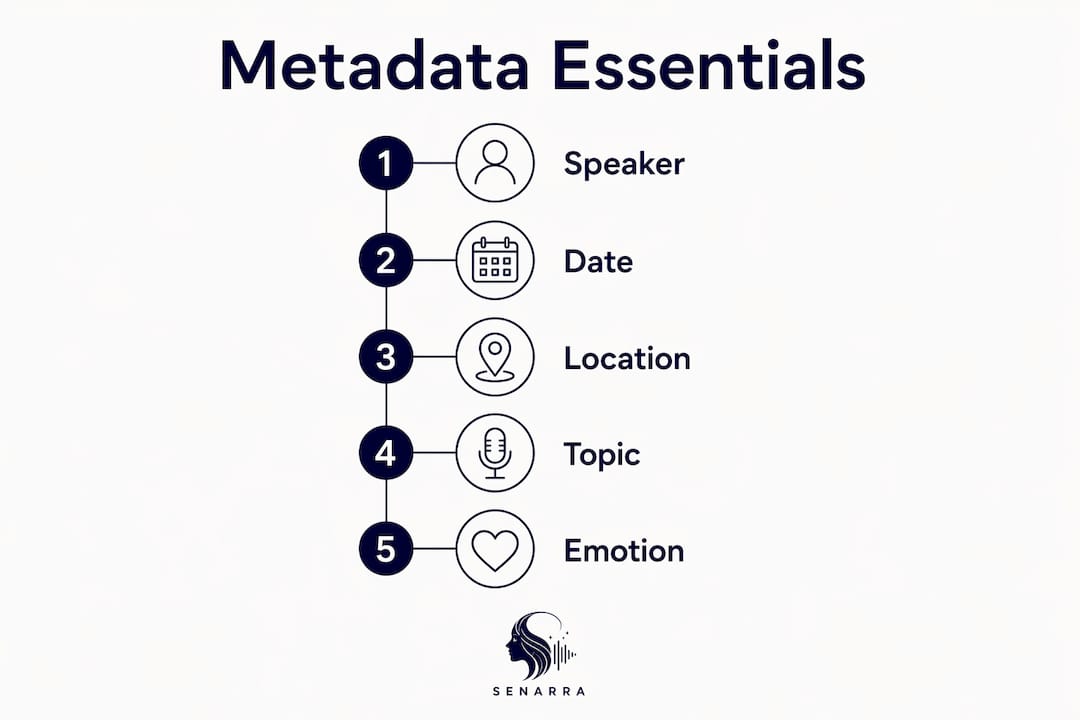
- Tag every entry. At minimum: speaker name, date, location, and one or two emotion tags. This is what makes retrieval work.
- Set a cadence. Short and frequent beats long and rare. A few minutes a week, sustained over months, produces an archive worth querying.
- Back up on a schedule. Export raw audio plus transcripts monthly. Store locally and in at least one off-device location.
Recommended metadata fields
| Field | Why it matters | Suggested format |
|---|---|---|
| Speaker name | Identifies whose voice and story | First and last name |
| Date recorded | Enables timeline queries | YYYY-MM-DD |
| Location | Grounds place-based recall | City, State or address |
| People mentioned | Powers person-based search | Comma-separated names |
| Emotion tags | Separates facts from feelings | 1–3 descriptors |
| Topic / theme | Enables semantic grouping | Free text or taxonomy |
| Export version | Tracks backup history | v1, v2, date-stamped |
Pro Tip: Aim for regular short sessions rather than marathon interviews. Entries recorded close to the moment carry more emotional specificity than reconstructed memories recorded weeks later.
What to look for in a voice archive provider
The single most important check: clear data ownership, one-tap export, account deletion that removes derived data, and opt-in voice cloning. Everything else is negotiable.
Non-negotiable features:
- AES-256 encryption at rest and in transit
- On-device processing option or customer-controlled encryption keys
- JSON/CSV export that includes raw audio, transcripts, and metadata
- Explicit legacy access controls (named contacts, export tokens)
- Opt-in voice cloning with written consent logs
- Published model-training policy that names whether your data is used
Questions to ask during a trial:
- Who legally owns my recordings after upload?
- What happens to my voice model if I delete my account?
- Is my audio used to train any AI model, yours or a third party's?
- Can I export everything, including derived embeddings?
- Who can access my archive after I die, and how?
- Where are servers located, and which privacy laws apply?
- Do you offer on-device processing for any pipeline stage?
- How do you handle a data breach involving voice data?
- What's your retention period for deleted accounts?
- Can I see a sample of what my export file contains?
Pro Tip: During a free trial, immediately request an export. If the export is incomplete, delayed, or requires a support ticket, that tells you more about the vendor's data philosophy than any privacy page.
How Senarra approaches voice-based life archiving
Senarra is built specifically for preserving the voices and stories of people and pets you love, during their lifetime and after. The mission is memory that stays present, not data that sits in a folder.
Senarra's features mapped to the selection checklist:
- Voice cloning: opt-in, consent-based, designed to let families hear a loved one's voice again
- Memory line: a phone-accessible interface so family members can call in and interact with preserved memories without needing an app
- Export and ownership: recordings and transcripts stay portable and accessible to the account holder
- Encryption and privacy controls: data is protected at rest; legacy contacts can be designated for post-death access
- Legacy planning: explicit controls for who accesses the archive and when
Senarra's approach to preserving personal voice legacy reflects a philosophy that memory preservation is an act of care, not a technical feature. The memory line, in particular, sets Senarra apart: most platforms require a screen and an app; Senarra lets a grieving family member pick up a phone.
Key Takeaways
A voice-based life archive is only as useful as the metadata and retrieval design behind it — start with clear tagging, consistent short recordings, and a provider that gives you full export control from day one.
| Point | Details |
|---|---|
| What it is | A searchable, queryable collection of voice recordings, transcripts, and indexed memories |
| How retrieval works | Semantic indexing by person, place, emotion, and date makes memories "askable" in natural language |
| Best use cases | Elder narratives, milestone capture, caregiver handoffs, grief support, and accessibility |
| Provider must-haves | AES-256 encryption, opt-in voice cloning, full JSON/CSV export, and explicit legacy access controls |
| Senarra's differentiator | Voice cloning plus a phone-accessible memory line lets families interact with preserved voices without an app |
Why voice archives matter more than most people realize
There's a gap between what people think they're building when they record a loved one and what they actually end up with. Most families capture audio. Almost none of them build retrieval. The recordings sit in a cloud folder, organized by date, and the specific moment someone wants — the story about the fishing trip, the advice about the hard decision — is buried somewhere in hour three of a recording from four years ago.
The "askable memory" framing isn't a marketing concept. It's the actual design problem. A voice archive without semantic indexing is a shoebox. With it, it's a conversation you can return to. The families who get the most from these tools are the ones who treat tagging and metadata as seriously as the recording itself. That discipline, more than any AI feature, is what separates a living archive from a digital attic.
Senarra makes it easy to start preserving voices today
Senarra is the privacy-first alternative for families who want more than storage. You get voice cloning, a phone-accessible memory line, and full export control — so the archive belongs to your family, not a platform. Getting started takes three steps: sign up, record your first entries using the guided prompts, and designate a legacy contact so the archive is protected and accessible when it matters most. Whether you're capturing a grandparent's stories now or building your own voice record for the people who come after you, Senarra gives you the tools to do it right. Start preserving voices today.
Useful sources and further reading
Building a voice archive well means understanding both the technology and the human side. These resources cover the ground worth knowing:
- Echologue: a private voice journal with on-device storage, JSON/CSV export, and askable recall — useful for understanding what a privacy-first retrieval architecture looks like in practice
- Supalog: demonstrates AES-256 encryption, cited answers, and a no-training-data policy — a useful benchmark for evaluating other providers' privacy claims
- Family voice archive best practices: Senarra's operational checklist for ongoing archive maintenance
- Caregiver digital archive guide: governance and handoff practices for families managing archives across caregivers
- Capture aging parent memories: practical tips for recording sessions with older family members, including consent and comfort considerations
- AI and mental well-being: context on how AI tools intersect with grief, reflection, and emotional health — relevant for families using archives during loss
- SOS-ID privacy policy: a clear, readable model for what strong privacy-policy language looks like — useful when comparing vendor disclosures
When reviewing any vendor's privacy page, look specifically for three things: a named retention period for deleted accounts, an explicit statement on whether voice data trains models, and a sample export file. If any of those are missing, ask before you record.