
Voice memory is defined as the brain's specialized process for encoding, storing, and retrieving spoken sounds through multisensory neural pathways that are deeply tied to emotion. Understanding how voice memory works changes how you think about preserving the voices of people and pets you love. The brain does not record voices like a tape machine. It builds dynamic neural patterns that link sound, emotion, and context into a single retrievable experience. Those patterns are why your grandmother's laugh can surface instantly after years of silence, and why a pet's familiar bark still feels present long after they are gone.
How voice memory works in the brain
Voice memory is not a single process. It activates multiple cognitive channels at once, including auditory cortex processing, emotional tagging in the amygdala, and language encoding in Broca's area. That combination makes voices far stickier in memory than most other sensory inputs.
The brain stores voice as dynamic neural activation patterns, not static recordings. That distinction matters because it means voice memories shift slightly each time you retrieve them, shaped by your current emotional state and the context around you.
Emotional and social cues embedded in tone and inflection make voice memory especially vivid. Auditory memory is sensitive to rhythm, tone, and expressiveness, not just the words spoken. This is why you can recall exactly how someone said "I love you" but struggle to remember the exact words of a speech you watched silently.
The production effect and active retrieval
One of the most important findings in auditory memory research is the "production effect." People who verbally explain information aloud retain up to 92% more than those who passively review the same material. That figure reflects how speaking activates visual processing, motor production, auditory feedback, and language encoding simultaneously.
Active retrieval strengthens voice memory far more than passive listening. When you hear a voice and then repeat or respond to it aloud, you create a richer neural trace. That trace is easier to find later, especially under emotional stress, which is exactly when you most want access to a cherished memory.
- Multisensory encoding: Hearing and producing voice activates at least four cognitive channels at once.
- Emotional tagging: The amygdala links voice memories to emotional context, making them more durable.
- Active retrieval: Speaking aloud during memory formation creates stronger, more accessible neural pathways.
- Pattern flexibility: Voice memories are adaptive, not fixed, which means emotional cues can trigger recall even after long gaps.
Pro Tip: Record yourself describing a memory of a loved one's voice out loud. The act of speaking it reinforces the neural trace far better than writing it down.
What techniques actually improve voice memory retention?
The most effective voice memory techniques share one feature: they require active verbal engagement, not passive listening. Passive review feels productive but produces weak encoding. Active verbalization produces durable memory.
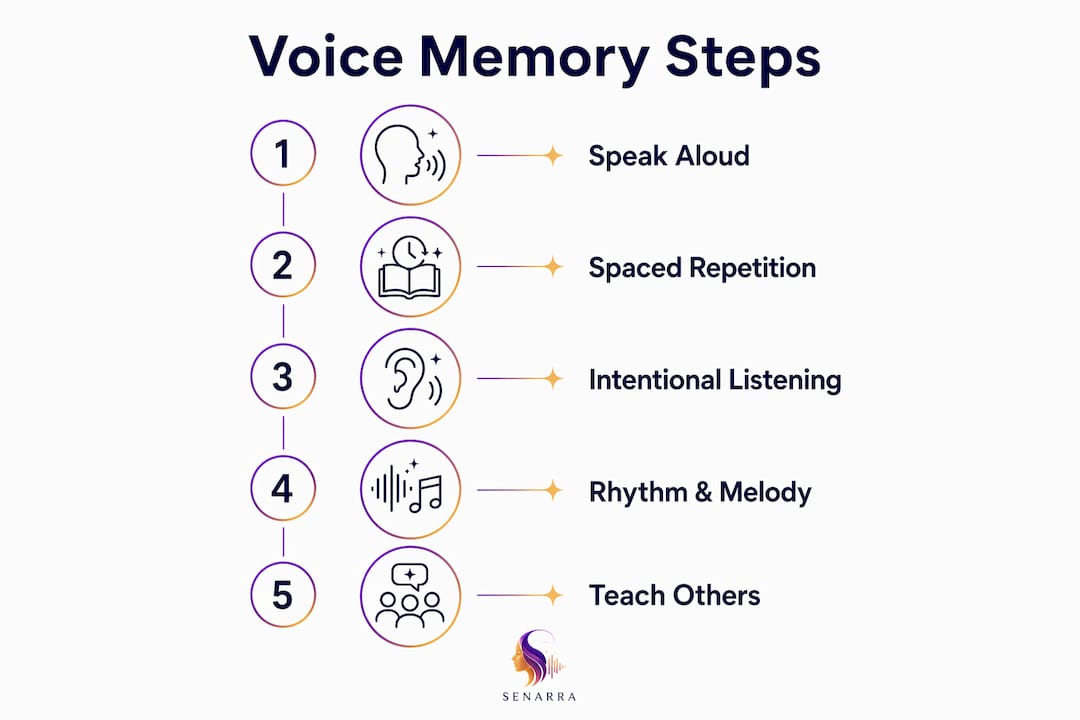
1. Use the production effect deliberately
Speak information aloud rather than reading it silently. Active speaking triggers multiple neural pathways simultaneously, making it the most powerful way to encode and retrieve voice information. If you want to remember how a loved one told a particular story, narrate it back in your own words immediately after hearing it.
2. Apply spaced repetition to audio
Spaced repetition converts short-term vocal memories into durable long-term ones by scheduling retrieval at increasing intervals. Listen to a recording today, then again in three days, then a week later. Each retrieval strengthens the neural pattern without requiring hours of repeated listening.

3. Record and re-listen with intention
Voice notes are one of the simplest and most underused memory tools. Record a loved one's story, a pet's sounds, or your own narration of a shared memory. Re-listen actively, meaning pause, reflect, and respond aloud. Passive playback adds little. Active engagement adds a great deal.
4. Use rhythm and melody as anchors
Auditory memory responds strongly to rhythm and melody. If a loved one had a particular phrase or saying, try setting it to a simple rhythm or tune. The musical structure gives your brain an additional retrieval hook that works even when direct recall fails.
5. Teach or explain the memory to someone else
Explaining a memory to another person forces you to reconstruct it actively. That reconstruction process deepens encoding. Telling a child about a grandparent's voice, mannerisms, and stories is not just meaningful. It is one of the most effective memory recall methods available.
Pro Tip: Set a recurring reminder to re-listen to a saved voice recording every few weeks. Spaced repetition works for emotional memories just as well as it does for academic learning.
How can you create a lasting voice memory keepsake?
Preserving a voice memory as a physical or digital keepsake gives you a reliable retrieval cue that does not depend on your brain alone. Modern methods range from tactile objects to AI-assisted archives, and the best approaches combine both.
Physical keepsakes with embedded audio
3D crystal engraving etches voice waveforms into optical glass with sub-millimeter laser accuracy. These objects often include a QR code that links to the original audio file, giving you both a visual and auditory retrieval cue in one object. The waveform itself becomes a visual representation of a voice, which activates additional memory channels when you look at it.
Physical keepsakes work because they provide a tangible trigger. Holding an object associated with a loved one activates emotional memory networks that purely digital files sometimes cannot reach.
Digital archives and AI-assisted preservation
AI-assisted voice archiving has changed what is possible for families and individuals. Rather than storing raw audio files that become hard to navigate, modern AI systems organize and summarize voice content for faster, more meaningful retrieval. Generating concise summaries per interaction is more effective for recall than storing raw transcripts, because it reduces noise and preserves emotional context.
Senarra takes this further by capturing authentic conversations in a loved one's real voice and making them accessible through a memory line you can call. That approach mirrors how the brain actually retrieves voice memory: through context, emotion, and active engagement rather than passive file browsing.
- Voice waveform crystals: Durable, multi-sensory objects that combine visual and audio retrieval cues.
- QR-linked audio objects: Physical items that connect directly to stored recordings for instant playback.
- AI voice archives: Organized, summarized voice libraries that reduce retrieval friction.
- Conversational AI companions: Platforms like Senarra that let you interact with preserved voices, not just listen to them.
Families who want to document ancestry stories through voice recording find that combining physical keepsakes with digital archives creates the most resilient preservation system. Neither format alone is as effective as both together.
Common myths about voice memory that mislead people
Voice memory is widely misunderstood, and those misunderstandings lead people to preserve voices in ways that do not actually work.
Myth 1: Passive listening is enough to preserve a voice memory. Passive listening creates weak encoding. People commonly fail at voice memory preservation because they rely on silent, passive review. Active verbalization is the key to effective encoding and retention.
Myth 2: Voice memory is a fixed recording in the brain. Voice memory is stored as dynamic neural patterns, not static recordings. Each retrieval slightly reshapes the memory based on current emotional context. That is not a flaw. It is how the brain keeps memories emotionally relevant over time.
Myth 3: More listening time equals stronger memory. Duration of exposure matters far less than the quality of engagement. Ten minutes of active, emotionally engaged listening produces stronger encoding than two hours of background playback.
Myth 4: Emotional memories are automatically preserved. Emotional intensity helps, but it does not guarantee retention. Without retrieval practice and contextual cues, even emotionally significant voice memories fade. The importance of voice memory preservation lies precisely in the fact that emotion alone is not enough to keep a memory accessible.
Myth 5: Technology replaces the need for active memory engagement. Recordings and AI tools are retrieval aids, not substitutes for active engagement. The most effective use of any voice preservation technology involves listening actively, responding verbally, and revisiting recordings at spaced intervals.
Key Takeaways
Voice memory is a dynamic, emotionally driven neural process that requires active engagement to encode, retain, and retrieve effectively.
| Point | Details |
|---|---|
| Active verbalization encodes deeper | Speaking aloud during memory formation activates four cognitive channels, producing far stronger retention than passive listening. |
| Emotional context shapes retrieval | Voice memories are stored as neural patterns linked to emotion, making contextual cues the most reliable retrieval triggers. |
| Spaced repetition extends retention | Re-listening at increasing intervals converts short-term voice memories into durable long-term ones. |
| Physical and digital keepsakes work together | Combining tactile objects with AI-organized audio archives creates the most resilient voice memory preservation system. |
| Active myths cost real memories | Passive listening, excess duration, and assuming emotion alone preserves memory are the three most common preservation mistakes. |
Why I think most people wait too long to preserve a voice
The voices we most want to keep are almost always the ones we assume we will remember forever. A parent's specific way of saying your name. A pet's particular sound when they wanted attention. A grandparent's cadence when they told a story they had told a hundred times. We assume those sounds are locked in permanently because they feel so vivid right now.
What I have seen, again and again, is that vividness is not the same as durability. Voice memories fade not because we stop caring but because we stop actively engaging with them. We do not revisit them. We do not speak them aloud. We do not create retrieval cues that give the brain a reliable path back.
The other mistake I see is treating preservation as a single event. People record one conversation and consider the job done. But a single recording without spaced re-listening, without active engagement, without contextual anchoring, sits in a folder and slowly loses its emotional charge. The memory weakens not because the file degrades but because the neural pathway does.
The practical lesson is simple: start earlier than feels necessary, engage more actively than feels natural, and use every tool available, from physical keepsakes to AI companions like Senarra, to create multiple retrieval paths to the voices you love. A voice preserved well is a voice you can return to. A voice preserved passively is a voice you may lose without realizing it.
— Bryan
Senarra: a place where cherished voices live on
Losing a loved one's voice is one of the quietest forms of grief. Senarra was built to address exactly that.

Senarra captures authentic conversations in a loved one's real voice and organizes them into a living archive you can return to whenever you need it. The platform's memory line lets you call in and connect with preserved voices directly, making retrieval feel natural rather than clinical. For families working to capture aging parent memories before they fade, Senarra offers a way to preserve not just words but the full emotional texture of a voice. Visit Senarra to start preserving the voices that matter most.
FAQ
What is voice memory?
Voice memory is the brain's process for encoding and retrieving spoken sounds through multisensory neural pathways linked to emotion and context. It stores voices as dynamic patterns, not fixed recordings.
Why does a loved one's voice feel so vivid in memory?
The amygdala tags voice memories with emotional context, making them feel more immediate than other memory types. Tone, rhythm, and inflection create additional retrieval hooks that purely visual memories lack.
How can I improve my ability to recall a loved one's voice?
Spaced repetition and active verbal engagement are the two most effective methods. Re-listen to recordings at increasing intervals and speak your memories aloud to reinforce the neural trace.
What is the best way to create a voice memory keepsake?
Combining a physical object, such as a voice waveform crystal with a QR code, with a digital AI-organized archive creates the most durable preservation system. Each format reinforces the other as a retrieval cue.
Does passive listening preserve voice memories effectively?
Passive listening produces weak encoding. Active verbalization, spaced retrieval, and emotionally engaged re-listening are required to convert a voice memory into a durable long-term neural pattern.