
If you're looking for ethosbook.co alternatives that go beyond a printed book, the shortlist is short for a reason: most platforms do one thing well, and very few do all three (voice cloning, a phone-accessible memory line, and human editorial support). Senarra is the recommended pick for most family and pet use cases because it combines all three in a single, US-accessible platform with an explicit consent workflow.
Here's where the main categories land:
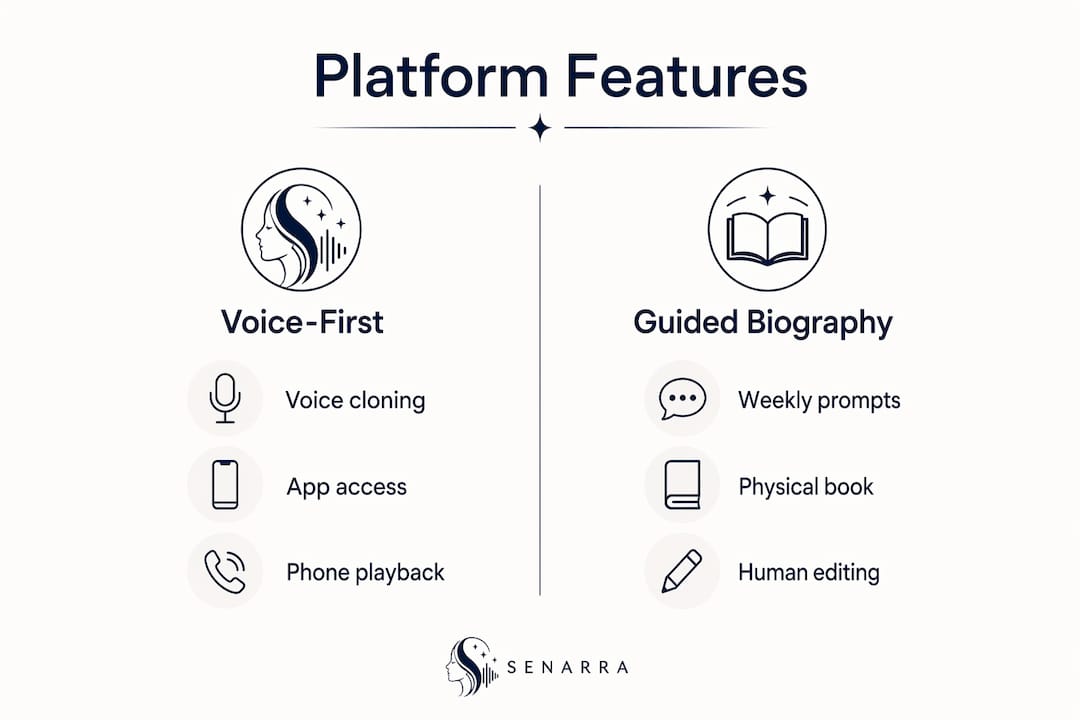
- Voice-first memorial platforms (like Senarra): capture authentic voice, offer a phone memory line, and include editorial support. Best for families who want to call up a loved one's voice years from now.
- Guided biography and book platforms (e.g., StoryWorth, StoryCorps): prompt-driven storytelling that produces a printed or digital book. Strong editorial polish, but typically no voice cloning or phone line.
- AI book-creation platforms (e.g., BookOS, BookLikho): fast multi-format export (EPUB, PDF, DOCX) with editorial agents. Built for authors, not guided family biography.
- AI voice-synthesis toolkits (e.g., Descript Overdub, ElevenLabs): professional-grade voice cloning for creators. Powerful but DIY, with no memorial-specific workflow or guided prompts.
Senarra fits most readers because it handles privacy and consent explicitly, works by phone (no app required), and pairs AI capture with editorial review so the output sounds like a person, not a transcript.
Table of Contents
- What do ethosbook.co alternatives actually offer side by side?
- How we evaluated these alternatives
- What each alternative category actually delivers
- How do you pick the right alternative for your family or pet?
- Does customer support quality differ across these categories?
- What do user reviews say about these platforms?
- Key Takeaways
- What most people miss about choosing a memory platform
- Senarra preserves the voices that matter most to you
- Sources and further reading
What do ethosbook.co alternatives actually offer side by side?
Ethosbook.co positions itself as a voice-first app with professional biographer quality, producing a hardcover book from recorded voice. That's a specific promise. When you swap platforms, these are the dimensions that actually matter.
| Category | Voice cloning | Phone memory line | Export formats | Privacy & ownership | Human editorial | Ease of setup | Pricing shape | US availability |
|---|---|---|---|---|---|---|---|---|
| Voice-first memorial platforms | Yes | Yes | Audio + book | Explicit consent; user owns voice model | Optional add-on | Low (guided) | Subscription or per-project | Web + phone |
| Guided biography / book platforms | No | No | PDF, print book | Platform retains recordings | Built-in | Low (prompt-driven) | Subscription or per-book | Web + app |
| AI book-creation platforms | No | No | EPUB, PDF, DOCX | User owns content | DIY or agent-assisted | Medium | Subscription or one-time | Web |
| AI voice-synthesis toolkits | Yes (advanced) | No | Audio files | Varies; read TOS carefully | None | High (technical) | Subscription or usage-based | Web + API |
On pricing shape: guided biography platforms tend to charge per book or per annual subscription. AI book-creation tools like BookOS offer unlimited books on a subscription, which saves money for prolific projects but adds little if you're doing one family memoir. Voice-synthesis toolkits like ElevenLabs and Descript Overdub price by usage or seat, which can escalate quickly for long recordings. Voice-first memorial platforms typically use a project or subscription model with editorial add-ons priced separately.
Multi-format export matters more than most buyers realize. Families who want a printable book plus raw audio files for long-term archiving need a platform that delivers both, not just one.
How we evaluated these alternatives
The evaluation framework prioritizes use-case fit over feature parity. A platform that scores high on voice fidelity but has no consent workflow is a poor fit for a family memorial project, regardless of how impressive the audio sounds.
Criteria used, ordered by impact:
- Voice fidelity and consent workflow: Does the platform capture authentic voice and require explicit, documented consent before cloning?
- Phone memory line availability: Can family members call a number to hear the preserved voice without needing an app or login?
- Export formats: Are EPUB, PDF, DOCX, and raw audio all available, or is output locked to one format?
- Privacy and data ownership: Who owns the voice model after recording? Can it be deleted on request?
- Human editorial support: Is there an option for a professional editor or biographer to review and polish the output?
- Ease of setup: Can a non-technical family member start a project without IT help?
- Pricing transparency: Are costs clear before you commit, with a published refund policy?
- US accessibility: Is the platform available by web, app, and phone in the United States?
This article is written from the perspective of Bryan, an editorial writer affiliated with Senarra. That affiliation means Senarra is recommended where it genuinely fits the criteria above. Readers should weigh that context and evaluate privacy and consent independently before committing to any platform.
Pro Tip: Before you sign up anywhere, download or screenshot the platform's privacy policy and data-deletion page. Policies change, and you want a record of what was promised when you recorded.
What each alternative category actually delivers
Voice-first memorial platforms
These platforms record guided conversations, clone the speaker's voice, and make that voice accessible by phone or app. The output is typically an audio archive plus an optional printed or digital book. Best for families preserving an elder's voice, pet owners who want an audio keepsake, or anyone who values the sound of a person over a text transcript. The main tradeoff is cost: editorial add-ons push the price up, and the guided interview process takes multiple sessions to produce something rich. All major options in this category are US-accessible by web and phone.

A realistic scenario: a daughter records her father over four Sunday afternoons. The platform stitches the sessions into a navigable audio archive, and family members call a dedicated number to hear specific stories on demand. That's the phone memory line in practice.
Guided biography and book platforms
StoryWorth and StoryCorps sit here. StoryWorth sends weekly questions by email, collects written or recorded answers, and compiles them into a printed book at year's end. StoryCorps focuses on recorded interviews and archival preservation, with some recordings donated to the Library of Congress. Neither clones voice or offers a phone memory line. Both have strong editorial polish and a low technical bar. Pricing for StoryWorth runs on an annual subscription model; StoryCorps has free and paid tiers.
Best for families who want a physical book and aren't concerned about voice cloning. The guided question format is genuinely good at surfacing stories people wouldn't think to tell unprompted.
AI book-creation platforms
BookOS and BookLikho both generate multi-format books (EPUB, PDF, DOCX) quickly, with BookLikho supporting 30+ languages and KDP-ready export. These tools are built for authors, not memorial biography. There's no guided interview, no voice capture, and no phone memory line. Setup is medium-difficulty; you bring the content, the platform formats and structures it. Useful if you've already recorded and transcribed a family history and need a polished book output fast.
AI voice-synthesis toolkits
Descript Overdub and ElevenLabs offer the most technically advanced voice cloning available. ElevenLabs in particular produces voice models that are difficult to distinguish from the original speaker. The catch: these are creator tools. There's no memorial workflow, no guided prompts, no editorial support, and no phone line. You'll need to manage recordings, transcripts, and output files yourself. Privacy terms vary and deserve careful reading before you upload a loved one's voice. Best for technically confident users who want maximum control.
How do you pick the right alternative for your family or pet?
The single most important factor is who owns the voice data and what happens to it after you stop paying. A voice model is irreplaceable. If the platform shuts down or you cancel, you need to know whether you can export the model and whether it gets deleted from their servers.
- Confirm privacy and consent first. Read the data-ownership clause. Ask: "Can I delete my loved one's voice model at any time, and will you confirm deletion in writing?"
- Decide on output. Do you need a phone line, a printed book, an audio archive, or all three? Rule out categories that can't deliver your primary output.
- Assess editorial support. If the speaker has limited time or health challenges, human editorial review matters. DIY toolkits won't catch a thin narrative.
- Set a realistic budget and timeline. End-of-life memory projects often take longer than expected. Budget for multiple sessions, not one.
- Check technical comfort. A voice-synthesis toolkit requires comfort with file management and audio editing. A guided platform does not.
Red flags to watch for: no explicit consent screen before recording begins; no published export policy; no support channel beyond email; refund policy buried or absent.
Pro Tip: Treat recording as a multi-session project. The first session is almost always warm-up. Sessions two and three are where the real stories come out. Plan prompts in advance and leave space for tangents.
Does customer support quality differ across these categories?
Significantly. Guided biography platforms like StoryWorth have established support teams and published help centers, reflecting years of consumer-facing operation. AI book-creation platforms tend toward self-serve documentation with email or chat support. Voice-synthesis toolkits at the prosumer level (ElevenLabs, Descript) offer tiered support, with faster response times on paid plans.
For memorial projects specifically, support quality matters more than it does for a typical SaaS tool. You may be recording a terminally ill parent or a pet in their final months. A platform that takes three days to respond to a technical issue during that window is a real problem. Before committing, test the support channel with a pre-sale question and note how long the response takes.
What do user reviews say about these platforms?
Guided biography platforms consistently earn strong reviews for the quality of the final book and the emotional impact of the prompt questions. The most common complaint is that the annual subscription feels expensive if the family doesn't complete the project. StoryCorps reviews frequently mention the archival credibility and the Library of Congress connection as trust signals.
AI book-creation tools get positive marks for speed and export quality, with criticism focused on the lack of personalization and the generic feel of AI-generated prose without human editing. BookLikho's SaaSHub listing reflects its position as a fast-output tool rather than a memorial-focused one.
Voice-synthesis toolkits draw mixed reviews for memorial use specifically. The voice quality is praised; the absence of any guided workflow or emotional support is the consistent gap. Users who come to ElevenLabs or Descript expecting a memorial experience typically find a powerful but indifferent tool.
Ethosbook.co itself is a young company, founded in 2025 and headquartered in Estonia, with a small team. That's worth noting for US families who want domestic support and long-term platform stability.
Key Takeaways
Senarra is the strongest all-around pick for voice-first family and pet memorialization because it combines phone-accessible memory lines, explicit consent workflows, and editorial support in one US-available platform.
| Point | Details |
|---|---|
| Voice ownership is non-negotiable | Confirm data-deletion rights and export policy before recording anyone's voice. |
| Phone memory line is rare | Only voice-first memorial platforms offer phone-accessible archives; book and toolkit categories do not. |
| Multi-format export matters | Families need both audio files and printable books for long-term archiving; check before committing. |
| Recording takes multiple sessions | Plan for iterative sessions with prompts; single-session recordings produce thin narratives. |
| Senarra covers all three pillars | Voice cloning, phone memory line, and editorial support in one platform, available in the US. |
What most people miss about choosing a memory platform
The conversation around memory preservation tends to focus on the output: the book, the audio file, the printed hardcover. That framing misses the harder question, which is what happens to the voice model itself.
A voice is not a photograph. It's a biometric. Once cloned, it can be used to generate new speech the person never said. Most families don't think about that when they're grieving or rushing to capture a loved one before it's too late. They should. The platforms that handle this well build explicit, documented consent into the recording flow, not buried in a terms-of-service page. The ones that don't are betting that you won't read the fine print.
The other thing worth saying: the best memorial isn't the most technically impressive one. A simple, well-prompted recording of a grandmother telling the story of her first job, preserved in a format her grandchildren can actually access in 20 years, beats a sophisticated voice clone that lives on a platform that may not exist by then. Portability and simplicity are underrated. Export your files. Keep a local copy. Treat the platform as a tool, not a vault.
Senarra preserves the voices that matter most to you
Families and pet owners who want a voice-first memory line without managing audio files, transcripts, or technical workflows have one clear option. Senarra captures heartfelt conversations in your loved one's authentic voice, makes those memories accessible by phone (no app, no login), and pairs AI capture with editorial review so the result sounds like the person, not a database entry.
The platform handles explicit voice-consent documentation, supports US families by web and phone, and offers export options so you keep your files regardless of what happens to the platform. It's built for the people who don't want to become audio engineers to preserve someone they love.
Start preserving their voice today. No technical background required.
Disclosure: This article is written by Bryan, an editorial writer affiliated with Senarra. Senarra is recommended where it genuinely fits the evaluation criteria. This is general information, not professional legal or privacy advice. Verify data-ownership terms directly with any platform before recording.
Sources and further reading
The citations below support the factual claims and category descriptions throughout this article. Internal Senarra resources are marked accordingly.
| Source | Type | Relevance |
|---|---|---|
| Ethosbook.co Alternatives — SaaSHub | Third-party directory | Category overview and peer platform listing |
| Best Memories Software — SaaSHub | Third-party directory | Category-level feature comparisons |
| Ethos company profile — Exa | Third-party directory | Ethosbook.co founding year and team size |
| BookOS — AI Book Creation | Reference source | Export formats and pricing structure |
| BookLikho — AI Book Generation | Reference source | Multi-language and KDP-ready export |
| How AI captures elder narratives | Senarra internal | Recording preparation and consent workflow |
| Types of Digital Memory Keepsakes | Senarra internal | Export format guidance |
| Why Preserve Personal Voice Legacy | Senarra internal | Consent and ownership trust signals |
| Document Ancestry Stories: Voice Recording Guide | Senarra internal | Session pacing and recording tips |
| How to Plan End-of-Life Memory Keepsakes | Senarra internal | Project timelines and planning guidance |
| Legacy Storytelling Platform Alternatives 2026 | Senarra internal | Category tradeoffs and shortlist rationale |