
Phone call recordings are defined as voice-captured conversations that preserve both the spoken words and emotional texture of a family member's memories. Understanding how phone calls record family stories is the first step toward protecting something up to 90% of families lose within three generations. That statistic is not abstract. It means your grandmother's story about immigrating at age 12, your grandfather's memory of his first job, and your parent's account of the day you were born could all disappear before your children are old enough to ask. The phone in your pocket is one of the most effective tools for stopping that loss.
How phone calls record family stories better than other methods
Phone call storytelling works because it removes the performance pressure that kills candid conversation. Face-to-face interviews create a stage effect. The storyteller sees the camera, the notepad, or the expectant face across the table, and they edit themselves in real time. A phone call collapses that dynamic entirely.
The absence of eye contact is the key psychological mechanism. When your aunt cannot see your reaction, she stops monitoring it. She stops worrying whether her story is interesting enough or whether she is taking too long. She simply talks. That shift from performance to conversation is where the richest memories surface.
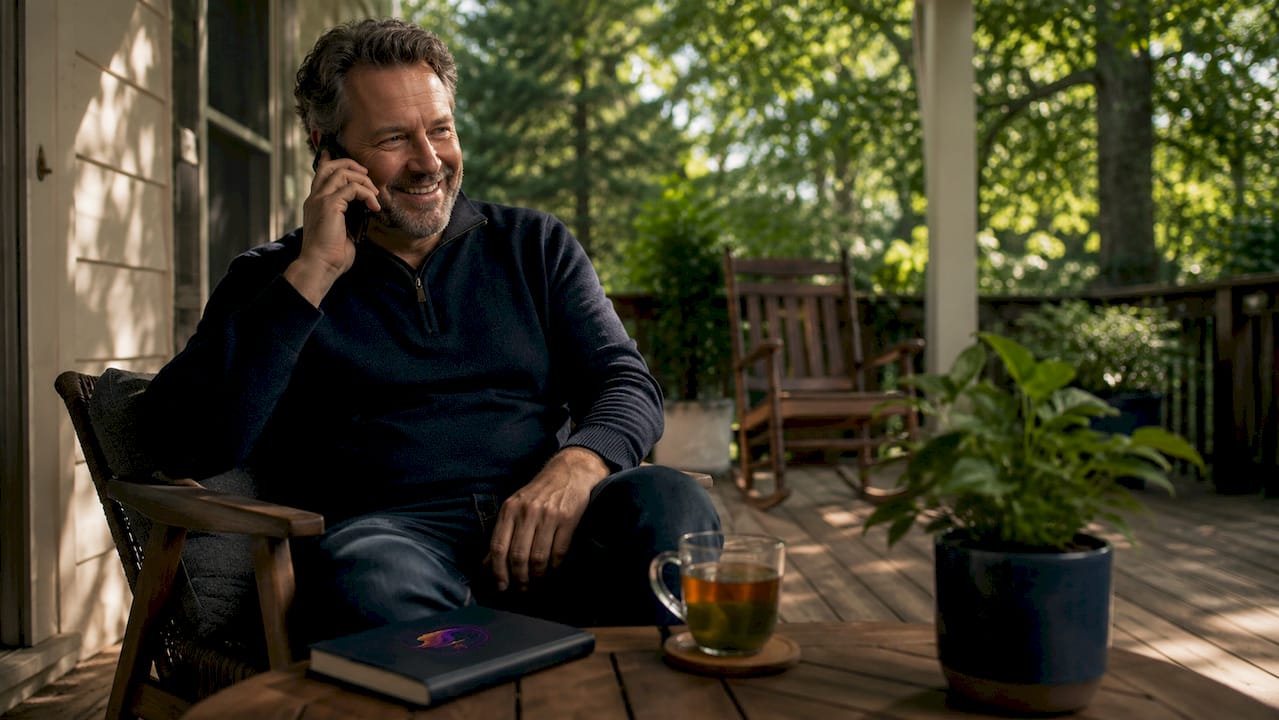
Voice also carries what text cannot. Laughter, a catch in the throat, the pause before a difficult memory, the pride in someone's voice when they describe an achievement. These emotional signals are the difference between a family story and a family record. Voice recording sessions produce over 2,000 words in 15 minutes, compared to roughly 600 words typed in the same time. That is three times the material, with emotional nuance included at no extra effort.
Phone calls also allow for short, repeated sessions. Older relatives experience cognitive fatigue after extended storytelling. A 20-minute call on a Tuesday covers one topic well. Another call the following week covers a different chapter. Over months, those calls build a complete oral history without exhausting anyone.
Key advantages of phone call storytelling:
- No camera, no setup, no self-consciousness about appearance
- Familiar home environment promotes comfort and spontaneity
- Emotional tone, laughter, and pauses are captured in the audio
- Short sessions prevent fatigue and keep stories focused
- No travel required, making it accessible for geographically scattered families
Pro Tip: Ask your relative to hold a physical object while you call. A watch, a photograph, a piece of jewelry. Touching something tangible while speaking activates sensory memory and often unlocks stories the person did not know they still remembered.
How to start and conduct effective family history phone calls
The single biggest mistake families make is treating the first call like a formal interview. Asking "Tell me about your childhood" produces a short, rehearsed answer. Asking "What did your kitchen smell like on Sunday mornings when you were eight?" produces a story.
The quality of the prompt determines the quality of the story. Specific, sensory questions unlock memory in ways that broad, open-ended questions cannot. This is not a minor stylistic preference. It is the most reliable technique in oral history practice.
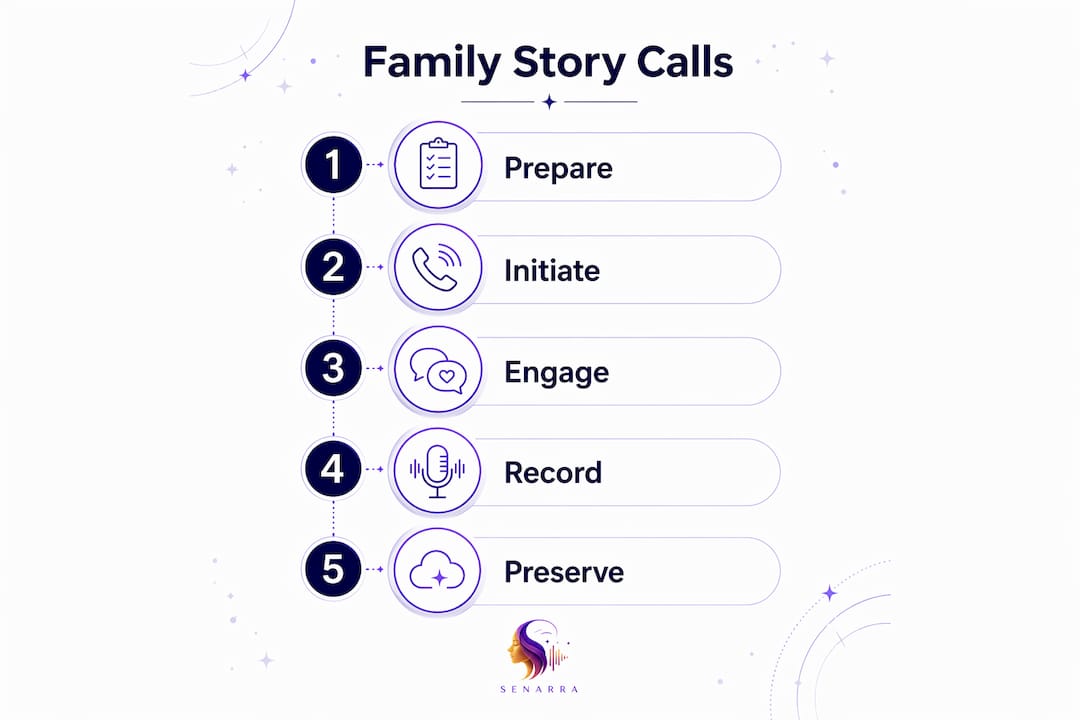
A practical framework for your first calls
-
Choose one topic per call. Pick a single era or event: the first apartment, a specific holiday, a job they loved or hated. Narrow focus produces deeper answers than broad sweeps.
-
Call at the right time. Mid-morning, after breakfast and before lunch, is typically when older adults are most alert and least fatigued. Avoid late afternoons or evenings for cognitively demanding conversations.
-
Use a photo as your starting point. Send a family photo by text or email before the call, then open with "I was looking at this picture. Can you tell me what was happening that day?" Photograph-guided conversation regularly produces 30 minutes of rich detail compared to the shorter answers that generic questions generate.
-
Keep calls to 15–20 minutes. Older individuals experience cognitive fatigue after about 20–30 minutes of deep storytelling. Stopping while the energy is still good leaves both of you wanting the next call.
-
Let tangents run. If your relative drifts from the 1960s into a story about a neighbor you have never heard of, follow it. Tangents are where the unexpected gems live. You can always return to the original thread.
-
Record with what you already have. The built-in voice memo app on any smartphone records calls clearly when placed on speaker. Dedicated phone call services like Senarra's memory line capture conversations directly without requiring any app download from the person being recorded.
Pro Tip: End every call with a forward hook. Say "Next time I want to ask you about the summer you worked at the lake." That gives your relative something to look forward to and often prompts them to start remembering details before you even call.
How to manage and preserve recorded family stories long-term
Recording the story is only half the work. Digital recordings are vulnerable to loss through device upgrades, forgotten cloud passwords, and platform shutdowns. A recording that exists only on one phone is one cracked screen away from being gone.
The archival best practice is to pair audio recordings with transcripts and printed material. Combining audio with physical formats creates a richer, more durable family archive than audio alone. A printed book with embedded QR codes linking to audio clips gives future generations both the words and the voice. That combination is what separates a preserved legacy from a forgotten file.
Storage and organization best practices
- Back up to at least two locations. Use a cloud service like Google Drive or iCloud and an external hard drive. Neither is sufficient alone.
- Name files with dates and topics. "Grandma_Ruth_1952_Chicago_Move.mp3" is findable in 20 years. "Recording_003.mp3" is not.
- Transcribe every recording. AI transcription tools produce accurate text from audio in minutes. Transcripts make stories searchable, shareable, and readable by family members who prefer text.
- Create a physical archive. Print transcripts and bind them. A family oral history archive in book form survives power outages, platform changes, and technology shifts that digital files cannot.
- Share copies widely. Send transcripts to cousins, siblings, and adult grandchildren. The more people who hold a copy, the lower the risk of total loss.
Senarra addresses the digital fragility problem directly. The platform stores recordings with transcripts and makes them accessible through a dedicated memory line, so the archive does not depend on any single device or account.
| Format | Durability | Accessibility | Best use |
|---|---|---|---|
| Cloud audio file | Medium | High | Active listening and sharing |
| External hard drive | High | Medium | Long-term backup |
| Printed transcript | Very high | Very high | Reading and gifting |
| Book with QR audio | Very high | High | Multi-generational legacy sharing |
What are the most common challenges in recording family phone stories?
Reluctance is the most common barrier. Many older relatives feel their stories are not interesting enough to record. The most effective response is not persuasion. It is curiosity. Ask one specific question and listen without interrupting. When they hear genuine interest in their answer, the resistance usually dissolves.
Technology anxiety is the second barrier. Phone call storytelling services that require no apps or internet access from the storyteller significantly increase participation among older adults. The person being recorded needs only to answer a phone call. All the recording technology sits on the other end.
Common challenges and practical solutions:
- Reluctance to share: Start with a lighthearted topic, not a heavy one. Ask about a favorite food, a funny neighbor, or a beloved pet before asking about loss or hardship.
- Sensitive topics: Respect boundaries without abandoning the subject entirely. "We do not have to talk about that today" keeps the relationship safe and the door open for later.
- Inconsistent scheduling: Treat calls like appointments. Set a recurring time, such as every other Sunday at 10:00 AM, so both parties expect it.
- Poor audio quality: Use speaker mode and record in a quiet room. Ask your relative to move away from televisions or radios before you start.
- Fatigue mid-call: Watch for slower speech, repeated phrases, or shorter answers. These signal fatigue. Wrap up warmly and schedule the next call before hanging up.
Pro Tip: Frame the recordings as a gift to younger family members, not as an interview of the older one. "I want your grandchildren to hear this in your own voice" shifts the dynamic from interrogation to contribution.
Key Takeaways
Phone calls record family stories most effectively when sessions are short, prompts are specific, and recordings are backed up in both digital and physical formats.
| Point | Details |
|---|---|
| Voice captures more than text | A 15-minute call produces over 2,000 words with emotional nuance intact. |
| Specific prompts unlock deeper stories | Sensory, scene-based questions outperform broad, open-ended ones every time. |
| Short calls beat long sessions | Keep calls to 15–20 minutes to prevent fatigue and sustain engagement over months. |
| Digital files need physical backups | Pair audio recordings with printed transcripts to protect against device loss or platform failure. |
| Low-tech access increases participation | Services requiring no app download from the storyteller remove the biggest barrier for older relatives. |
Why I think most families wait too long to start
The families I have seen do this well share one trait: they started before they felt ready. They did not wait for the perfect microphone, the right questions, or a formal plan. They called their grandmother on a Tuesday and asked what she remembered about her first apartment. That call led to another, and then another.
The phone call method democratizes story preservation in a way that formal oral history projects never could. You do not need a grant, a studio, or a journalism degree. You need a phone and the willingness to listen. That accessibility is the method's greatest strength, and it is also why so many families underestimate it.
What surprises people most is how the recordings change the living relationship, not just the archive. When your uncle knows you are genuinely interested in his stories, he starts telling them at dinner, at holidays, in passing. The act of recording creates a culture of storytelling within the family. That culture is the real legacy.
I have also seen families regret waiting. The recording they planned to make in spring became impossible by summer. Voice carries something a photograph cannot. It carries personality, humor, and the specific cadence of how someone thinks. Once that voice is gone, no amount of technology brings it back. Start now, with whatever you have, and refine the process as you go.
— Bryan
Preserve family voices with Senarra
Senarra makes it straightforward for families to start capturing stories today. The platform's memory line works by phone, so older relatives need only answer a call. No apps, no downloads, no passwords required on their end.

Senarra records conversations, generates transcripts, and stores everything in one place so the archive grows with every call. Families use it to capture aging parent memories before those memories fade, and to build a collection that future generations can access in both audio and written form. Visit Senarra to see how the platform supports family story preservation through simple, accessible phone calls.
FAQ
How do phone calls record family stories effectively?
Phone calls capture voice, tone, and emotional nuance in a relaxed setting that reduces performance pressure. A 15-minute call produces over 2,000 words of material, making it one of the most efficient methods for recording family memories.
What is the best length for a family storytelling call?
Keep calls to 15–20 minutes. Older adults experience cognitive fatigue after about 20–30 minutes of deep storytelling, and shorter, more frequent calls produce richer and more complete stories over time.
Do I need special equipment to record a family phone call?
No special equipment is required. A smartphone on speaker mode with a built-in voice memo app records clearly. Services like Senarra handle recording automatically through a dedicated phone line, requiring no setup from the person sharing their story.
What questions work best for capturing family history by phone?
Specific, sensory questions work best. Ask about smells, sounds, and scenes from a particular moment rather than broad questions like "Tell me about your childhood." Photograph-guided questions are especially effective and often generate 30 minutes of detailed storytelling.
How should I store recorded family stories to prevent loss?
Back up audio files to at least two locations, such as a cloud service and an external hard drive. Pair every recording with a written transcript and create a printed copy. Storing family stories in multiple formats protects against digital loss and keeps them accessible across generations.