
Audio legacies outlast written records because the human voice carries emotional presence, timing, and nonverbal cues that text simply cannot encode. A handwritten letter tells you what someone said. A recording tells you how they said it: the pause before a punchline, the catch in the throat, the laugh that sounds exactly like yours. That difference is not sentimental; it is neurological and psychological.
Three reasons this matters for families:
- Emotional immediacy. Voice activates memory and recognition in ways that reading does not. Tone, pacing, and humor are processed as social signals, not just information.
- Practical storage. Audio files are smaller than video and far simpler to back up, migrate, and share across generations.
- Ritual use. Families return to recordings on anniversaries, during grief, and at reunions in ways they rarely revisit written documents.
The importance of audio legacies becomes clearest when a voice is gone. By then, recording is no longer an option.
Table of Contents
- Why does the human voice carry what text cannot?
- How does audio support grief, identity, and family bonds?
- What should you record, and how do you start?
- How do you use AI voice cloning ethically and safely?
- What file formats and backup strategies keep audio for decades?
- How do families share and ritualize audio memories?
- Key Takeaways
- The case for audio that most families miss
- Senarra makes it easy to start preserving voices today
- Useful sources and further reading
Why does the human voice carry what text cannot?
Voice encodes what linguists call prosody: the rhythm, pitch, and pace of speech that carries emotional meaning alongside the words themselves. A sentence like "I'm so proud of you" reads identically whether spoken with warmth or sarcasm. Heard, it is unmistakable.
Beyond prosody, voice carries paralinguistic cues: laughter, hesitation, breath, regional accent, the particular way someone says a grandchild's name. These cues are processed by the brain as markers of identity and relationship, not just content. That is why hearing a recording of someone you love can feel startlingly present, even years after their death.
Text still earns its place. Written records are searchable, quotable, and precise for facts like dates, addresses, and legal details. The strongest family archives combine both: voice for emotional presence, text for reference. But when the goal is feeling connected to a person, audio wins every time.
How does audio support grief, identity, and family bonds?
Hearing a loved one's voice after loss is not a sign of complicated grief. It is a normal, often comforting part of bereavement.
The continuing bonds model, developed by bereavement researchers Klass, Silverman, and Nickman, reframed grief as an ongoing relationship rather than a process of detachment. Maintaining a felt connection to the deceased, including through sensory experiences like hearing their voice, is now understood as adaptive rather than pathological for many mourners.
"Hearing, seeing, or sensing someone who has died is a normal part of the grieving process for many people. It can be a comforting experience and a way of maintaining a bond with the person who has died." — Cruse Bereavement Support
A published case study in Omega: Journal of Death and Dying documented a bereaved person who regularly heard the voice of the deceased without clinical distress, describing the experience as meaningful and sustaining. The researchers concluded that such experiences deserve inclusion in bereavement-support frameworks, not pathologizing. For families building audio archives, this research carries a clear message: the recordings you make today may become someone's most important source of comfort later.
What should you record, and how do you start?
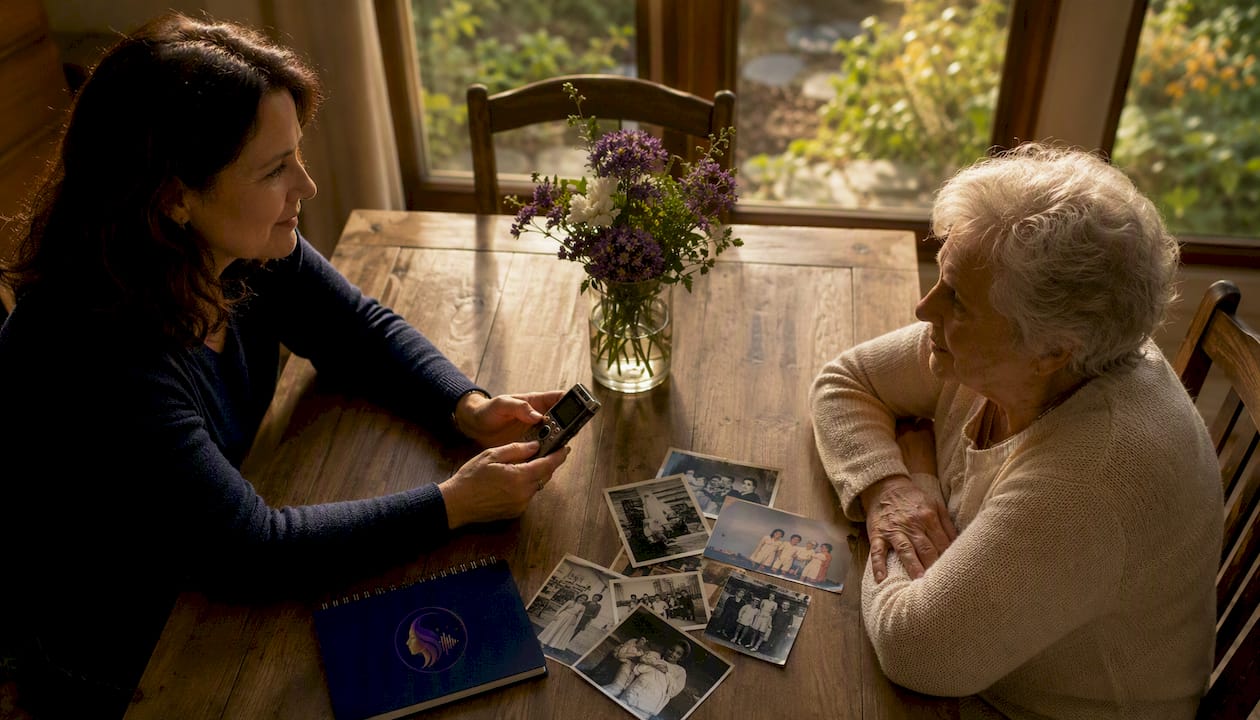
Start short. A 10-minute guided conversation about a single memory is more valuable than a two-hour interview that never happens. The lasting impact of audio records comes from consistency and specificity, not length.
What to record:
- Life-story prompts: "Tell me about the house you grew up in" or "What was your first job?"
- Milestone stories: weddings, immigrations, career changes, moments of personal pride
- Recipes and rituals: narrate a dish being cooked, not just the ingredients
- Gratitude messages: record what you want someone to know while you can still say it
- Everyday voice moments: voicemails, phone calls, casual conversations
- Pet sounds: a dog's bark, a cat's purr, a bird's call, captured while they are still here
Recording tips:
- Use a smartphone in airplane mode to eliminate notification sounds; hold it 6–8 inches from the speaker's mouth
- Record in a small, soft-furnished room (a bedroom beats a kitchen) to reduce echo
- Do a 30-second test playback before the real session starts
- Let silence breathe; do not rush to fill pauses, since the pauses are often where the real stories live
Sample opening prompts:
- "What do you remember most about your parents?"
- "Tell me about a time you were genuinely scared."
- "What's something you wish you'd said to someone?"
Pro Tip: Frame the session as a conversation, not an interview. Sit side by side rather than face to face, and start with a story you already know the answer to. Familiar ground relaxes the speaker and produces far more candid recordings than cold questions do.
For capturing aging parents' memories, timing matters as much as technique. Early afternoon tends to work better than evenings for older adults, and shorter, more frequent sessions beat one long exhausting one.
How do you use AI voice cloning ethically and safely?
AI voice cloning can deepen connection to a loved one's voice, but it requires explicit, documented consent and clear family boundaries before anyone presses record.
At a technical level, voice cloning tools analyze a sample of recorded speech (typically several minutes of clean audio) and generate a model that can reproduce that person's vocal characteristics. The output is not the person's actual voice; it is a statistical approximation. That distinction matters for how families use and present it.
Informed consent checklist:
- The person whose voice will be cloned has given written or recorded verbal consent
- They understand the voice model may be used after their death
- They have specified who may access it and under what circumstances
- They have reviewed and approved a sample output before finalizing consent
- The original raw recordings are preserved separately as the authoritative source
Family governance questions to settle in advance:
- Who controls access to the cloned voice after the person's death?
- Can the model be updated, or is it locked to recordings made during their lifetime?
- Are there topics or contexts where using the cloned voice would feel wrong to the family?
Pro Tip: Store the signed or recorded consent alongside the original audio files, not just in a separate document folder. Future family members who inherit the archive need to find the consent and the source recordings together, without having to search.
What file formats and backup strategies keep audio for decades?
Store audio in a widely supported, lossless or near-lossless format, and follow the 3-2-1 backup rule: three copies, on two different media types, with one stored off-site.
| Format | Fidelity | File Size | Best Use | Migration Notes |
|---|---|---|---|---|
| WAV | Lossless | Large | Master archive copy | Universally supported; no compression artifacts |
| FLAC | Lossless | Medium | Long-term storage with compression | Open format; re-encode if playback support drops |
| MP3 | Lossy | Small | Sharing and everyday playback | Widely supported; keep WAV or FLAC as master |
Backup checklist:
- Local copy on an external hard drive, updated at least annually
- Cloud backup in a service that supports folder sync (not just photo storage)
- Offline copy on archival-grade USB or optical media, stored away from the home
- Metadata embedded in each file: full name, date recorded, location, brief context note
- Calendar reminder every two years to check file integrity and migrate formats if needed
The metadata step is the one most families skip and later regret. A file named "grandma_voice_2024.wav" tells you almost nothing in 2045. A file with embedded tags reading "Eleanor Marsh, recorded March 2024, kitchen table, talking about her childhood in rural Georgia" tells you everything.
How do families share and ritualize audio memories?
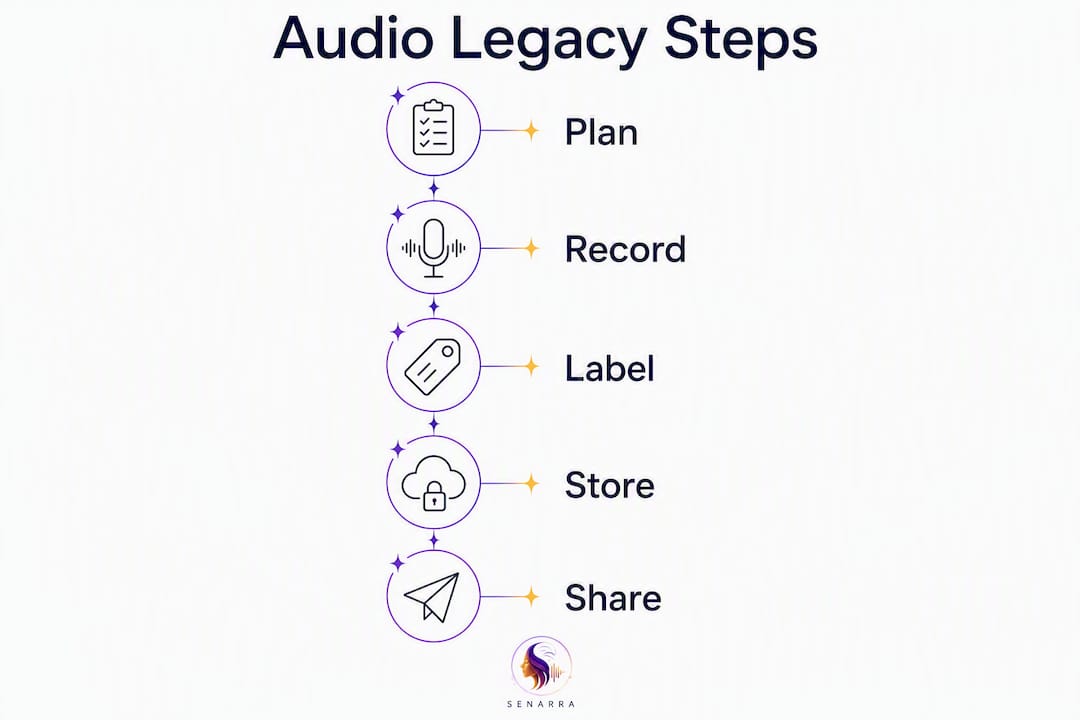
The most common use cases are caregiving, grief rituals, family reunions, and storytelling to children. Each one works differently, and the best families build small, repeatable habits around them.
Weekly listening ritual. One family designates Sunday evenings to play one recording of a grandparent. Children hear the voice regularly enough that it becomes familiar, not foreign, and the stories become part of the family's shared vocabulary.
Memory line. Some families set up a dedicated phone number that plays a rotating selection of recordings. Relatives who are not tech-savvy can call in and hear a voice without needing an app. Senarra's memory line feature makes this accessible without any technical setup on the caller's end.
Holiday story session. Before a holiday meal, one family member plays a two-minute recording of an ancestor describing what that holiday meant to them. It takes less than three minutes and consistently becomes the most talked-about moment of the gathering.
On access control: not every recording needs to be shared with everyone. Some stories are for adult children only; some are private messages meant for one person. Build that structure early, before the archive grows large enough to become unmanageable.
Key Takeaways
Audio legacies outlast written records because voice encodes emotional presence, nonverbal cues, and identity markers that text cannot replicate, and because families return to recordings in ways they rarely revisit written documents.
| Point | Details |
|---|---|
| Voice carries what text cannot | Tone, pacing, and paralinguistic cues create emotional presence that written words cannot encode. |
| Audio supports grief and bonds | Bereavement research supports hearing a loved one's voice as adaptive and comforting, not pathological. |
| Start with short guided sessions | A 10-minute conversation about one memory is more valuable than a long interview that never happens. |
| Consent before cloning | Document written or recorded consent before any AI voice cloning, and store it with the original files. |
| Senarra as your next step | Senarra's guided interviews, voice cloning with consent, and memory line make it practical to start today. |
The case for audio that most families miss
There is a version of this conversation that treats audio preservation as a nice-to-have, something to get around to eventually. That framing is wrong, and the bereavement research makes it clear why.
The families who most regret their archives are not the ones who recorded imperfectly. They are the ones who waited. A shaky smartphone recording of a grandmother telling a story about her childhood is worth more than a polished video made six months after she lost the ability to speak clearly. Authenticity beats production quality every time, and the window to capture it is shorter than anyone wants to admit.
There is also a subtler point worth making: written records preserve what people chose to say. Audio preserves how they actually were. The difference shows up in the pauses, the laughter, the way someone's voice changes when they talk about something they love. That is the texture of a person, and it does not survive transcription.
The audio storytelling benefits families feel most acutely are not the ones they anticipated when they started recording. They are the ones they discover years later, when a voice they thought they remembered turns out to be more vivid, more specific, and more them than memory alone could hold.
Senarra makes it easy to start preserving voices today
Most families know they should be recording. The gap is not motivation; it is friction. Where do you start? How do you organize what you capture? What happens to the recordings when you are gone?
Senarra addresses all of that in one place. The app guides you through structured interviews with prompts built for real family conversations, not generic questionnaires. It transcribes and organizes what you capture, supports voice cloning with documented consent, and gives family members access through a phone-based memory line that requires no technical skill to use. Recordings are backed up securely, shareable with the people you choose, and built to last beyond any single device or platform.
If you have been putting this off, the 14-day free trial is the lowest-friction way to start. Record one conversation this week. You will understand immediately why families who use Senarra describe it as the thing they wish they had started years earlier.
Useful sources and further reading
- Phenomenology and impact of hallucinations concerning the deceased — Cambridge University Press study supporting the continuing bonds model and the adaptive role of sensory experiences in grief.
- Very Present and Very Real: A Case Study of Regularly Hearing the Voice of the Deceased Without Distress — Omega: Journal of Death and Dying case study used in the psychology section.
- Seeing, hearing or sensing someone who has died — Cruse Bereavement Support guidance normalizing auditory experiences during grief.
- Narratives of experiences of presence in bereavement — Counseling and Psychotherapy Research study on comfort, ambivalence, and distress in continued-presence experiences.
- How to Record Milestone Stories for Family History — Senarra guide with structured prompts for milestone interviews.
- Capture Aging Parent Memories Audio: A Family Guide — Senarra guide on timing, consent, and sensitivity when recording older relatives.
- Why Family Stories Fade Without Recording — Senarra post on the practical and emotional cost of waiting to record.