
Memory is the foundation of grief after pet loss. Without memories of your pet, there would be no grief. That paradox sits at the heart of every healing process: the same memories that cause pain are the very ones that carry you forward.
Psychologists call this "continuing bonds theory," a framework that replaced the older idea that healthy grief means "letting go." The role of memory in pet loss healing is now understood as active, not passive. Memories preserve your bond with your pet, sustain their identity in your life, and give grief its shape. Memories fuel grief in two distinct ways: happy memories contrast painfully with absence, while negative ones trigger regret. Both matter. Both heal. The goal is not to stop remembering. The goal is to change your relationship with what you remember.
How do memories influence the emotional experience of pet loss?
Memories act as both a source of comfort and a source of acute pain during grief. This is not a contradiction. It is the mechanism by which grief works.
When you recall your dog's morning routine or the sound of your cat settling beside you, your brain activates the same neural pathways it built during years of daily contact. Routine memories compress into felt-sense experiences, becoming woven into your identity rather than fading like ordinary recollections. That is why losing a pet can feel like losing part of yourself. The memory is not just about the animal. It is about who you were with them.
Grief also changes how memories feel over time. In the early weeks, memories arrive with full sensory force. A smell, a sound, or a specific time of day can trigger an overwhelming wave of loss. This intensity is normal. It reflects how deeply integrated your pet was into your daily life.
"Memories, while a source of pain, are essential to living with grief over time by facilitating continuing bonds. The goal is not to erase them but to carry them differently." Grief and Memory, Dale Wisely
The neuroscience here is worth understanding. Grief does not erase memory. It reshapes it. Over time, the emotional charge attached to a memory softens, while the meaning of that memory deepens. Pet owners who understand this process report less fear about "losing" their pet's memory and more confidence in the healing process.
Key ways memories shape the emotional experience of pet loss:
- Sensory triggers (scent, sound, texture) activate grief most intensely in the first weeks
- Narrative memories (stories you tell about your pet) build meaning and identity continuity
- Regret memories (things left unsaid or undone) require specific processing to avoid prolonged distress
- Joyful memories become bittersweet before they become purely comforting, a normal arc
What memory preservation techniques support healing after pet loss?
Memory preservation is the deliberate act of capturing, organizing, and honoring your pet's story so that grief has a container. Without structure, memories scatter. With structure, they become a coherent narrative that affirms both your pet's life and your own survival.
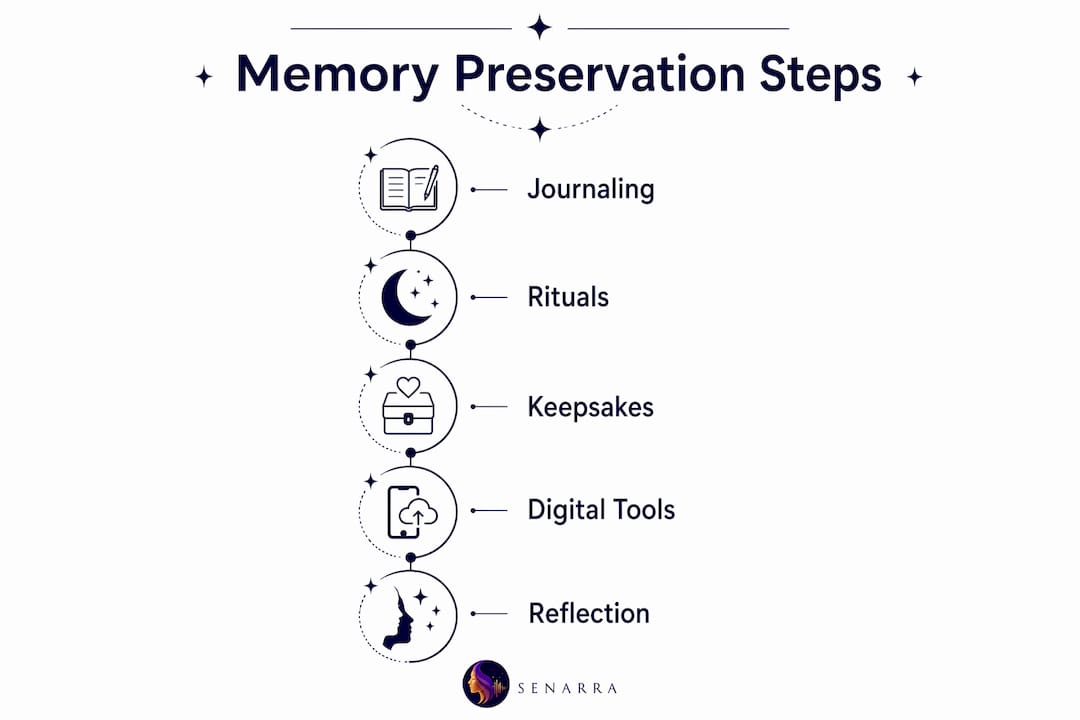
Journaling for grief narrative coherence
Grief journaling helps pet owners organize scattered traumatic memories into coherent narratives that affirm survival and shared life. The act of writing forces the brain to sequence events, which reduces the chaotic quality of early grief. You do not need to write beautifully. You need to write honestly.
Start with the mundane. What did your pet eat for breakfast? What was their favorite spot in the house? Contemporaneous, everyday records anchor memory better than highlight-focused memorials because they capture the texture of ordinary life. That texture is what you miss most.
Rituals as meaning-making tools
Structured grief rituals create symbolic containers for grief expression, which is critical for meaning-making and grief integration. A ritual does not need to be elaborate. Lighting a candle at your pet's usual feeding time, visiting a favorite walking trail on their birthday, or planting a tree in their memory all qualify. Rituals work because they give grief a predictable outlet. They prevent the feeling of being "stuck" by channeling emotion into purposeful action.
Physical keepsakes and sensory anchors
Physical memory anchors like scent preservation, custom figurines, or paw print casts allow natural memory triggering without psychological strain. These objects reduce anxiety about forgetting by creating reliable access points for remembrance. You do not have to force yourself to remember. The object does the work.
Digital memory keepsakes and storytelling
Digital memory keepsakes extend the life of your pet's story beyond physical objects. Voice recordings, photo timelines, and curated video collections preserve details that physical keepsakes cannot. Platforms like Senarra go further by capturing your pet's story in an immersive, personalized format, including voice-based memory lines you can call to reconnect with cherished moments.
Pro Tip: Build at least three different types of memory access points: one written (journal), one physical (keepsake), and one digital (audio or video). Each type triggers different neural pathways, giving you more ways to reconnect with your pet's memory on difficult days.
Practical steps to start your memory preservation practice:
- Write one memory each day for the first two weeks, focusing on ordinary moments rather than milestones
- Choose one ritual to practice weekly, tied to a time or place that was meaningful to your pet
- Gather physical objects that carry sensory memory (a collar, a toy, a blanket) and keep them accessible
- Create a digital archive using photos, videos, or voice recordings organized by theme or time period
- Share at least one memory with another person each week to build social validation around your grief
How do healthy memory bonds differ from distressing memory attachments?
Not all memory work leads to healing. The difference lies in whether your relationship with a memory is internalized or externalized.
An internalized memory bond feels warm and growth-oriented. You think of your pet and feel love, gratitude, or gentle sadness. The memory lives inside you as part of your identity. An externalized memory bond feels distressing and stuck. You rely on external objects or behaviors to feel connected, and the absence of those objects triggers acute anxiety. Healthy memory bonds promote emotional growth, while externalized bonds prolong distress and impede healing.
Signs of healthy memory work:
- Memories bring a mix of sadness and warmth, not only acute pain
- You can speak about your pet without becoming incapacitated
- Rituals feel comforting rather than compulsive
- You feel your pet's presence as part of your identity, not as an absence you must fill
Signs that memory work may need support:
- Memories trigger panic or inability to function weeks after the loss
- You avoid all reminders because the pain is unmanageable
- You feel guilt or shame about the intensity of your grief
- Social isolation increases rather than decreases over time
Pet loss grief is often disenfranchised, meaning society frequently minimizes it. This lack of social validation makes deliberate memory work and supportive communities especially important. Joining a pet loss support group, whether in person or online, provides the external validation that helps internalize memories in a healthy way.
Pro Tip: If a specific memory consistently triggers distress rather than comfort after several weeks, write it down in detail and then write what you wish had been different. This narrative reprocessing technique helps shift regret-based memories toward acceptance.
How can pet owners apply memory preservation to honor their pet's legacy?
A personalized memory preservation plan gives your grief direction. Without one, healing happens by accident. With one, it happens by design.
Here is a practical framework for building yours:
- Document before you forget. The fear of forgetting peaks 3–8 weeks after loss. Start writing and recording immediately, even if the entries are short and raw.
- Involve your family or community. Ask others who knew your pet to share their memories. Each person holds a different piece of your pet's story. Collecting those pieces builds a richer, more complete picture.
- Create a legacy object. This could be a memory box, a photo book, a digital storytelling archive, or a commissioned piece of art. The form matters less than the intention behind it.
- Balance preservation with integration. Memory preservation is not about freezing time. It is about carrying your pet's story forward into your evolving life. Review your memory archive periodically, not obsessively.
- Address the fear of forgetting directly. Memory compression during grief is natural. It signals that your pet's presence is becoming part of your identity rather than a separate, retrievable file. That is not loss. That is love reshaping identity.
| Approach | Best for |
|---|---|
| Daily journaling | Processing raw grief and building narrative coherence |
| Weekly rituals | Creating predictable emotional outlets and meaning |
| Physical keepsakes | Sensory memory access without forced recall |
| Digital archives | Long-term preservation and sharing with others |
| Community sharing | Social validation and collective remembrance |
Key Takeaways
Memory is both the source of grief pain and the primary tool for healing after pet loss, making deliberate memory preservation the most effective grief practice available.
| Point | Details |
|---|---|
| Memory fuels and heals grief | Both painful and joyful memories are necessary for healthy grief integration. |
| Journaling builds narrative coherence | Writing ordinary daily memories creates durable, emotionally accessible grief narratives. |
| Rituals create grief containers | Weekly rituals give grief a predictable outlet and prevent emotional stagnation. |
| Healthy bonds are internalized | Growth-oriented memory bonds feel warm and identity-affirming, not anxious or stuck. |
| Fear of forgetting is normal | Memory compression 3–8 weeks after loss signals integration, not true memory loss. |
What I've learned about memory and grief after pet loss
Grief counselors and psychologists talk a lot about "processing" loss. I find that word too clinical for what actually happens when you lose a pet. What you are really doing is renegotiating a relationship. Your pet is gone, but the bond is not. Memory is the medium through which that bond continues.
The part that surprises most people is how much the ordinary memories matter more than the extraordinary ones. Not the vacation photo or the birthday celebration. The way your dog looked at you when you picked up the leash. The exact weight of your cat settling onto your lap at 9:00 PM. Those mundane moments are where the love actually lived. They are also the hardest to hold onto, which is why documenting them early and often is the single most useful thing you can do.
I also think the fear of forgetting is one of the most misunderstood parts of pet grief. People panic when they cannot picture their pet's face clearly or remember the exact sound of their bark. That panic is not a sign of failure. It is a sign that the memory is moving inward, becoming part of who you are rather than something you access from the outside. The love does not disappear. It changes form.
The most healing thing you can do is give your memories a home. Write them down. Record them. Share them. Build rituals around them. Not because you are trying to hold on, but because you are learning to carry your pet's story forward with you.
— Bryan
How Senarra helps you preserve your pet's memory
Losing a pet leaves a silence that is hard to describe. Senarra was built to help fill that silence with something real.

Senarra is an AI companion that captures the voices and stories of loved ones, including pets, in an immersive and personalized format. Its voice cloning feature and memory line let you revisit your pet's story whenever you need to reconnect. Whether you are building a personalized memory experience for the first time or looking for a structured way to preserve what you already have, Senarra gives your memories a permanent, accessible home. Visit Senarra to learn how memory preservation can become part of your healing practice.
FAQ
What is the role of memory in pet loss healing?
Memory sustains the emotional bond between a pet owner and their lost pet, giving grief its shape and providing the raw material for healing. Continuing bonds theory shows that integrating memories, rather than releasing them, leads to healthier long-term grief outcomes.
Why do I fear forgetting my pet after they die?
The fear of forgetting peaks 3–8 weeks after loss and reflects memory compression, not true memory loss. Routine memories become embedded in your identity rather than fading, which means your pet's presence reshapes who you are over time.
What is the most effective memory preservation technique for pet grief?
Journaling ordinary daily memories is the most effective starting point because it builds narrative coherence and anchors grief in specific, dateable details. Combining journaling with physical keepsakes and weekly rituals creates multiple access points for healthy remembrance.
How do I know if my memory work is healthy or harmful?
Healthy memory work produces a mix of sadness and warmth, and memories gradually become more comforting over time. If specific memories consistently trigger panic or functional impairment weeks after the loss, a grief counselor or pet loss support group can help reprocess those attachments.
Can digital tools help with healing from pet loss?
Digital archives, voice recordings, and platforms like Senarra preserve details that physical keepsakes cannot, including your pet's voice, daily stories, and personality. These tools extend the life of your pet's story and make memories accessible whenever you need them most.