
Memory is the connective tissue of personal identity. Without it, the self fractures into disconnected moments with no thread running between them. The role of memory in identity preservation is the process by which your accumulated experiences, beliefs, and self-knowledge create a continuous, recognizable “you” across time. A University of Arizona 2026 study confirmed that older adults show greater self-representation stability than younger adults, suggesting that memory consolidation actually strengthens identity over a lifetime. New research in psychology, philosophy, and AI-assisted tools is reshaping how we understand and actively protect that continuity.
How memory types shape identity preservation
Memory and personal identity are not a single system. They are built from at least three distinct but interlocking types of memory, each contributing differently to who you are.
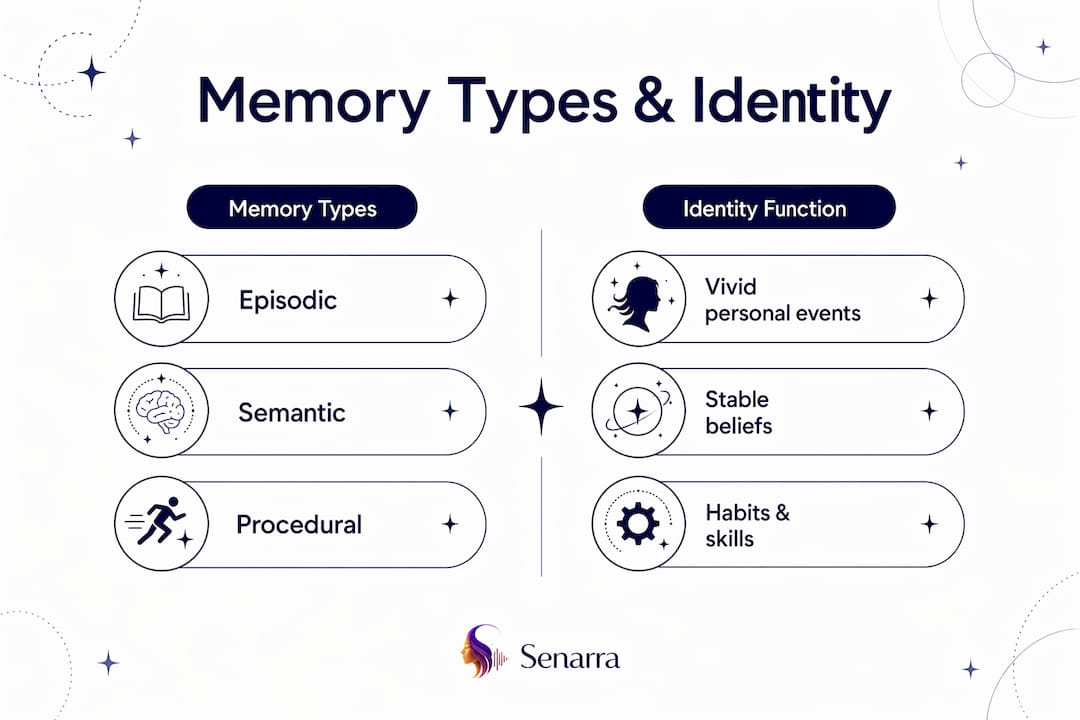
Episodic memory stores specific lived events: your first day at a new job, a conversation with your grandmother, the smell of a childhood home. These are the raw materials of your personal story. Semantic memory holds general knowledge about yourself, including your values, beliefs, and personality traits, without tying them to a specific moment. Autobiographical memory is the fusion of both. It is the ongoing narrative you construct about your life, drawing on vivid episodes and stable self-knowledge alike.

The interaction between these two types is where identity gets built and maintained. Research from The Conversation shows that episodic memory declines with age, but semantic memory remains relatively stable. That stability is what keeps your core identity intact even as specific memories fade.
A process called semanticisation explains how this works in practice. Over time, vivid episodic memories condense into broader beliefs and values. The specific details of a childhood argument may blur, but the lesson it taught you about fairness becomes a permanent part of your character. Memory is not a passive archive. It is an active, selective process that curates which experiences become part of your future self.
-
Episodic memory: specific events, places, and people tied to time
-
Semantic memory: stable self-knowledge, values, and beliefs independent of time
-
Autobiographical memory: the personal narrative that weaves both together
-
Semanticisation: the conversion of episodes into lasting identity traits
Pro Tip: Keep a brief weekly journal. Writing down specific events while they are fresh gives your semantic memory more material to work with when building your long-term self-narrative.
What neuropsychological research reveals about memory and self-concept
The science of how memory shapes identity is advancing fast, and the findings challenge some common assumptions about aging and cognitive decline.
The University of Arizona 2026 study compared adults aged 60–90 with adults aged 18–35 and found that older adults showed significantly higher stability of self-representation. That finding means aging, when not complicated by disease, does not erode identity. It often deepens it.
Dementia tells a different story. Disruption of autobiographical memory in dementia leads to identity fragmentation that goes beyond simple forgetfulness. The breakdown severs the narrative link between preverbal and verbal autobiographical memory, leaving a person unable to construct a coherent sense of self. This is why dementia care increasingly focuses on memory reconstruction, not just memory retention.
“Memory loss in dementia challenges identity not just by forgetfulness but by breaking the narrative link between preverbal and verbal autobiographical memory.” — Psychiatric Times, 2026
Legal discourse is catching up to the neuroscience. Psychological continuity is now recognized as a core neuroright in 2026 ethical and legal frameworks. That recognition means protecting your memory from unauthorized modification or loss is increasingly treated as a fundamental human right, not just a medical concern.
| Memory type | Stability with age | Identity function |
|---|---|---|
| Episodic | Declines | Provides vivid personal events |
| Semantic | Remains stable | Anchors core values and beliefs |
| Autobiographical | Partially stable | Maintains narrative coherence |
Memory is also reconstructive, not photographic. Every time you recall an event, you slightly rewrite it. That fallibility is not a flaw. It is the mechanism by which memory adapts your identity to new experiences and contexts.
What philosophy says about memory and personal identity
Philosophers have debated memory and personal identity for centuries, and their arguments remain directly relevant to how you think about preserving your own story.
John Locke laid the groundwork in the 17th century. His consciousness-based memory theory argues that personal identity is sustained by consciousness extending over past thoughts and memories. For Locke, what makes you the same person you were ten years ago is not your body or your soul. It is your ability to remember being that person. Personhood, in his view, is a psychological thread, not a physical one.
Philosophers who followed Locke pushed back on this framework in productive ways:
-
David Hume argued that identity is not located in memory alone but in the broader relational context of perceptions, emotions, and social bonds. Memory is one strand in a larger web, not the whole fabric.
-
Thomas Reid challenged Locke directly by pointing out that you can be the same person as your younger self even if you cannot remember being that child. Memory gaps do not erase identity.
-
Derek Parfit introduced the concept of quasi-memory, suggesting that what matters for identity is psychological continuity in general, not the specific accuracy of any single memory.
These debates have a practical implication. Locke’s psychological continuity framework is powerful, but it needs to be complemented by relational and social memory to fully explain how identity works. You are not just the sum of your private recollections. You are also the person others remember you to be.
The philosophical tradition, taken together, points to a hybrid model of identity preservation. Memory is necessary but not sufficient. It works best when embedded in relationships, shared stories, and social context. That insight has direct consequences for how you choose to preserve your own legacy.
What practical methods help preserve memory and identity today
Identity preservation through memory is no longer limited to photo albums and handwritten letters. The methods available in 2026 range from time-tested cognitive practices to AI-assisted tools that extend human memory in genuinely new ways.
Environmental and cognitive tools
Journals, photographs, digital recordings, and social interactions function as cognitive artifacts, external extensions of the self that compensate for the biological limits of human memory. These tools do not just store information. They actively shape which memories get reinforced and which fade. Choosing what to record is itself an act of identity construction.
Reminiscence therapy, used widely in dementia care, demonstrates the power of structured memory work. Immigrants who reconstructed identity early in life show particular resilience in dementia through reminiscence therapy that recalls past self-rebuilding experiences. The act of narrating your own story, even partially, reinforces the neural pathways that sustain identity.
AI-assisted memory tools
AI-curated memory systems can emphasize certain traits and stories over others, which means they carry real influence over how identity is shaped and preserved. March 2026 research distinguishes between AI-curated memory, where an algorithm selects what to surface, and human-AI co-memory, where the person remains in control of the narrative with AI acting as a support. The second model is more authentic and more protective of identity.
AI tools work best as what researchers call “junior partners” in memory. They provide adaptive, interactive functions that extend human cognitive limits while requiring social anchoring to remain meaningful.
| Method | Best use case | Identity impact |
|---|---|---|
| Journaling | Daily reflection and event capture | Strengthens episodic and semantic memory |
| Photo and video archives | Visual anchoring of key life moments | Reinforces autobiographical narrative |
| Reminiscence therapy | Dementia care and elder identity support | Reconstructs narrative coherence |
| AI co-memory tools | Legacy creation and long-term preservation | Extends memory beyond biological limits |
| Oral history recording | Capturing voice, tone, and relational context | Preserves full identity, not just facts |
Pro Tip: When recording memories for legacy purposes, capture the context and emotion around an event, not just the facts. “We drove to the lake every August” carries less identity than “My father always sang off-key on that drive, and we all pretended not to notice.”
Key takeaways
Memory is the primary mechanism by which personal identity achieves continuity across time, and protecting it requires both internal practices and external tools.
| Point | Details |
|---|---|
| Semantic memory anchors identity | Stable values and beliefs persist even as episodic memories fade with age. |
| Aging can strengthen self-concept | University of Arizona 2026 research shows older adults have higher self-representation stability than younger adults. |
| Philosophical frameworks matter | Locke, Hume, and Reid together suggest identity needs both memory and relational context to hold. |
| AI tools require human oversight | Human-AI co-memory preserves authentic identity better than algorithm-curated memory alone. |
| Active curation shapes legacy | Semanticisation means the memories you choose to record and revisit become the values you carry forward. |
Memory, identity, and what we owe the future
I have spent years reading research on memory and identity, and the finding that surprises people most is this: memory does not just record your past. It actively constructs your future self. Every time you revisit a memory, you are making a small editorial decision about who you are.
What the science and philosophy together suggest is that identity preservation is not a passive act. You do not preserve your identity by simply living. You preserve it by narrating, recording, and sharing. The people who age with the strongest sense of self are not the ones with the best recall. They are the ones who have told their stories out loud, to others, repeatedly.
I am also cautious about AI in this space, not because the technology is untrustworthy, but because the temptation is to outsource the work entirely. The research is clear that social anchoring is what makes memory preservation authentic. An AI tool that captures your voice and stories is only as meaningful as the human relationships it connects to.
The most important thing you can do for your own legacy is start now. Not when you are older, not when something prompts you. The memories you record today, with their specific details and emotional texture, are the ones that will define how you are known and remembered.
— Bryan
Preserve your story with Senarra
If this article has prompted you to think seriously about your own legacy, Senarra offers a concrete place to start.

Senarra is an AI companion built specifically for memory and identity preservation. It captures your voice, your stories, and the texture of your relationships in a format that can be revisited and shared across generations. Unlike generic memorial apps, Senarra uses voice cloning and a dedicated memory line to keep your narrative alive in your own words. The platform is built on a clear ethical framework that prioritizes psychological continuity and neurorights, so your identity is protected, not just archived. Whether you are documenting your own story or preserving the voice of someone you love, Senarra gives that work a permanent home.
FAQ
What is the role of memory in identity preservation?
Memory is the mechanism that creates psychological continuity across time, linking your past experiences to your present self. Without memory, identity fragments into disconnected moments with no coherent narrative thread.
How does memory loss affect personal identity?
Memory loss, particularly in dementia, disrupts the autobiographical narrative that holds identity together. Research from Psychiatric Times shows this goes beyond forgetting facts. It severs the link between preverbal and verbal self-narrative.
Does aging weaken memory’s role in self-concept?
No. A University of Arizona 2026 study found that adults aged 60–90 show greater self-representation stability than adults aged 18–35. Semantic memory, which anchors core values and beliefs, remains relatively stable throughout life.
How can AI tools support identity preservation through memory?
AI tools function best as co-memory partners rather than autonomous curators. March 2026 research distinguishes human-AI co-memory, where the person guides the narrative, from AI-curated memory, where an algorithm decides what to surface. The first model better protects authentic identity.
What did Locke say about memory and personal identity?
John Locke argued that personal identity is sustained by consciousness extending over past memories, meaning you are the same person as your younger self because you remember being that person. Later philosophers including Hume and Reid expanded this to include relational and social context as equally necessary.