
Voice cloning platforms can genuinely deepen emotional connection when they combine authentic vocal timbre with memory-rich context, and research confirms that integrating a person's real voice features with personal anecdotes produces responses that feel meaningfully resonant rather than hollow. The short version:
- Yes, voice cloning can strengthen emotional bonds — but only when the platform preserves prosody, rhythm, and semantic history together, not just the sound of a voice.
- Consent and data control are non-negotiable. A documented opt-in from the voice owner (or their estate) and clear deletion rights protect everyone involved.
- Your next step: evaluate any platform against emotional fidelity, privacy safeguards, and stable output before you commit to preserving someone's voice.
Table of Contents
- How do voice cloning platforms create emotional connection?
- Which technical features make a cloned voice feel emotionally truthful?
- How do you evaluate a voice cloning platform for memory preservation?
- How to capture emotionally rich source recordings
- What should you expect emotionally when you use a cloned voice?
- Key Takeaways
- Why a privacy-first approach is the only responsible one
- Senarra preserves voices the way families actually need
- Further reading and primary sources
How do voice cloning platforms create emotional connection?
The mechanism is not magic. When you hear a loved one's voice, your brain responds to timbre (the unique tonal quality), rhythm, and the specific phrases they used. A clone that captures only the surface sound misses the deeper layer: the way your grandmother paused before a punchline, or how your father's voice softened when he told a story from childhood.
Emotional voice synthesis research shows that AI voice models produce far more emotionally resonant output when they draw on both authentic voice features and semantic history — real anecdotes, family stories, and contextual memories. The voice alone is not enough. The memories it carries are what make it feel alive.
Prosody (the rise and fall of pitch, stress, and pacing) is the single most powerful emotional carrier in speech. A flat clone sounds wrong even when the timbre is perfect. Pair that with continuous affect conditioning, where a system adjusts emotional tone along a valence-arousal scale rather than snapping between discrete labels like "happy" or "sad," and the output starts to feel genuinely human.
Practical use cases where this matters most: legacy messages recorded before a terminal diagnosis, interactive memory lines a family can call to hear a grandparent's stories, and pet persona audio that captures a companion's playful energy for children coping with loss.
Which technical features make a cloned voice feel emotionally truthful?
Not all voice cloning tools are built the same. The features below are the ones that actually move the needle on emotional fidelity.
- High-fidelity audio output (48kHz). Lower sample rates flatten the subtle harmonics that make a voice recognizable. Models like VoxCPM2 output at 48kHz, preserving the acoustic detail that triggers recognition.
FeelWave research demonstrates that emotion-aware voice systems achieve 92.3% emotion recognition accuracy and a 74.3% user preference rate over standard baselines, showing that users genuinely notice and prefer systems that handle emotion well. The gap between a technically adequate clone and an emotionally resonant one is real, and these features are where it lives.
How do you evaluate a voice cloning platform for memory preservation?
Prefer platforms that combine emotional controls, strong consent workflows, and transparent security practices. A platform that excels at voice quality but offers no deletion rights is not a safe choice for something as personal as a family member's voice.
Questions worth asking any vendor:
- Who can generate new audio from the cloned voice, and how is that access controlled?
- Is synthetic audio labeled as AI-generated in all outputs?
- Can I export the voice model and all associated data?
- What is your data retention policy after account cancellation?
- Do you use human moderation to review outputs?
Coqui TTS documentation offers a useful technical reference for understanding cloning workflows and what "controllable cloning" actually means in practice — helpful context when a vendor makes capability claims you want to verify.
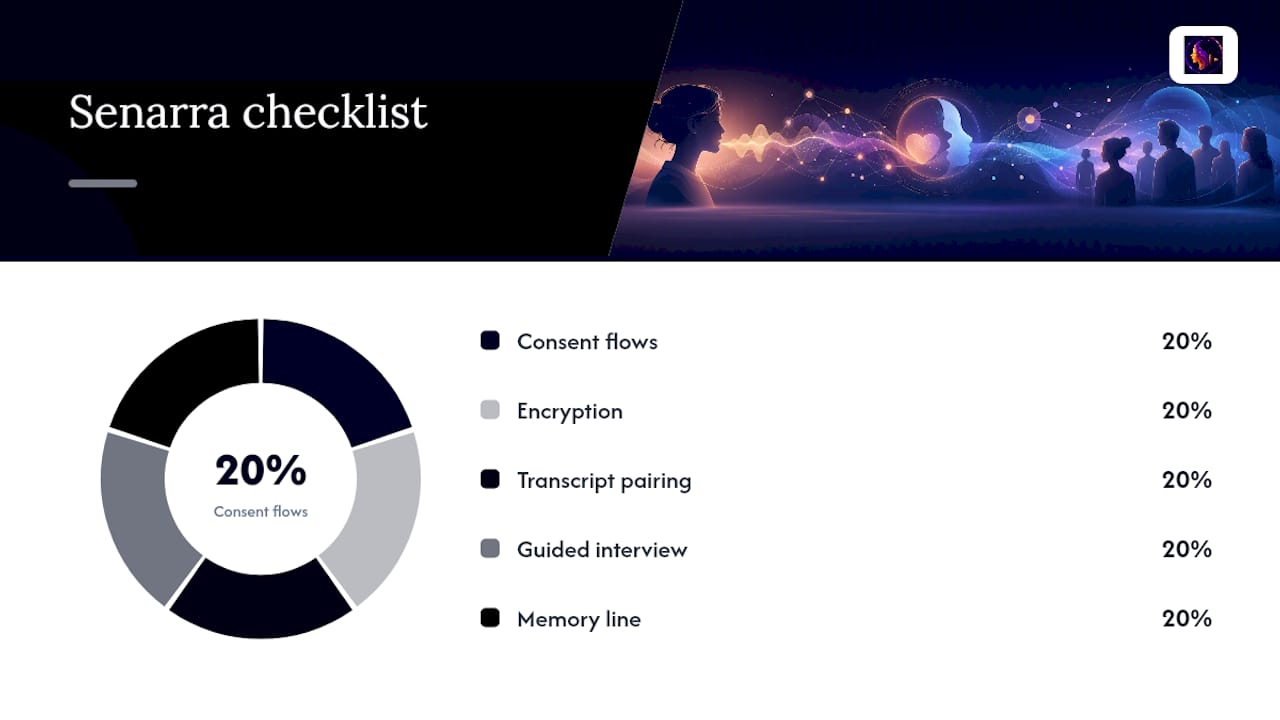
Senarra addresses the full checklist: consent flows, encryption, transcript pairing, guided interview capture, and a memory line families can access by phone. For U.S. families prioritizing both emotional fidelity and privacy, it is the publisher's recommended starting point.
How to capture emotionally rich source recordings
Varied, memory-rich recordings consistently outperform a single scripted clip for emotional authenticity. A model trained on one flat reading session will sound flat.
- Emotional voice synthesis research (arXiv 2504.12867v1)
- EmoCtrl‑TTS (Microsoft Research project)
- FeelWave: Enabling Emotion-Aware Voice Interaction through Noise-Robust mmWave Emotion Sensing
- OpenBMB / VoxCPM (GitHub)
- Coqui TTS documentation
- SYMPATHEIA: Emotionally Adaptive Voice Assistant (arXiv 2606.00851)
For older or distressed participants, this family guide covers pacing, breaks, and emotional safety in detail. Move at their pace, not yours.
What should you expect emotionally when you use a cloned voice?
Results vary. Many people find genuine comfort in hearing a familiar voice again. Some feel unsettled. Plan for both.
A common emotional arc: initial comfort and relief, followed by a wave of bittersweetness as the gap between the clone and the real person becomes apparent, then gradual normalization. For some, that normalization tips into dependency — reaching for the voice app instead of processing grief through other means.
Healthy practices:
- Keep grief support resources nearby. The American Psychological Association's grief resources are a starting point; a licensed counselor is a better one.
Audio memories carry emotional weight that photos often cannot match, which is precisely why the emotional impact of a cloned voice can be stronger than families anticipate.
Key Takeaways
Voice cloning platforms create genuine emotional connection only when they combine authentic timbre, memory-rich context, and strong privacy safeguards — the technical quality and the ethical framework both matter.
| Point | Details |
|---|---|
| Timbre plus memory context | Emotional connection requires both authentic voice features and personal anecdotes, not sound alone. |
| Consent is foundational | Document written opt-in from the voice owner and verify your state's recording consent law before capturing audio. |
| Technical quality markers | Look for 48kHz output, prosody control, controllable emotional conditioning, and stable reproducible results. |
| Recording best practices | Use varied, memory-rich sessions with guided prompts and transcript pairing for the most emotionally faithful clone. |
| Senarra as a starting point | Senarra combines voice cloning, guided interviews, consent flows, encryption, and family sharing in one privacy-first app. |
Why a privacy-first approach is the only responsible one
The conventional wisdom in this space tends to focus on the emotional upside of voice cloning and gloss over the governance side. That framing gets it backwards. The emotional upside is real, but it is entirely contingent on getting the consent, access control, and data security right first. A cloned voice stored insecurely, or generated without the person's documented agreement, is not a memorial. It is a liability.
What the research actually shows is that emotional authenticity in cloned voices comes from explicit conditioning and memory-rich prompts, not from the model spontaneously "feeling" something. Families who understand this go in with realistic expectations and get better outcomes. Those who expect the AI to intuitively know their loved one are setting themselves up for disappointment.
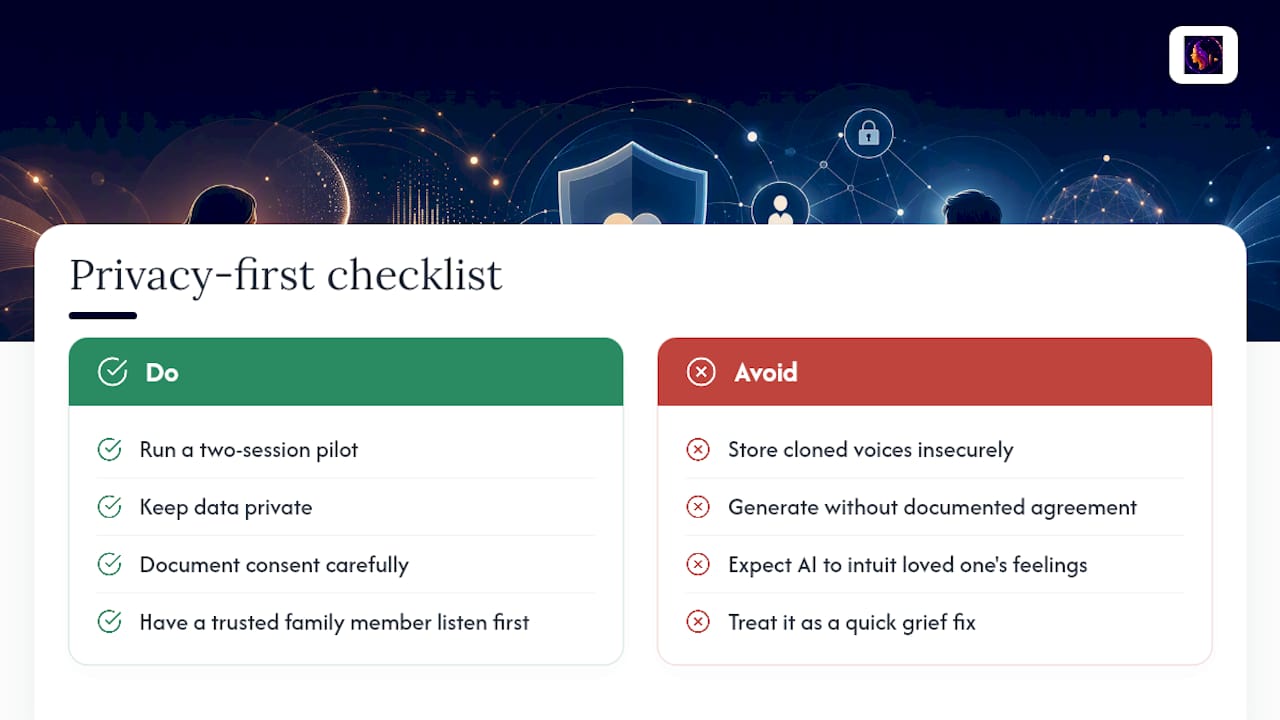
The practical suggestion: start with a two-session pilot. Keep the data private, document consent carefully, and have one trusted family member listen before anyone else does. Digital storytelling done well is a long-term archive, not a quick fix for grief. Build it slowly and build it right.
Senarra preserves voices the way families actually need
Senarra is the memory preservation app built specifically for this use case: voice cloning paired with secure storage, guided interview capture, family sharing with access controls, and export and deletion rights that put you in charge of the data.
Every feature maps directly to the evaluation checklist above. Consent flows are built into the onboarding. Audio is encrypted in transit and at rest. The memory line lets family members call in and hear recorded stories in the voice they recognize. Guided interview prompts handle the hardest part: knowing what to ask.
Start with a 14-day free trial on Senarra and capture the first session before you commit to anything. Disclosure: this article is published by Senarra.
Further reading and primary sources
- Emotional voice synthesis research (arXiv 2504.12867v1) — Academic work on combining voice authenticity with semantic history to improve emotional resonance in AI voice systems.
- EmoCtrl-TTS (Microsoft Research) — Microsoft's research on emotional control, guardrails, and stability in text-to-speech systems; the primary reference for mitigation strategies and consent ethics.
- FeelWave: Emotion-Aware Voice Interaction (CHI 2026) — Demonstrates noise-robust emotion sensing and its impact on user satisfaction and empathy in voice agents.
- OpenBMB / VoxCPM (GitHub) — Technical reference for controllable voice cloning, voice design, and high-fidelity 48kHz output.
- Coqui TTS documentation — Practical implementation guide for voice cloning workflows, multi-speaker TTS, and developer APIs.
- SYMPATHEIA: Emotionally Adaptive Voice Assistant (arXiv 2606.00851) — Research on continuous affect conditioning (valence-arousal control) as a method for producing more emotionally aligned spoken dialogue.