
Start today: record a five-minute audio clip of your loved one telling a favorite story, document their explicit consent on camera, and store both in a lossless file format. That single session, paired with a written consent record and a named family steward, is the foundation of a voice-and-values archive that can last generations. Here is what the full process looks like:
- Record first. Capture at least one short monologue or guided Q&A session before anything else.
- Consent in writing and on camera. Document who authorized what, for which audiences, and for how long.
- Encode values as metadata. Tag recordings with the person's beliefs, signature phrases, and topics they would not want extrapolated.
- Assign a steward. Name one family member responsible for access, review, and succession.
- Choose a provider with encryption, deletion rights, and clear AI labeling.
Key Takeaways
Preserving a loved one's voice and personal values in a durable digital format requires explicit consent, structured recordings, value-encoding design controls, and a named family steward before the archive goes live.
| Point | Details |
|---|---|
| Consent comes first | Record explicit authorization on camera and in writing before any voice cloning begins. |
| Recording variety matters | Capture monologues, Q&A, everyday phrases, and emotional stories for a reliable voice model. |
| Design controls preserve values | Require topic whitelists, first-person restrictions, and persistent AI labeling from any provider. |
| Stewardship is ongoing | Assign a primary steward, schedule annual reviews, and document succession before go-live. |
| Senarra implements the full framework | Guided interviews, consent capture, encryption, and per-family access controls are built into the platform. |
Table of Contents
- Why do families preserve voice, stories, and personal values?
- What ethical and legal guardrails should families follow?
- What should you actually record, and how?
- How do you keep an AI replica aligned with a person's values?
- How do you vet a provider for security and privacy?
- Who manages the archive long-term?
- How long does this take, and what does it cost?
- How does Senarra implement these principles?
- Why the ethics matter more than the technology
- Senarra makes this process concrete and private
- Sources
Why do families preserve voice, stories, and personal values?
A grandparent's voice reading a bedtime story carries something a photograph cannot: cadence, warmth, the specific pause before a punchline. Families preserve audio memories for reasons that range from grief support to genealogical research to caregiving. A parent with early-stage dementia can record life stories while recall is still sharp. A military family separated by deployment can share a voice archive with young children. Genealogists can attach spoken context to census records that would otherwise stay flat on a page.
The limits matter as much as the benefits. AI voice cloning can reproduce cadence, vocabulary, and emotional tone with striking accuracy, but it cannot restore a person's judgment, update their opinions, or guarantee that every generated response reflects what they would actually say. Treat the archive as a faithful record, not a living mind.
What ethical and legal guardrails should families follow?
Research published in Ethics and Information Technology recommends a Minimally Viable Permissibility Principle (MVPP) for AI-mediated afterlife tools, built on four pillars: authentic presence, consent, transparency, and harm-risk mitigation. Applied to family archives, that framework translates into a concrete checklist:
- Explicit recorded consent. The subject states on camera or in a signed document that they authorize voice cloning, the intended audience (immediate family only, extended family, public), and the duration of use.
- Scope of use defined. Specify which topics the replica may address and which it must decline or flag as extrapolated.
- Audience controls documented. Children's access should be separate from adult access; public sharing requires a higher consent threshold.
- Harm-risk review. Identify topics (medical advice, financial decisions, contested family history) where a generated response could cause real harm and restrict them explicitly.
- Transparency labeling. Every AI-generated interaction must carry a visible signal that it is not a live person.
On the legal side, U.S. right-of-publicity laws vary by state. California, New York, and Tennessee have statutes that extend personality rights post-mortem, which affects who can authorize a voice replica and for how long. For anything beyond immediate family use, consult an attorney familiar with digital estate planning before publishing or commercializing the archive.
Pro Tip: Record the consent session on the same device you use for the voice archive. Keeping consent and content in one folder eliminates the most common documentation gap families discover years later.
What should you actually record, and how?
A reliable voice replica needs variety, not just volume. Aim for these session types when building a voice-based life archive:
Short monologues (5–10 minutes each). Ask the person to describe a childhood memory, a career turning point, or a personal belief. These give the model natural sentence rhythm and vocabulary range.
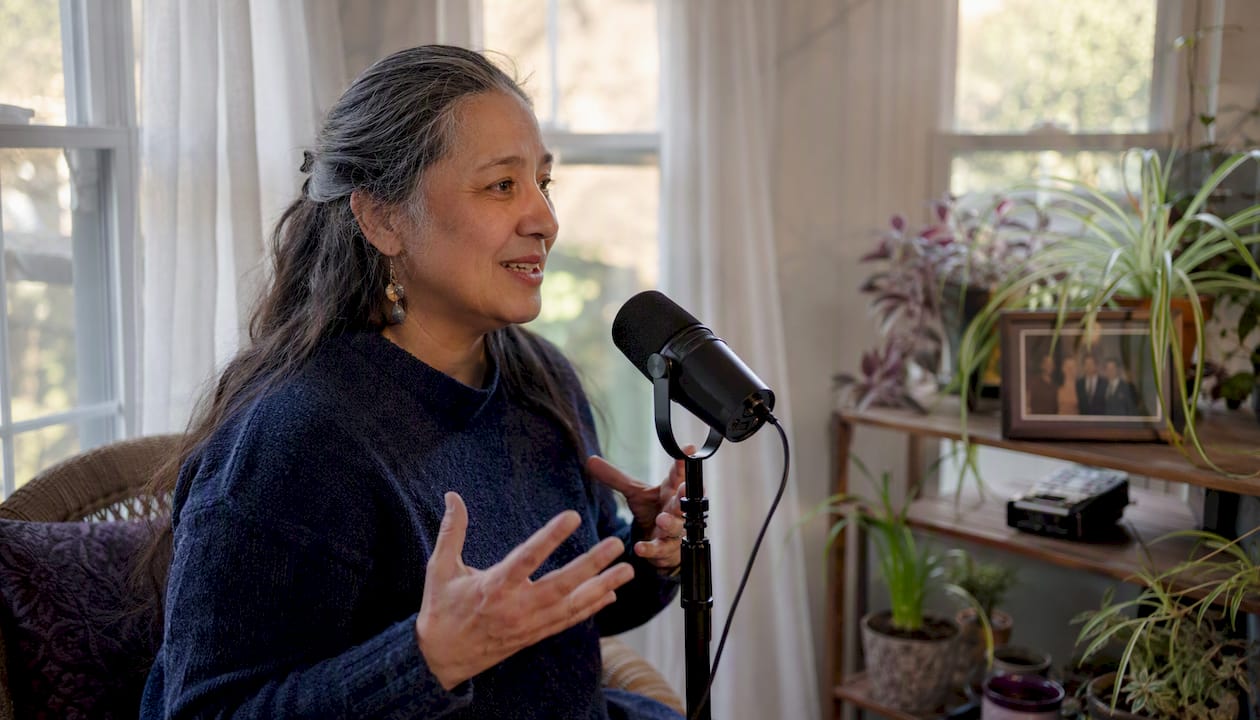
Guided Q&A. A family member asks open questions; the subject answers conversationally. This captures interruptions, laughter, and the informal register that monologues sometimes miss.
Everyday phrases and signature expressions. "That's the way it goes," "Don't borrow trouble," or a specific greeting. These anchor the replica's personality.
Emotional memory. A story about loss, pride, or a defining moment. Emotional range improves tonal fidelity.
For technical specs: record in a quiet room, use a cardioid USB microphone (the Blue Yeti or Audio-Technica AT2020 are widely available and produce clean results), and target a 44.1 kHz sample rate at 24-bit depth. Save masters as WAV or FLAC. Export MP3 only for sharing. Transcripts should be saved as plain-text or SRT files alongside each audio file, with timestamped notes identifying the speaker, date, location, and relationship context.
Sample prompts to read aloud during a session: "Tell me about the house you grew up in." / "What do you wish you had known at 25?" / "What's a rule you've always lived by?"
How do you keep an AI replica aligned with a person's values?
The design controls a family requires from any provider determine whether the replica preserves the person or gradually drifts from them. Research on digital duplicates recommends distinguishing responses drawn directly from recorded source material from those generated by extrapolation, and using prefatory disclaimers or third-person phrasing when the system must go beyond what was actually said.
Practical controls to require:
- Topic whitelist and blacklist. Define which subjects the replica may address (family stories, stated beliefs, favorite recipes) and which it must decline (medical advice, legal opinions, contested relationships).
- First-person restrictions. For extrapolated content, require the system to use a framing like "Based on what [Name] recorded, they might say..." rather than a direct first-person statement.
- Ethical tags. Flag sensitive topics so the system surfaces a disclaimer rather than generating a response.
- Audience-level access. Children's sessions can be limited to stories and values; adult family members may access a fuller archive.
Pro Tip: Disable any feature that allows the replica to send unsupervised outbound messages, such as automated birthday texts or unprompted check-ins. Outbound autonomy is where misattribution risk spikes fastest.
High-fidelity replication paired with persistent disclosure — visible UX labels, in-conversation cues, and session-opening disclaimers — keeps users from mistaking generated output for living agency.
How do you vet a provider for security and privacy?
Digital archives scholarship treats AI-enhanced preservation as sustained stewardship, not a one-time upload. That framing changes what a family should demand from a provider.
Red flags: vague data-use clauses that allow model training on your family's recordings, no deletion option, model ownership that transfers to the provider, or broad reuse rights buried in terms of service.
Who manages the archive long-term?
Archival stewardship guidance is clear: AI-enhanced preservation requires ongoing management, not a set-and-forget approach. Assign roles before the archive goes live:
- Primary steward. Manages access credentials, approves new users, and conducts annual reviews.
- Co-steward. Backs up the primary steward and holds a copy of access documentation.
- Auditor. Reviews the archive annually for drift, unauthorized additions, or outdated consent.
- Beneficiary access rights. Documented in writing: who can listen, who can interact, who can export.
Store access credentials and succession instructions in a digital estate document alongside the will. Trigger a re-consent review whenever the subject's health status changes significantly, when a new platform version alters how the model behaves, or on a fixed annual schedule. A short policy covering archival deletion or repurposing should state: who can authorize deletion, what happens to the data after deletion, and whether any export copy is retained by the family.
How long does this take, and what does it cost?
A realistic project runs across four phases:
- Planning (1–2 weeks). Consent documentation, steward assignment, topic scope definition.
- Recording (2–4 weeks). Multiple sessions spread over time produce better variety than a single marathon day.
- Processing and governance setup (1–2 weeks). Provider onboarding, access controls, metadata tagging.
- Go-live and review (ongoing). First formal review at 90 days, then annually.
Pricing models vary. A subscription-based service typically offers a free trial period followed by monthly or annual tiers. DIY setups using consumer recording hardware and cloud storage cost less upfront but require more family time for transcription and organization. Guided interview services, where a facilitator runs sessions, add a per-session fee on top of any platform cost.
Pro Tip: Budget for re-consent events. If the subject's condition changes or a new family member needs access, a formal re-consent session protects everyone and keeps the archive legally clean.
How does Senarra implement these principles?
Senarra builds the recommended framework directly into its product rather than leaving families to assemble it from separate tools. Key features tied to the guidance above:
- Guided interview flows with structured prompts covering life stories, values, and everyday expressions.
- Explicit consent capture recorded within the app at onboarding and stored alongside the archive.
- Per-family access controls that separate children's access from adult access and restrict sharing by role.
- Encryption protecting recordings at rest and in transit.
- Clear AI labeling on every generated interaction so family members always know when they are engaging with a replica rather than a recording.
- Voice cloning and a memory line accessible by phone, so family members can connect with preserved memories without needing to open an app.
- Voicemail import and transcription, animated video memories, and pet personas round out the archive's multimodal depth.
Onboarding follows a collect-verify-import-tune-govern sequence: families record or import existing audio, verify consent documentation, tune the voice model, set access controls, and assign a steward before the archive goes live. Long-term stewardship and re-consent workflows are supported within the platform, reducing the administrative burden on families over time. For a deeper look at the memory archive process, Senarra's blog covers each phase in detail.
Why the ethics matter more than the technology
The families who get this right are not the ones with the best microphones. They are the ones who had the consent conversation before it felt urgent, named a steward before anyone needed to make a hard call, and chose a provider that treats the archive as a responsibility rather than a data asset. The technology is genuinely good now. The governance is where most families underinvest.
Senarra makes this process concrete and private
Most families know they want to preserve a loved one's voice. What stops them is not motivation — it's not knowing where to start or whether the platform they choose will handle the data responsibly.
Senarra addresses both. The app guides families through recording, consent capture, and access setup in a structured onboarding flow, with encryption protecting every file and clear AI labels on every generated response. There is no guesswork about who can access the archive or what the provider does with the data. Start with a 14-day free trial and record your first session this week at Senarra.
Sources
These sources informed the ethical and technical guidance throughout this article. Each was selected for its direct relevance to consent, archival stewardship, or AI design constraints in personal and cultural heritage contexts.
- The making of digital ghosts: designing ethical AI afterlives | Ethics and Information Technology | Springer Nature Link
- Applying AI to digital archives: trust, collaboration and shared professional ethics | Digital Scholarship in the Humanities | Oxford Academic
- Digital Dybbuks and virtual Golems: the ethics of digital duplicates in Holocaust testimony | Memory, Mind & Media | Cambridge Core