
If you're looking for KindredMind.care alternatives, the short answer is: Senarra is the strongest in-category option for families who want voice cloning, phone-accessible memory lines, and pet-persona support in one app. Beyond Senarra, the practical shortlist breaks into three categories:
- AI memory companions with voice cloning (Senarra, YouEver.ai, Pontis.life): best for families preserving stories, building legacy archives, and wanting authentic voice replay
- Phone-first companion AI services (JoyCalls AI, GrandPad): best for caregivers managing mild-to-moderate dementia who need simple, phone-based access with minimal tech friction
- Senior communication tablets (GrandPad): best for older adults who need a managed device, not just an app
All options listed here offer a free trial or free tier. Before uploading any voice recordings, check the privacy and consent section below — voice data deserves more scrutiny than a photo backup.
Table of Contents
- What are the best KindredMind.care alternatives in 2026?
- How do you pick the right memory companion for your family?
- What should you check for privacy, consent, and safety?
- Which approach fits your family's situation?
- How do you run a safe trial and migrate memories later?
- Does the service support pet personas?
- Do these platforms have user communities or social features?
- What languages and accents do these services support?
- How deep is the AI conversation, and how personalized does it get?
- Key Takeaways
- Why voice memory preservation deserves more scrutiny than most families give it
- Senarra gives your family a memory line that actually works
- Sources and further reading
What are the best KindredMind.care alternatives in 2026?
The table below maps the six services across the dimensions that actually change a recommendation. Voice realism, phone access, and clinical guidance are the three columns most likely to shift your choice.
| Service | Best for | Voice cloning | Access modes | Pet memory support | Dementia suitability | Privacy & consent controls | Data export / ownership | Pricing & free trial |
|---|---|---|---|---|---|---|---|---|
| Senarra | Full-family legacy: voice, video, pets | Yes — high realism | App + phone memory line | Yes (pet personas) | Moderate (guided interviews, family collaboration) | Consent capture, encrypted storage, export available | MP3, WAV, transcripts, photos, video | Tiered subscription; 14-day free trial |
| KindredMind.care | AI companionship and emotional support | Limited | App + web chat | Not listed publicly | Mild companionship; no clinical oversight listed | Not publicly detailed | Not publicly listed | Free tier; paid plans |
| YouEver.ai | Digital legacy and story capture | Yes | App + web | Not listed publicly | Mild; no clinical oversight listed | Basic consent flows | Export available | Free tier; paid plans |
| Pontis.life | Guided life-story interviews | No | App + web | Not listed publicly | Mild; interview-guided | Basic | Limited export | Subscription |
| GrandPad | Senior tablet with managed calls | No | Dedicated tablet + phone | No | Moderate; simplified UI, family oversight | Managed device controls | Limited | Device + subscription |
| JoyCalls AI | Phone-based AI companion calls | No | Phone only | No | Moderate; phone-first, low friction | Basic | Not publicly listed | Subscription; trial available |
Voice realism separates Senarra and YouEver.ai from the rest. If hearing a loved one's actual voice matters to your family, those two are the only options on this list with genuine voice-cloning capability. Phone access narrows the field further: Senarra and JoyCalls AI both offer a phone memory line, which is critical for older adults who won't use a smartphone app. Clinical guidance is largely absent across all consumer-grade services here — GrandPad comes closest through its managed-device model, but none of these are HIPAA-covered entities. Feature clusters like voice cloning, call summaries, and multilingual support are cataloged by aggregators but verified features should always be confirmed directly with each vendor.
How do you pick the right memory companion for your family?
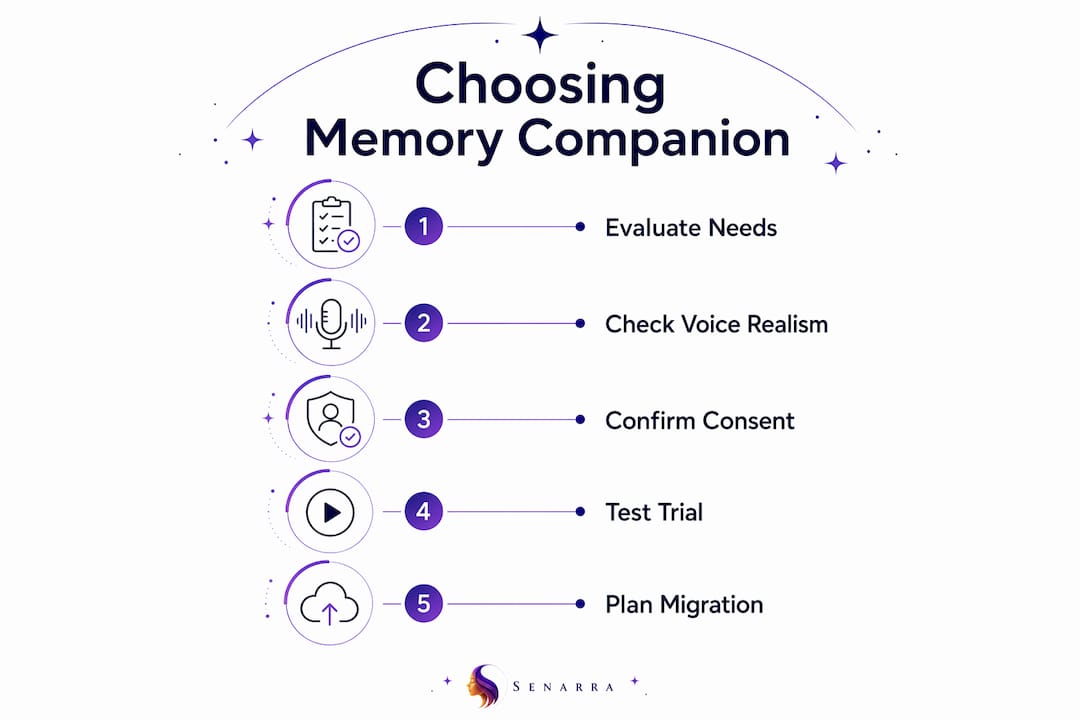
Start with these six criteria, roughly in priority order:
- Voice realism and training data — how many minutes of audio does the service need, and how natural does the output sound?
- Access modes — does the person you're preserving memories for use a phone, tablet, or smartphone app?
- Dementia suitability and clinical input — is there any human oversight, or is it purely AI-driven?
- Privacy, consent, and export policy — can you delete voice data, and can you take it with you?
- Pricing model and trial length — is there a genuine free trial, or just a limited free tier?
- Customer support and migration help — will someone assist if you need to move data later?
Questions worth asking during any demo or trial:
- Can voice data be permanently deleted on request?
- Is a phone memory line available, or is app access required?
- What audio format does the voice clone use, and can I export it?
- Does the service have any clinical advisory board or dementia-care guidance?
- What happens to my data if the company shuts down?
Red flags: no data export option, vague or buried consent flows, no human escalation path for distressed users, and pricing that locks you in before you've tested voice quality. Digital platforms make switching easier than traditional in-person services, so any vendor that discourages a trial period deserves skepticism.
Pro Tip: Test voice realism with three scripted prompts using 60–90 seconds of family-sourced audio before committing. Ask the AI to repeat a phrase the person said often — something with a distinctive cadence. If it sounds flat or robotic on a familiar phrase, it will sound worse on longer conversations.
What should you check for privacy, consent, and safety?
Voice data is more sensitive than most families realize. A recording of someone's voice can be cloned, impersonated, or misused if it ends up in the wrong hands. Before uploading anything, run through this checklist:
- Consent capture: Is consent recorded, timestamped, and revocable? Can the person (or their legal guardian) withdraw it later?
- Data ownership: Does the service explicitly state you own the recordings, not them?
- Encryption: Is data encrypted in transit (TLS) and at rest (AES-256 or equivalent)?
- Retention policy: How long does the service keep data after you cancel? Is automatic deletion available?
- Emergency detection: Does the AI flag distress signals, and is there a human escalation path?
- Export format: Can you download original audio files, not just a proprietary backup?
When the person being recorded has cognitive impairment, document family authorization in writing before any recordings begin. A signed note naming the family member authorizing the session, dated and witnessed, is a reasonable minimum. For clinical support alongside memory tools, FindTreatment.gov is the U.S. federal resource for locating covered mental health services. One regulatory note: HIPAA applies to covered entities such as hospitals and insurers. Consumer memory apps, including every service on this list, are not covered entities — verify data practices directly with each vendor rather than assuming HIPAA protections apply. For deeper guidance on recording during cognitive decline, the family guide on dementia memory preservation covers consent workflows in detail.
Which approach fits your family's situation?
Not every service fits every use case. Here's how the categories map to real family needs:
- Active dementia support: Phone-first services (JoyCalls AI, GrandPad) reduce friction for people who won't navigate an app. Senarra's phone memory line also works here, with the added benefit of voice cloning for family members who want to hear a familiar voice. See how to record stories during cognitive decline for step-by-step guidance.
- Long-term legacy archives: Senarra and YouEver.ai both support multimedia import and export, which matters if you want an archive that outlasts any single platform. Exportability is non-negotiable for legacy use.
- Grief and remembrance: Scheduled messages and animated memory videos (Senarra) serve families who want to revisit a loved one's voice on anniversaries or milestones, not just in the immediate aftermath of loss.
- Pet personas: Research on senior pet companionship documents real mental-health benefits for older adults. Senarra is the only service on this list with explicit pet-persona support, making it the clear choice for families preserving a pet's personality alongside human memories.
For multi-member families, look for services that offer shared access with role-based permissions — so a grandchild can listen without being able to delete recordings.
How do you run a safe trial and migrate memories later?
- Sign up with a limited test profile — use a secondary email and upload nothing irreplaceable yet.
- Upload 2–5 short clips of family audio (60–90 seconds each) to test voice quality.
- Run three scripted prompts: a familiar phrase, a short story, and an emotional memory.
- Test both phone and app access with the actual person who will use it most.
- Request a test export — download the files and confirm the format opens correctly.
- Confirm the cancellation policy and billing cycle before the trial ends.
Before committing, verify these migration items:
- Export formats available (MP3, WAV, SRT, transcript)
- Whether metadata (timestamps, speaker labels) is preserved on export
- Family-sharing controls and permission levels
- Whether support assists with bulk export or import from another platform
Store original master audio files in a separate location — a local hard drive or encrypted cloud folder — independent of any subscription service. Caregiver digital archive best practices covers this in detail.
Does the service support pet personas?
Most services on this list do not. Senarra is the explicit exception, offering pet-persona capture alongside human memory preservation. This matters more than it might seem: pets are often central to an older adult's daily routine and emotional life, and pet companionship benefits for seniors are well-documented. Preserving a pet's personality — their sounds, habits, and the stories attached to them — follows the same logic as preserving a person's voice. If pet memory support is a requirement, Senarra is currently the only in-category option that addresses it directly.
Do these platforms have user communities or social features?
Most memory-companion apps are built around private family use, not public communities. Senarra supports family collaboration with shared access and secure sharing controls. GrandPad includes a family network for photos and messages. YouEver.ai and Pontis.life are primarily single-user or small-group tools. None of the services on this list offer a public community forum or social feed comparable to a mainstream social platform — which is appropriate given the sensitivity of the content.
What languages and accents do these services support?
Language support varies significantly. Senarra's voice cloning works with the audio provided, so accent fidelity depends on the quality and quantity of source recordings rather than a fixed language list. JoyCalls AI and GrandPad are primarily English-language services. YouEver.ai and Pontis.life list English as their primary language; multilingual support, where it exists, is noted in aggregator directories but should be confirmed directly. If preserving memories in a language other than English is a priority, ask each vendor specifically whether their voice model supports that language before uploading recordings.
How deep is the AI conversation, and how personalized does it get?
The gap between services is widest here. Senarra builds its AI responses from actual uploaded memories — conversations, voicemails, guided interviews, and multimedia — so the AI reflects the real person rather than a generic personality model. YouEver.ai takes a similar approach with story-capture inputs. KindredMind.care and JoyCalls AI lean toward companionship-style conversation: warm and consistent, but not grounded in the specific person's history. GrandPad does not offer AI conversation depth; it is a communication device, not a memory AI. The more source material you provide, the more personalized the output. A service trained on 10 minutes of audio will always feel thinner than one trained on 10 hours of guided interviews and voicemails.
Key Takeaways
Voice cloning, phone access, and data export are the three criteria that most reliably separate the right memory companion from the wrong one for your family.
| Point | Details |
|---|---|
| Voice cloning narrows the field | Only Senarra and YouEver.ai offer genuine voice cloning; all others provide companionship without authentic voice replay. |
| Phone access matters for older adults | Senarra and JoyCalls AI both offer phone-line access; app-only services exclude users who won't navigate a smartphone. |
| Export before you commit | Confirm MP3/WAV export and metadata preservation during the free trial — not after you've uploaded years of recordings. |
| Pet personas are rare | Senarra is the only service on this list with explicit pet-persona support, relevant for families preserving a pet's personality. |
| Senarra's free trial | Senarra offers a 14-day free trial with voice cloning, phone memory line, and multimedia import/export included. |
Why voice memory preservation deserves more scrutiny than most families give it
The category is young enough that most families approach it the way they'd approach a photo-sharing app: sign up, upload, explore. That instinct is understandable, but voice data is categorically different from photos. A voice recording can be cloned, and once it's on a server you don't control, you can't un-upload it.
The services that handle this well are the ones that treat consent and export as first-class features, not afterthoughts buried in a settings menu. The ones that handle it poorly tend to make deletion difficult and export formats proprietary. That asymmetry is the single most useful signal when evaluating any service in this category.
Senarra's approach — capturing memories during a person's lifetime, with explicit consent workflows and exportable archives — reflects how this should work. The phone memory line is a practical detail that most competitors miss: it means the person whose voice is being preserved can actually use the service, not just be the subject of it.
Senarra gives your family a memory line that actually works
Senarra is the memory preservation app built for families who want more than a digital scrapbook. Voice cloning captures a loved one's authentic sound. The phone memory line means grandparents can call in and hear familiar voices without touching a smartphone. Pet personas let you preserve the personality of a companion animal alongside the people who loved them.
The 14-day free trial includes voice cloning, multimedia import, family sharing, and export — enough time to run the scripted voice test, check the export format, and confirm the cancellation policy before you spend a dollar. Download the app or visit senarra.app to get started. If you have questions about bulk import or family collaboration setup, Senarra's support team can walk you through it.
Sources and further reading
| Source | What it covers |
|---|---|
| FindTreatment.gov | U.S. federal resource for mental health and substance use treatment; use for clinical referrals alongside memory tools |
| Senarra — Memory Preservation App | Official product page: voice cloning, phone memory line, trial, and pricing |
| KindredMind.care Alternatives — SaaSHub | Aggregator listing feature clusters for memory and companion tools |
| Top KindredMind Alternatives — TopAI.tools | Marketplace overview of free-plan availability and feature focus |
| Talkspace — Forbes Health review | Expert-backed context on digital mental health access and switching ease |
| Talkspace | Online therapy and psychiatry; relevant when clinical support is needed alongside memory tools |
| Heallist | Verified holistic-practitioner marketplace; useful when integrative or grief support is needed |
| Senior pet companionship — MyPetsSafetyNet | Research-backed context on pet companionship benefits for older adults |
For crisis or clinical support, FindTreatment.gov lists covered providers by location and payment type. If you're pairing a memory-preservation tool with ongoing counseling, verify insurance coverage directly with the therapy platform — Talkspace, for example, works with many major insurance plans for mental health treatment.
This article is general information, not professional legal, medical, or financial advice. Confirm current data practices with each vendor and consult a qualified professional for your specific situation.