
AI-driven memory preservation technology captures audio, text, photos, and video from a person's lifetime, then turns that material into a searchable, conversational archive that a family can revisit and interact with through a subscription app. The short verdict: if you want more than a photo album, and you want to hear a loved one's voice answer a question years from now, this is how that becomes possible.
Here is what a full-featured memory preservation platform can do:
- Record and transcribe voice conversations, voicemails, and guided interviews
- Organize text, photos, scanned letters, and short videos into a searchable index
- Enable AI-powered chat that draws only from real, stored memories
- Optionally clone a voice so replies play back in the person's own sound
- Share access with family members and set permissions per contributor
Table of Contents
- How memorial technology works: what you supply and why quality matters
- The processing pipeline: how raw files become searchable memories
- The conversation layer: how the AI stays grounded in real memories
- Typical setup timeline, maintenance, and what subscriptions cost
- Which memorial AI platforms lead the U.S. market right now?
- What memorial AI apps actually cost
- Accessibility and interface design for older users
- How app updates affect your stored memorial data
- Key Takeaways
- Why privacy-first design is the only design that earns trust
- Senarra brings these principles together in one place
- Useful sources
How memorial technology works: what you supply and why quality matters
The archive is only as good as what goes into it. Most apps accept voice recordings, imported voicemails, typed notes, scanned letters, photos, and short videos. Of those, voice recordings carry the most weight because they feed both the conversational index and any optional voice clone.
For transcription accuracy, clean audio matters more than length. A quiet room, a phone held close, and natural conversational speech produce far better results than a crowded family dinner recording. When you add context metadata — dates, full names, locations — the system can retrieve that memory precisely later instead of surfacing a vague match.
Consent is not optional. If a living person's voice or stories will be captured, document their permission in writing before you upload anything. Label sensitive items (health details, family conflicts) so access controls can be applied later.
Pro Tip: Ask your family member to record short stories in multiple settings: a quiet morning call, a walk outside, a holiday meal. Varied acoustic environments and topics produce a richer, more natural voice profile than a single long session.

For practical guidance on building a memory archive before a loss occurs, the preparation steps matter as much as the technology itself.
The processing pipeline: how raw files become searchable memories
Once files land in the app, a multi-step pipeline converts them into something the AI can actually use.
Transcription (ASR). Speech-to-text models convert audio into written text. Errors creep in around accents, proper names, and background noise. Word Error Rate (WER) measures transcription accuracy, indicating how often the transcript differs from what was actually said.
Chunking and indexing. Long recordings get split into smaller segments, each tagged with metadata (speaker, date, topic). This prevents the system from treating a two-hour interview as one undifferentiated block.
Embeddings and vector search. Each chunk is converted into a numerical representation (an embedding) that captures its meaning. When you ask a question, the system finds the chunks whose meaning is closest to your query, not just chunks that share exact words. This is why you can ask "What did Dad say about his first job?" and get a relevant answer even if he never used the phrase "first job."
Retrieval before generation. The system pulls the most relevant chunks before the language model writes a response. The model works from retrieved evidence, not from general knowledge. This retrieval-before-model grounding is the primary safeguard against invented answers, and it is a standard design pattern in privacy-first projects like Heirloom.
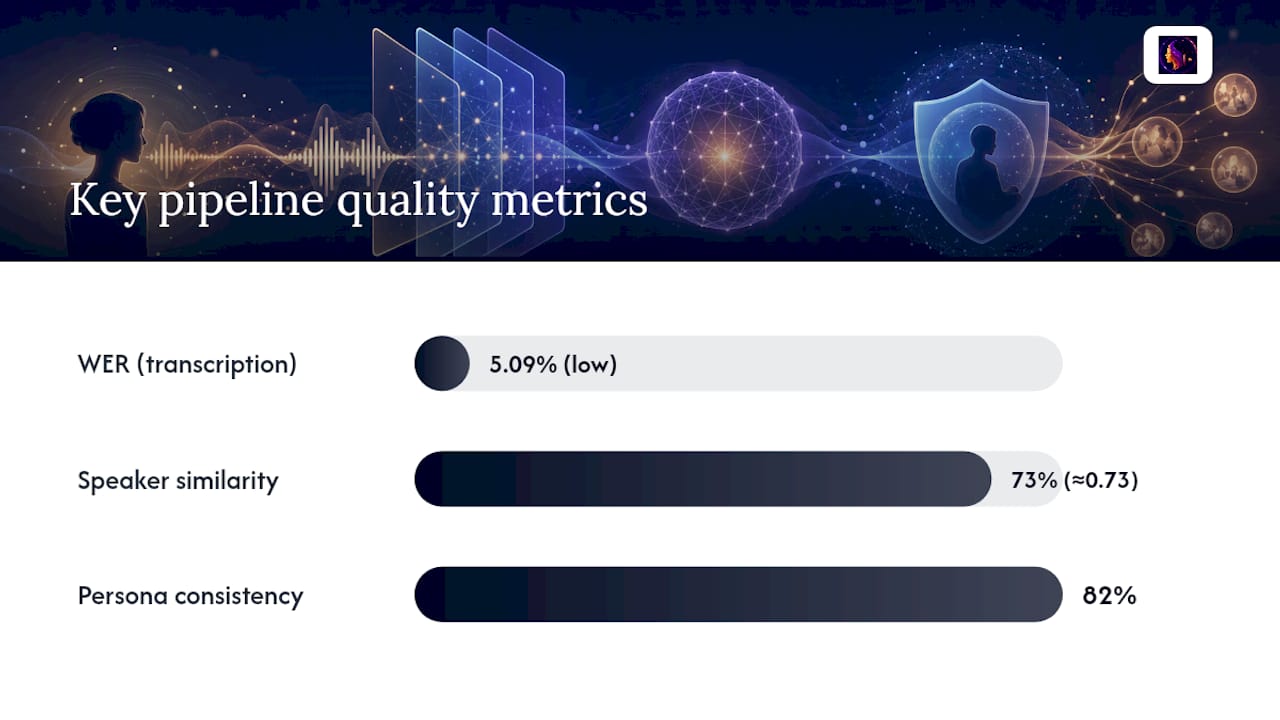
| Metric | What it measures | A good result |
|---|---|---|
| WER (Word Error Rate) | Transcription accuracy | Under 10%; JoyTTS research reports ~5.09% on clean data |
| Speaker Similarity (SS) | How closely a cloned voice matches the original | Around 0.73 on high-quality data (JoyTTS research) |
| Persona Consistency | Whether replies match the person's documented views | MemorialBot research reports 82% in user studies |
The conversation layer: how the AI stays grounded in real memories
The language model at the center of any memorial app is powerful but needs guardrails. Left unconstrained, it will fill gaps with plausible-sounding fiction. Well-designed apps prevent that through several interlocking checks.
Persona card. A structured prompt built from curated memories, documented preferences, and known facts about the person. It tells the model who it is representing and what it knows. The Memorial AI open-source project demonstrates how character cards combined with local embeddings constrain the model's behavior before a single word is generated.
Retrieval-augmented generation (RAG). Every query triggers a search of the archive first. The model only uses what the retrieval step surfaces. No retrieved evidence means no confident answer.
Grounding safeguards. A citation validator checks that each claim in a response traces back to a stored memory. A first-person scrubber prevents the model from asserting personal knowledge it cannot have. Fail-closed behavior means the system says "I don't have a memory of that" rather than inventing one.
When a memorial AI system is working correctly, it should feel like reading someone's journal out loud, not like a chatbot making educated guesses. The MemorialBot research framework describes ethical safeguards and reports user comfort scores indicating high satisfaction in structured studies, which suggests that grounded, consent-based design produces responses families actually trust.
Pro Tip: During setup, review the persona card the app generates. Add specific phrases, opinions, and habits your loved one was known for. The more precise the card, the less the model has to infer.
Typical setup timeline, maintenance, and what subscriptions cost
Initial setup (Week 1–2). Gather existing recordings, photos, and documents. Complete two or three guided interview sessions. Let the app index and chunk the material. Expect to spend 3–6 hours on the first pass.
Ongoing maintenance (Monthly). Add new recordings or notes, review any transcription errors flagged by the system, and run a periodic export check. A living archive grows; a static one goes stale.
Subscription models. Most memorial AI apps follow a free trial (typically 14 days) followed by tiered monthly or annual plans. Entry-level tiers usually cover basic capture and text-based chat. Higher tiers unlock voice cloning, phone-accessible memory lines, animated video memories, and expanded storage. Annual billing typically reduces the effective monthly cost compared to month-to-month pricing.
- Free trial: 14 days, core capture and chat features
- Mid-tier: voice playback, family sharing, guided interviews
- Top tier: voice cloning, phone memory line, animated memories, priority support
Pro Tip: Start the free trial with your highest-priority recordings, not a test file. You will learn more about the platform's transcription accuracy and retrieval quality from real material than from a placeholder.
Which memorial AI platforms lead the U.S. market right now?
The U.S. market for AI memory preservation has grown quickly, and platforms now differ meaningfully on architecture, privacy model, and feature depth rather than just price.
The clearest dividing line is local-first versus cloud-first storage. Local-first apps keep your data on your device and run models locally, which limits what third parties can access. Cloud-first apps offer stronger model quality, family sharing, and features like phone-accessible memory lines, but require trusting the vendor with sensitive recordings. Some platforms, including Senarra, offer tiered plans that let families choose their level of cloud involvement.
Feature differentiation at the top tier now includes voice cloning with opt-in consent workflows, animated video memories, guided interview prompts, voicemail import and transcription, and phone-based memory lines that let family members call in and hear a loved one's voice. These features sit behind higher subscription tiers on most platforms.
Senarra sits at the more full-featured end of this spectrum, combining voice cloning, AI-powered chat grounded in real memories, phone memory line access, pet personas, and family collaboration tools in a single subscription app available through the App Store.
What memorial AI apps actually cost
Pricing across the U.S. market follows a consistent pattern: a free trial period, then tiered monthly or annual subscriptions. Entry-level plans cover basic capture, text chat, and limited storage. Mid-tier plans add voice playback, family sharing, and guided interviews. Top-tier plans unlock voice cloning, phone memory lines, animated memories, and expanded storage.
Annual billing reduces the effective monthly cost on most platforms. Senarra offers a 14-day free trial through in-app purchase, with tiered plans that scale from core memory capture to the full voice cloning and phone memory line experience.
When comparing costs, factor in what sits behind each tier. A low headline price that locks voice cloning behind the most expensive plan may cost more in practice than a mid-tier plan on a platform that includes it earlier.
Accessibility and interface design for older users
The people most likely to be recorded are often the least comfortable with technology. A memorial app that a 78-year-old cannot use independently will not capture the stories it was designed to preserve.
Good accessibility design for older users includes large, high-contrast text, simple navigation with no more than two or three taps to reach core functions, and audio-first interfaces that do not require reading small labels. Voice-guided setup flows remove the barrier of typed input entirely.
Phone-based memory lines are particularly valuable here. A family member who is not comfortable with a smartphone can call a dedicated number and hear a loved one's voice without opening an app at all. Senarra's phone memory line feature is designed for exactly this scenario.
For families supporting a member with cognitive decline, the dementia memory preservation guide covers interface adaptations and caregiver-assisted capture workflows in detail.
How app updates affect your stored memorial data
Platform updates introduce two risks families rarely think about: model changes that alter how the AI interprets stored memories, and format changes that affect whether older files remain accessible.
Well-designed platforms version their models separately from user data. When the underlying language model is updated, the archive itself should not change. Retrieval behavior may improve, but the stored memories, transcripts, and voice recordings should remain exactly as uploaded.
Format stability matters for long-term archives. If a platform changes its internal storage format without providing a migration path or export option, files captured years earlier may become inaccessible. This is why exportability in standard formats (MP3, JSON, PDF) is not a nice feature — it is the only protection against platform risk.
Run a full export after every major app update. Compare it against your previous export to confirm nothing was lost or altered. Treat your archive the way a professional archivist would: the platform is a tool, and the master copy lives with you.
Key Takeaways
AI-driven memorial technology works by capturing real voice, text, and media, indexing it with semantic search, and using retrieval-grounded AI to generate conversational responses that stay anchored to what was actually said and documented.
| Point | Details |
|---|---|
| Retrieval before generation | The AI searches your archive before responding, preventing invented answers and keeping replies grounded in real memories. |
| Voice cloning needs consent | Opt-in controls and verbatim-only policies are the ethical standard; current quality benchmarks include strong speaker similarity and low WER. |
| Persona consistency matters | Research reports 82% persona consistency in structured user studies, a useful benchmark when evaluating any memorial platform. |
| Export protects your archive | Download your full archive in standard formats regularly; proprietary lock-in is the biggest long-term risk in this category. |
| Senarra as a starting point | Senarra combines voice cloning, AI chat grounded in real memories, a phone memory line, and a 14-day free trial for families ready to start. |
Why privacy-first design is the only design that earns trust
The technical details in this article add up to one practical conclusion: the families who will use memorial AI most deeply are also the most vulnerable to its failure modes. A system that invents memories, shares data without consent, or locks a family's recordings behind a proprietary format is not just a bad product. It causes real harm at the worst possible moment.
What separates a trustworthy memorial app from a risky one is not the quality of the voice clone or the sophistication of the language model. It is the design choices made before any of that runs: retrieval-before-model grounding, verbatim-only voice synthesis, explicit opt-in consent, use of standard export formats, and clear data ownership policies. These are not premium features. They are the baseline.
Families deserve to know that the voices they preserve will be represented honestly, that the data will remain theirs, and that the system will say "I don't know" rather than fill a gap with something plausible. That is what privacy-first design actually means in practice, and it is the standard every platform in this category should be held to.
Senarra brings these principles together in one place
Preserving a loved one's voice and stories is too important to leave to a platform that treats privacy as an afterthought. Senarra was built around the principles this article describes: retrieval-grounded AI chat that stays anchored to real memories, opt-in voice cloning with verbatim-only synthesis, a phone memory line that works without a smartphone, and family collaboration tools with role-based access.
Setup takes less than a week for most families. The guided interview feature walks you through the first recording sessions, and the app handles transcription, chunking, and indexing automatically. A 14-day free trial gives you enough time to capture your first real memories and hear how the AI responds before you commit to a subscription.
Start your free trial at Senarra and capture the first story today.
Useful sources
The following research and project references support the technical claims in this article.
- JoyTTS: LLM-based Spoken Chatbot With Voice Cloning (arXiv)
- JoyTTS: LLM-based Spoken Chatbot With Voice Cloning (arXiv HTML)
- MemorialBot: Voice Cloning And Personality-Driven Conversational Framework For Post-Humous Digital Interaction And Grief Support
- gautamp8/heirloom
- logi-cmd/memorial-ai
- Eternity Chat: AI-Driven System Configured to Provide User Simulation Conversation with Deceased Individuals - Patent Application
- Digital Legacy for Kids with AI Clones