
What is a digital legacy?
Your digital legacy is everything you leave behind online after you die. The Digital Legacy Association defines it as all digital information available about a person following their death, shaped by every online interaction they made while alive. Think social media profiles, cloud photo libraries, cryptocurrency wallets, email accounts, and even the behavioral data collected by apps like Spotify or Google.
Digital legacy falls into two broad categories:
- Digital assets: Items with real economic value, including domain names, online businesses, digital currencies, and personal intellectual property
- Digital presence: Content with personal rather than financial significance, such as photos, chat threads, social media profiles, and archived emails
- Behavioral and analytic data: Location history, search patterns, viewing habits, and health tracking records collected by platforms
Together, these form a picture of a person that can be more vivid than any physical keepsake.
What makes up your digital legacy?
Digital assets include domain names, financial accounts, monetized social media channels, online businesses, virtual currencies, and personal digital intellectual property. Access to all of them is typically locked behind passwords or restricted by platform privacy policies.
Digital presence covers:
- Photos and videos stored in cloud services
- Social media profiles and comment histories
- Email and chat threads carrying intimate conversations
- Blog posts, gaming profiles, and website content
Then there is a third layer most people overlook. Behavioral data, such as the music a loved one played on the day they died, or their daily location patterns, can carry intimate personal meaning that no photograph captures. Scheduled posthumous messages and AI-generated avatars now count as digital remains too.
How does U.S. law govern your digital estate?

The Revised Uniform Fiduciary Access to Digital Assets Act, known as RUFADAA, is the primary legal framework governing digital estates across most U.S. states. Under RUFADAA, a fiduciary, such as an executor or trustee, can access only the metadata of electronic communications by default. Reading the actual content of emails or messages requires explicit consent documented in a legal will or trust.
That distinction trips up most families. Naming an executor in a will is not enough. Without specific language authorizing that person to access communication content, service providers can and do deny access, even to court-appointed representatives.
Key legal steps for digital estate planning:
- Designate a digital executor with explicit authority over digital accounts in your will or trust
- Include specific language granting access to communication content, not just account metadata
- List digital assets with account names, platforms, and access instructions in a secure document
- Use platform legacy tools where available, such as Google's Inactive Account Manager or Apple's Digital Legacy feature
Pro Tip: A general power of attorney does not automatically cover digital assets under RUFADAA. Your estate attorney needs to add specific digital-access language to your documents.
What makes digital legacy management so difficult?
The core tension is ownership versus corporate control. Service agreements routinely prevent heirs from accessing accounts, even when the deceased clearly owned the content. Platform terms of service often supersede inheritance rights entirely.
Practical and emotional challenges include:
- Passwords and two-factor authentication blocking family access after death
- Inconsistent legacy policies across platforms, with some offering memorialization and others offering nothing
- Unmanaged digital remains, such as chat histories and cloud archives, complicating the grief process
- Photos removed from their original platform losing relational meaning without associated comments and reactions
- No unified legal framework forcing providers to prioritize family access over data privacy
The emotional weight here is real. A loved one's text thread or voice memo can feel as significant as a handwritten letter, yet accessing it legally can require months of documentation and legal filings.
How AI is changing what a digital legacy looks like
AI transforms digital legacy from a static archive into something that can generate new content. Rather than a fixed collection of posts and photos, AI-enabled tools can synthesize a person's historic data into dynamic representations, including voice simulations and conversational avatars.
Key implications to plan for:
- AI-generated avatars may be stored indefinitely on commercial servers with no standard protocol for curation or deletion
- Posthumous AI content raises questions about digital personhood and who controls a person's likeness after death
- Families need to decide in advance whether they consent to AI-generated representations of their loved ones
- The question of authentic versus generated voice matters deeply when preserving someone's memory
Planning for AI's role in your digital legacy is no longer optional. It belongs in the same conversation as your will.
Why managing your digital legacy matters now
An unmanaged digital estate can expose your identity to fraud, cost your family real money in lost assets, and leave emotionally significant content permanently inaccessible. Digital legacy management also intersects directly with grief. When families cannot access a loved one's photos, voice recordings, or messages, the loss compounds.
Understanding digital storytelling as part of legacy planning helps families treat these assets with the same care as physical heirlooms. The more connected our lives become, the more meaningful the digital footprint left behind.
How to create a digital legacy plan
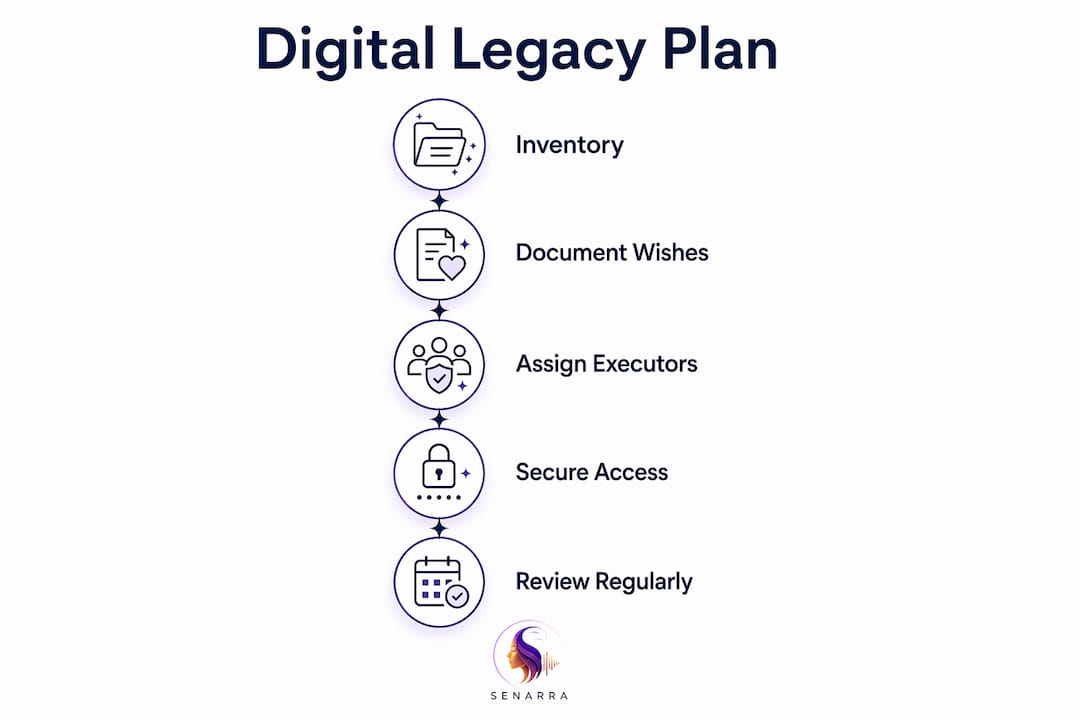
Start with an inventory. List every account, platform, and digital asset you own, including usernames and where login credentials are stored. A password manager like 1Password or Bitwarden keeps this information secure and shareable with a trusted person.
Then document your wishes in writing. Specify what should be preserved, deleted, or transferred, and to whom. Pair that document with legally sound estate planning that names a digital executor and includes explicit RUFADAA-compliant language. For caregiver digital archive situations, where a family member manages another's accounts, the same documentation applies.
Best practices for preserving your digital heritage
Preserving a digital legacy well requires more than backing up files. Consider these practices:
- Download and store locally copies of photos, videos, and important documents rather than relying solely on cloud platforms
- Record voice and stories now, while the person is alive, using dedicated memory preservation tools
- Use accessible formats for audio and video archives so future generations can actually open them; audio accessibility standards matter here
- Review and update your digital estate plan annually, since platforms change their policies regularly
- Preserve voice specifically, because a recording of someone speaking carries emotional weight that text simply cannot replicate
The voice legacy of a loved one, their laugh, their way of telling a story, is among the most irreplaceable parts of any digital estate.
Senarra was built for exactly this. It captures authentic voice conversations with the people and pets you love, preserving them as living memories you can return to whenever you need. Whether you are honoring an ancestor or documenting your own story for future generations, Senarra makes that preservation personal, accessible, and lasting.
Key Takeaways
A digital legacy is the complete collection of digital assets and presence a person leaves behind, and managing it requires both legal preparation and intentional preservation before death.
| Point | Details |
|---|---|
| Digital legacy definition | Everything left online after death: accounts, assets, behavioral data, and AI-generated content |
| Two core categories | Digital assets carry economic value; digital presence holds personal and emotional significance |
| RUFADAA governs access | Fiduciaries access only metadata by default; communication content requires explicit documented consent |
| Corporate control is a real barrier | Service agreements often override inheritance rights, blocking family access to accounts |
| Preserve voice while you can | Voice recordings carry emotional weight no text can match; capture them now with dedicated tools |