
A family narrative archive is defined as a curated, organized collection of stories, documents, photographs, heirlooms, and recordings that preserves a family's identity and lived experience across generations. Unlike a box of old photos in the attic, a true archive adds context: who these people were, why objects mattered, and how individual stories connect to a larger family history. Platforms like Evaheld and archival guides from institutions like San Diego State University both confirm that intentional organization and labeling are what separate a meaningful archive from a random pile of keepsakes. Understanding what does family narrative archive mean starts with recognizing that the stories are just as important as the objects themselves.
What does a family narrative archive actually contain?
A family narrative archive holds far more than physical objects. The materials inside gain meaning only when they are connected to the stories behind them.
Common items found in a well-built family archive include:
- Photographs labeled with names, dates, and locations
- Letters and postcards with the sender, recipient, and context noted
- Legal and vital documents such as birth certificates, marriage licenses, and immigration papers
- Heirlooms like jewelry, tools, or clothing with written explanations of their origin
- Recipes tied to cultural traditions or specific family members
- Audio and video recordings of relatives sharing memories or family events
- Diaries and journals with brief notes on the author and time period
- Newspaper clippings connected to family milestones or historical events
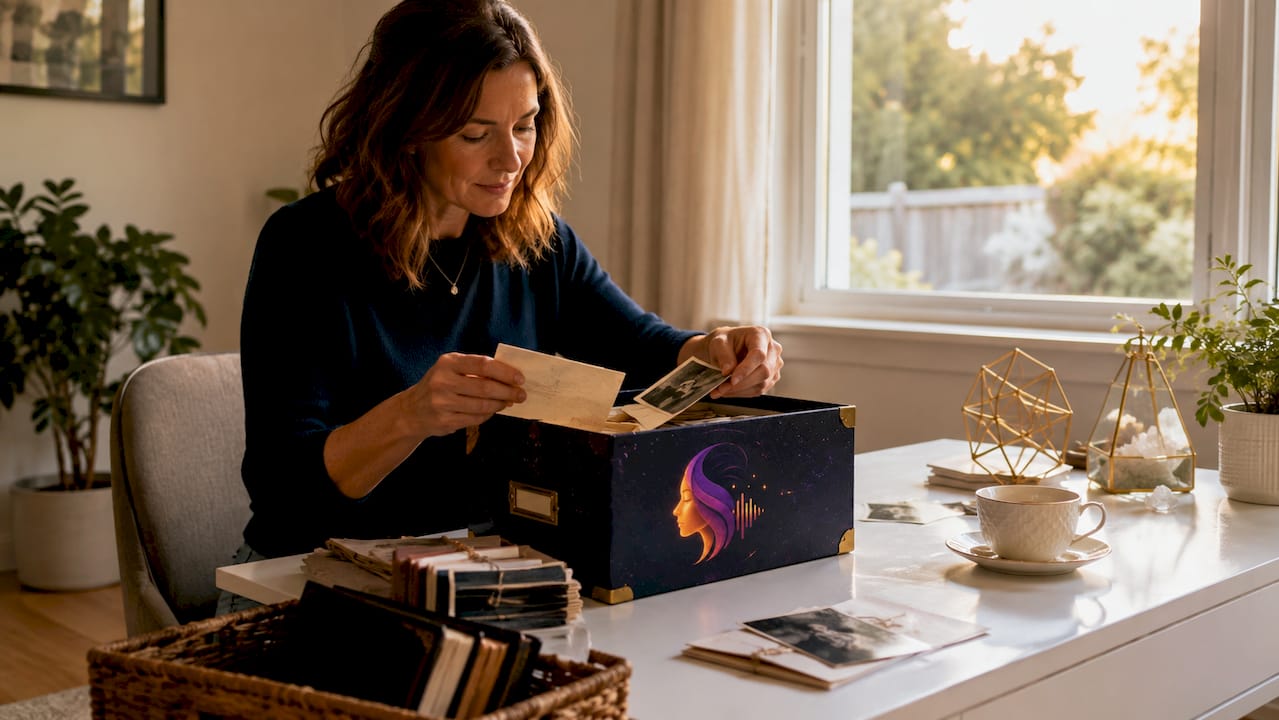
The difference between a collection and an archive is context. A photograph of a woman in 1942 is interesting. A photograph labeled "Grandma Rosa, Chicago, 1942, the week she started her first job" is a story. Family history archives become usable only when items carry clear information about dates, events, people, and locations. That labeling transforms stored items into something a grandchild can actually understand and connect with decades later.
Pro Tip: Start labeling while the people who know the stories are still alive. A five-minute conversation with an elderly relative about a single photograph can produce more context than years of research later.
Why does a family narrative archive matter for identity?
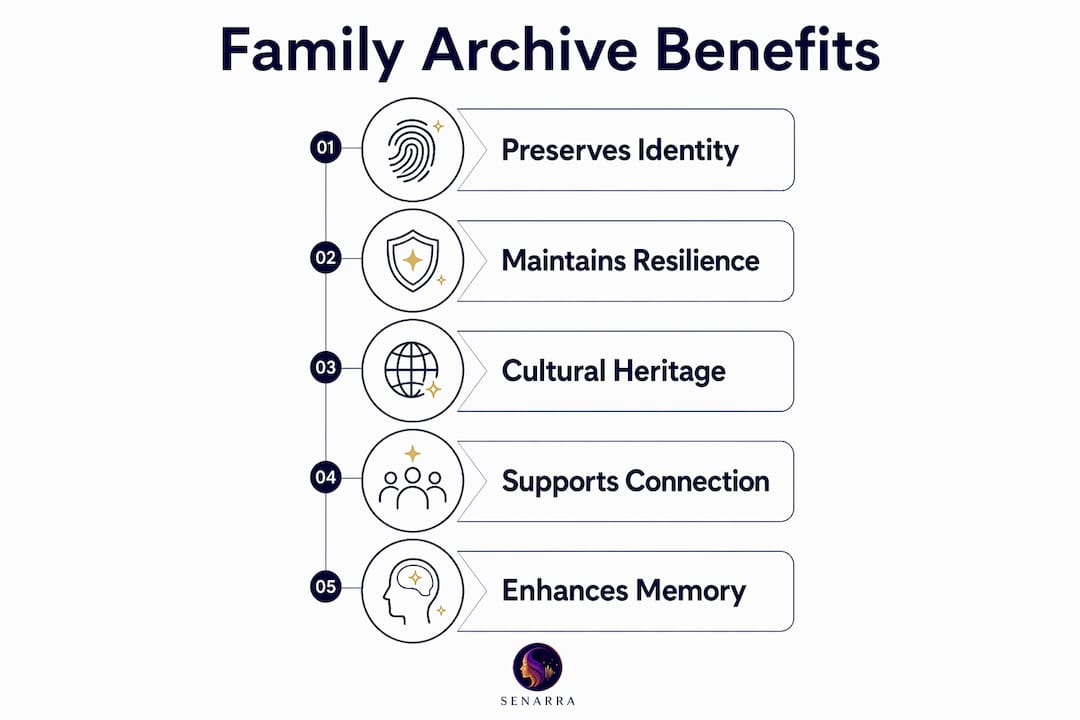
Family narratives preserve continuity and identity in ways that physical objects alone cannot. Psychology Today reports that family stories act as identity anchors, strengthening cohesion and psychological resilience, particularly for younger generations navigating change or displacement.
"Stories serve as lifelines that foster identity coherence, shared values, and emotional endurance over generations." — Psychology Today
This is especially true for immigrant families, where stories of origin, sacrifice, and adaptation carry cultural capital that no document alone can transmit. A child who knows why their grandparents left their home country, what they carried with them, and what they built in a new place has a stronger sense of self than one who only knows names and dates on a family tree. The importance of family storytelling goes beyond sentiment. It builds the psychological scaffolding that helps people handle adversity, maintain values, and feel connected to something larger than themselves.
Family archives also preserve cultural heritage that formal history often overlooks. Recipes, folk sayings, religious practices, and everyday routines captured in an archive become primary sources for understanding how ordinary people actually lived. That is a form of cultural capital that belongs to the family and to no one else.
How do archival principles improve a family narrative archive?
Professional archivists use two core principles that families can apply directly: provenance and original order. These principles are not bureaucratic rules. They are practical tools for keeping meaning intact.
Provenance means keeping materials grouped by their origin. Letters from your grandmother stay with your grandmother's collection, not mixed into a general pile. This preserves the relationships between records and prevents confusion about who created what and why.
Original order means maintaining the sequence or grouping in which materials were found. If your grandfather kept certain letters together in a specific envelope, that grouping itself is information. Disrupting it loses context that may be impossible to reconstruct.
Archival theory must adapt to informal family collections rather than imposing rigid categories. Most family archives are messy by nature. The goal is not perfection but preserving the relationships between records so future family members can follow the thread of a story.
The table below shows the practical difference between a casual collection and a structured archive:
| Feature | Casual collection | Structured family archive |
|---|---|---|
| Organization | Random or by object type | Grouped by person, branch, or time period |
| Labeling | Little or none | Names, dates, locations, and events noted |
| Story context | Absent | Written or recorded explanations attached |
| Archival principle | None applied | Provenance and original order respected |
| Usability for future generations | Low | High |
Provenance and original order preserve authenticity and the relationships among records. Losing that structure means losing the story, even if the physical objects survive.
How to create a family archive that lasts
Building a family narrative archive does not require professional training. It requires a clear process and consistent habits.
- Start with irreplaceable materials. Prioritize fragile photographs, handwritten letters, and physical heirlooms before anything else. These are the items most at risk from time, moisture, and loss.
- Label everything immediately. Write names, dates, locations, and a brief story note on or with every item. Use acid-free labels for physical materials and consistent file naming for digital files.
- Record living relatives. Sit down with older family members and record them talking about specific items or memories. Even a ten-minute audio recording adds irreplaceable context.
- Organize by person or family branch. Group materials by their origin rather than by object type. Keep one person's letters, photos, and documents together.
- Create digital backups. Scan physical items and store copies in at least two separate locations. A modern digital family archive combines preservation with story context, not just file storage.
- Plan for long-term digital survival. Digital archives require separate strategies for short-term backups and long-term format migration. File formats change. Platforms disappear. Store files in open, widely supported formats like JPEG, PDF, and MP3.
- Review and add to the archive regularly. Schedule an annual review to add new materials, update labels, and record fresh stories while relatives can still contribute.
Pro Tip: Never store the only copy of a digital archive on a single hard drive or a single cloud platform. Use the 3-2-1 rule: three copies, on two different media types, with one stored off-site or in a separate cloud service.
Knowing how to create a family archive with voice recordings adds a dimension that text and photos cannot match. Hearing a relative's actual voice telling a story is qualitatively different from reading a transcript of the same words.
Key Takeaways
A family narrative archive preserves identity, resilience, and cultural heritage only when stories, context, and archival principles are applied alongside the physical or digital materials.
| Point | Details |
|---|---|
| Definition matters | A family narrative archive is a curated, labeled, story-connected collection, not just stored objects. |
| Context is the core | Labeling with names, dates, and stories transforms items into a usable archive for future generations. |
| Archival principles help | Provenance and original order preserve meaning and prevent loss of story context over time. |
| Digital archives need two strategies | Short-term backups and long-term format planning are both required for digital archives to survive. |
| Start with living relatives | Recording stories from older family members now creates irreplaceable context that no document can replace. |
Why I think most families wait too long
Most families treat archiving as something to do later. Later usually means after someone has died, after the house has been cleared, and after the person who knew the stories is gone. I have seen this pattern repeat itself in family after family. The box of photographs survives. The stories do not.
The uncomfortable truth about family narrative archives is that the physical materials are almost never the hard part. Scanning a photograph takes minutes. Getting your 80-year-old aunt to sit down and explain who is in that photograph, where it was taken, and what happened the week after it was shot. That is the irreplaceable work, and it has a deadline.
Families also tend to confuse preservation with archiving. Saving files to a hard drive is preservation. Attaching a story, a name, and a date to each file is archiving. The difference sounds small. Over two generations, it is the difference between a collection that means something and one that means nothing to anyone who did not live through it.
The families I have seen do this well treat their archives as living resources, not finished projects. They add to them at holidays. They record conversations at family dinners. They update labels when new information surfaces. That habit, more than any tool or platform, is what makes a family narrative archive actually work.
— Bryan
How Senarra helps families preserve their stories
Families ready to build a real narrative archive need more than cloud storage. They need a way to capture voice, context, and story in one place.
Senarra is a memory preservation app built specifically for this purpose. It captures conversations in a relative's authentic voice, stores them alongside photos and written context, and makes them accessible to family members across generations. Senarra's voice cloning feature preserves the actual sound of a loved one's voice, not just a transcript. Its memory line lets family members call in and hear recorded stories directly. For families who want to preserve memories with meaning, Senarra offers a practical, private, and personal way to build a family narrative archive that future generations will actually use.
FAQ
What is the difference between a family archive and a family history?
A family history is a written account of ancestry and events. A family narrative archive is the physical and digital collection of materials, stories, recordings, and documents that supports and enriches that history.
How do I start a family narrative archive with no experience?
Start by gathering irreplaceable items like old photographs and letters, then label each one with names, dates, and a brief story note. No professional training is required.
Why does provenance matter in a family archive?
Provenance keeps materials grouped by their origin, which preserves the relationships between records. Mixing materials from different family members destroys context that is often impossible to reconstruct.
Can a family narrative archive be entirely digital?
Yes, but digital archives need two separate strategies: regular backups for day-to-day protection and long-term format planning to prevent files from becoming unreadable as technology changes.
How does family storytelling benefit younger generations?
Family stories strengthen identity and psychological resilience in younger generations by giving them a sense of belonging, shared values, and continuity with their heritage.