Documenting milestones for descendants hands them something no inheritance can replicate: a clear sense of who they come from, how their family survived hard times, and what values shaped the people before them. Research from Emory's Family Narratives Lab consistently finds that young people who know their family history show higher self-esteem, lower anxiety, and fewer depressive symptoms than peers who lack that knowledge. The case for starting now is that strong.
Three things to do in the next 72 hours:
- Record a 5-minute voice memo answering: "What's the hardest thing our family ever got through, and how did we do it?"
- Write down three milestones you'd be devastated to lose if the person who lived them passed away tomorrow.
- Pick one format — audio, video, or written — and commit to it for your first capture session.
Key Takeaways
| Point | Details |
|---|---|
| Identity and resilience | Young people who know their family history show higher self-esteem and lower anxiety, per Emory Family Narratives Lab research. |
| Benefits for the recorder | Structured legacy creation reduces depressive symptoms and improves life satisfaction for the person doing the documenting. |
| What to capture first | Start with turning-point stories and moments of recovery — these are the most useful to descendants as coping models. |
| Storage and access | Use the 3-2-1 backup rule and name a digital executor; an archive with no access plan is nearly as lost as one never created. |
| Senarra | Senarra centralizes voice capture, guided interviews, voice cloning, and secure family sharing in one app, with a 14-day free trial. |
What descendants gain when you document milestones
The benefits aren't sentimental. They're measurable. Young people who know their family history show a stronger sense of purpose and better coping skills — outcomes that track directly to identity formation and mental health. When a teenager knows her grandmother fled a war and rebuilt a life from scratch, she has a model for resilience she can actually use.
Research anchor: Research from Emory's Family Narratives Lab indicates that adolescents with strong family narrative knowledge generally score better on well-being indicators such as self-esteem, anxiety, depression, and behavioral outcomes.
Intergenerational stories function as a "narrative of resilience," transmitting coping strategies and a sense of belonging across generations. Stories of struggle and recovery are especially useful — not the polished highlight reel, but the real account of how someone made a decision under pressure and lived with the outcome.
Concrete outcomes for descendants include:
- Identity clarity: knowing where the family came from, what it stood for, and how it changed over time.
- Coping resources: a mental library of real examples showing that hard things can be survived.
- Stronger family bonds: shared stories create a common language that spans generations and geography.
Pro Tip: When recording milestones for future generations, ask specifically about the moment a decision was made — not just what happened, but what the person was thinking and feeling at the time. That emotional detail is what descendants actually remember.
How recording your own milestones benefits you
Legacy creation isn't only for the people who come after. A structured Legacy Project intervention — which engaged patients and families in creating scrapbooks and audiotaped stories — found improved family communication, positive emotional experiences, and meaningful quality-of-life benefits for the people doing the recording. Separately, reminiscence interventions using structured memory prompts have shown fewer depressive symptoms and improved life satisfaction among older adults.
Legacy writing provides meaning-making and can resolve existential uncertainty — articulating what you value and what you've learned turns a life into a coherent story rather than a series of disconnected events. That process is genuinely therapeutic, not just productive.
This is what practitioners who work with end-of-life patients describe repeatedly: the person recording often benefits as much as the family receiving the record. Documenting milestones for family legacy isn't a gift you give after you're gone. It starts working the moment you begin.
Exactly what to document: milestone types and starter prompts
The scope can feel paralyzing, so narrow it. Start with categories, then pick one item from each.
Life milestones and events:
- Births, marriages, divorces, deaths
- Migrations, relocations, and the reasons behind them
- Career turning points and financial decisions
- Moments of failure and how the family recovered
Rituals, traditions, and practical records:
- Holiday traditions and their origins
- Recipes with the story behind them
- Addresses of homes and what life was like there
- Cultural or religious practices and what they mean
Values, lessons, and turning-point stories:
- The piece of advice that actually changed something
- A moment when the family's values were tested
- What the person wishes they'd known at 25
Starter interview prompts:
- "Tell me about the day you knew everything was going to change."
- "What's something you did that you're still proud of, and why?"
- "What did your parents or grandparents teach you that you've never forgotten?"
- "Describe a typical Tuesday when you were 30. What did your days look like?"
- "What do you want your great-grandchildren to know about you?"
Preserving first-person narratives alongside primary documents — letters, certificates, photos — turns family memory into historical documents that anchor descendants' sense of self. Don't just record the story; scan the letter it references.
Best formats for preserving milestones
Each format has a different strength, and the right choice depends on what you're trying to preserve and who will access it.
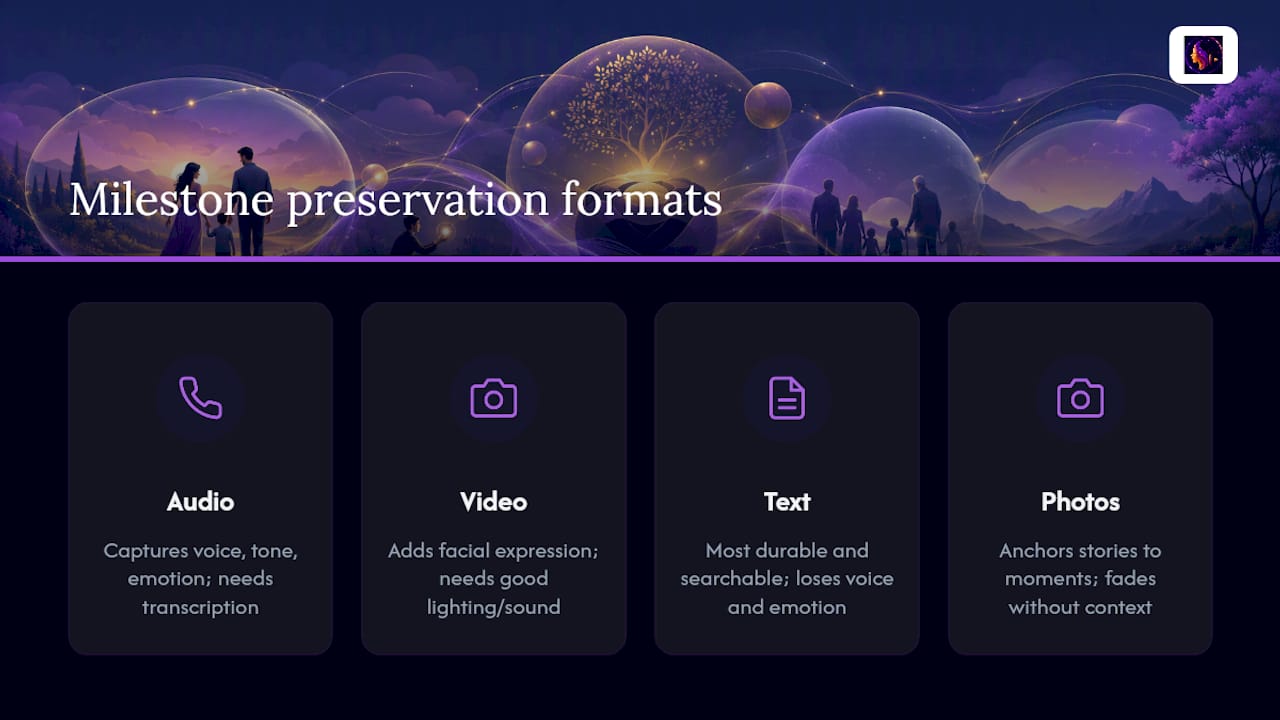
Audio captures voice, tone, and emotion with minimal setup. It's the most authentic format for personality and the easiest to produce. Downside: it requires transcription for searchability, and audio-only loses visual context.
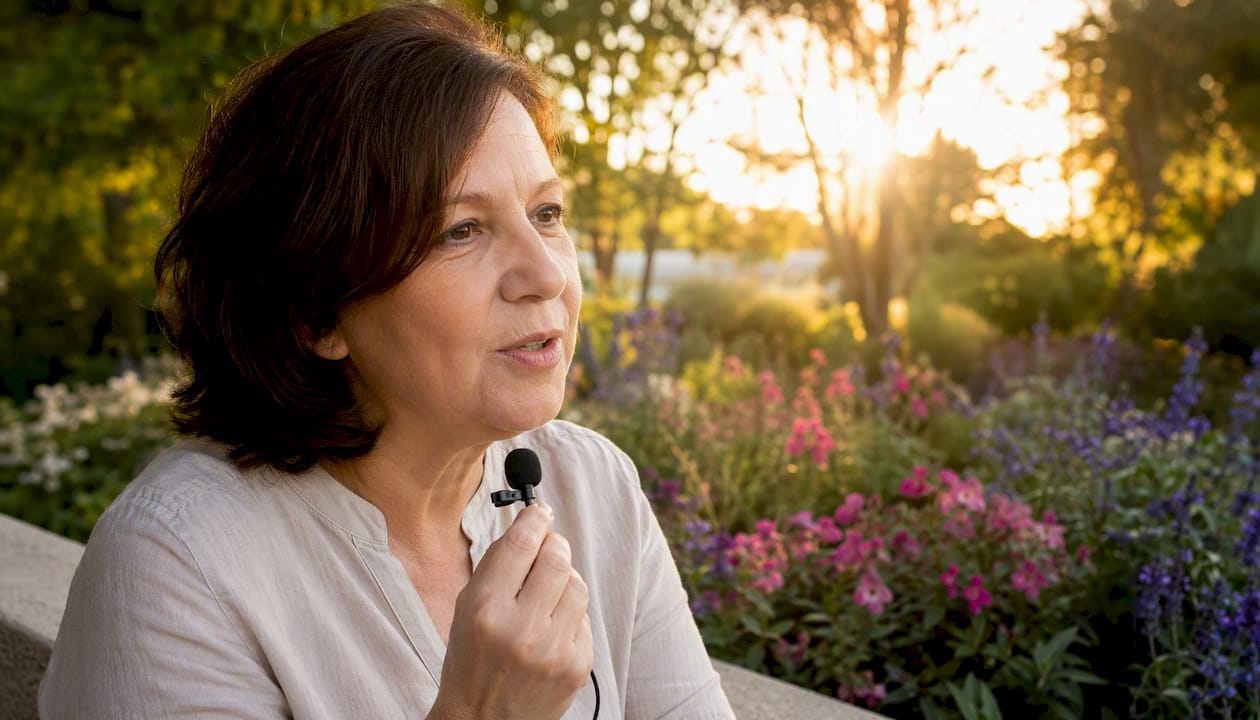
Video adds facial expression and physical presence. It's the richest format but also the most demanding to produce well — poor lighting or sound quality can make it harder to watch than a clean audio recording.
Text and written accounts are the most durable and searchable format. They're easier to share, quote, and archive. What they lose is the person's actual voice and the emotional texture that comes with it.
Photos with captions anchor stories to specific moments and places. A photo without context fades; a photo with a written story attached becomes a primary document.
Hybrid archives — combining audio or video with written transcripts and photos — give descendants the most complete picture. Digital storytelling tools that centralize multiple formats in one place make hybrid archives far more manageable than maintaining separate folders and drives.
Voice recordings in particular act as a "living bridge" for grieving families, providing sustained comfort and facilitating bereavement in ways that text alone cannot replicate.
Pro Tip: For long-term preservation, save audio as WAV or high-quality MP3, photos as TIFF or high-resolution JPEG, and documents as PDF/A. These formats are widely supported and less likely to become unreadable as software changes.
A 6-step plan to start documenting in the first 30–90 days
- Clarify scope and audience. Name the specific descendants you're documenting for. A record for your children reads differently than one for grandchildren you may never meet. Knowing the audience shapes what you include.
- Choose formats and set 30/60/90-day goals. Pick one primary format to start. Set a 30-day goal of five captured items, a 60-day goal of ten, and a 90-day goal of a first organized archive.
- Schedule sessions and assign roles. Block two recording sessions in the next month. Identify who will interview, who will archive, and who will handle editing or transcription.
- Capture your first five milestone items. Use the prompts from the previous section. One story per session is enough to start — a single-prompt approach reduces inertia and makes completion realistic.
- Organize and back up immediately. After each session, file materials in a named folder, back up to at least two locations, and add a brief description of what was captured.
- Set sharing permissions and access rules. Decide who can view the archive now, who inherits access, and how materials will be delivered to future descendants. Document those decisions in writing.
How to store, share, and protect your family milestone records
The 3-2-1 backup rule applies here: keep three copies of every file, on two different media types, with one stored off-site or in the cloud. For a family archive, that typically means a local hard drive, a cloud service like Google Drive or iCloud, and a second external drive kept at a different address.
Access and permissions checklist:
- Name a digital executor in your will or estate documents — someone who knows where the archive lives and has the credentials to access it.
- Store account usernames and passwords in a secure password manager, and include the master access information in a sealed document with your estate papers.
- Document consent: note in writing who gave permission to be recorded and what they agreed could be shared.
- Set clear rules about what is private (for family only) versus what can be shared publicly or with extended family.
Planning for posthumous access is a step most families skip until it's too late. A well-organized archive with no access plan is nearly as lost as one that was never created. For file formats, use WAV/MP3 for audio, TIFF or high-resolution JPEG for images, and PDF/A for documents.
This section provides general guidance only, not legal advice. Consult an estate attorney for formal digital-executor provisions in your jurisdiction.
Pro Tip: Label every file with the person's name, approximate date, and a one-word topic — for example, "GrandmaRose\1962\immigration.wav" — so the archive stays navigable as it grows.
How to make legacy documentation a family project
The most complete archives are built by more than one person. Different family members hold different pieces of the story, and collaborative projects tend to produce richer records than solo efforts.
Roles that make collaboration work:
- Interviewer: asks questions, keeps the conversation moving, and creates a safe space for honest answers.
- Archivist: handles file naming, storage, and backup after each session.
- Rights manager: tracks consent, manages sharing permissions, and handles requests from extended family.
- Editor: reviews transcripts, adds context, and flags gaps that need a follow-up session.
- Emotional support lead: checks in with participants after difficult sessions and ensures the process feels safe.
Project ideas that scale:
- Themed collection days: gather the family around one topic — immigration stories, recipes, or a specific decade — and record everyone's version.
- Memory parties: informal gatherings where family members bring one object with a story attached and record the story on the spot.
- Shared editing sessions: use a collaborative platform to let multiple family members add context, correct dates, or attach related photos to existing recordings.
Digital co-creation improves authenticity and emotional bonding, but it works best with clear governance — agree in advance on who has final say over edits and what happens when family members disagree about how a story is told.
Handling sensitive memories and ethical concerns
Some milestones involve pain, conflict, or information that not everyone in the family has agreed to share. A few clear rules prevent harm.
Before recording sensitive material:
- Ask explicitly whether the person is comfortable discussing the topic. Never assume silence means consent.
- Offer the option to pause, skip, or revisit a topic in a later session.
- Let the person review the recording before it's shared with anyone else.
- Record verbal consent at the start of each session: "I'm recording this conversation with your permission. Is that okay?"
Consent and permissions:
- For anything that will be shared beyond immediate family, get written permission.
- Note in the file metadata who consented, when, and what they agreed to.
- Redact or archive separately any material that involves third parties who did not consent to be recorded.
Family stories shape identity across diverse cultural groups, and cultural context matters. When recording traditions, rituals, or community-specific practices, include the cultural meaning — not just the what, but the why, and who holds the authority to speak to it.
Why the research supports this approach
The evidence base for documenting milestones for descendants spans developmental psychology, palliative care, and digital legacy studies.
- Emory Family Narratives Lab: adolescents with strong family-history knowledge consistently score higher on self-esteem and lower on anxiety and depression — the effect holds across socioeconomic backgrounds.
- Legacy Project intervention (PMC): structured legacy creation with patients and families produced improved family communication and positive emotional experiences, with meaningful benefits during end-of-life periods.
- Reminiscence research (PMC): structured memory prompts and behavioral activation in older adults reduced depressive symptoms and improved life satisfaction.
- Frontiers in Psychology: intergenerational stories function as a practical coping toolbox, with stories of recovery and concrete decisions being most useful to descendants.
- Digital legacy research (Well-Being Sciences Review): digital legacy practices increase well-being through narrative coherence and co-creation, while raising legitimate questions about governance and authenticity that families need to address proactively.
The convergence across these fields is clear: writing family history for descendants isn't a nostalgic hobby. It's a documented intervention with measurable psychological benefits for both the people recording and the people who will one day receive what was recorded.
An honest note on why this work matters
The families I've seen engage with this process — through the work behind Senarra and the stories that shaped it — share one thing: they all wish they'd started sooner. Not because they ran out of time, though sometimes they did. Because the conversations they finally had turned out to be the ones they'd been waiting their whole lives to have.
Legacy documentation is often framed as something you do for others. That's true. But the person who sits down to record their first milestone story almost always discovers something they didn't expect: they needed to tell it as much as anyone needed to hear it.
Recording milestone stories is one of the most direct ways to close the gap between the life someone lived and the life their descendants will know about. The research supports it. The families who've done it confirm it. The only thing left is to begin.
[Author credentials and bio to be inserted here. Case studies or testimonials from Senarra users to be inserted here.]
Senarra makes it easier to preserve the voices that matter most
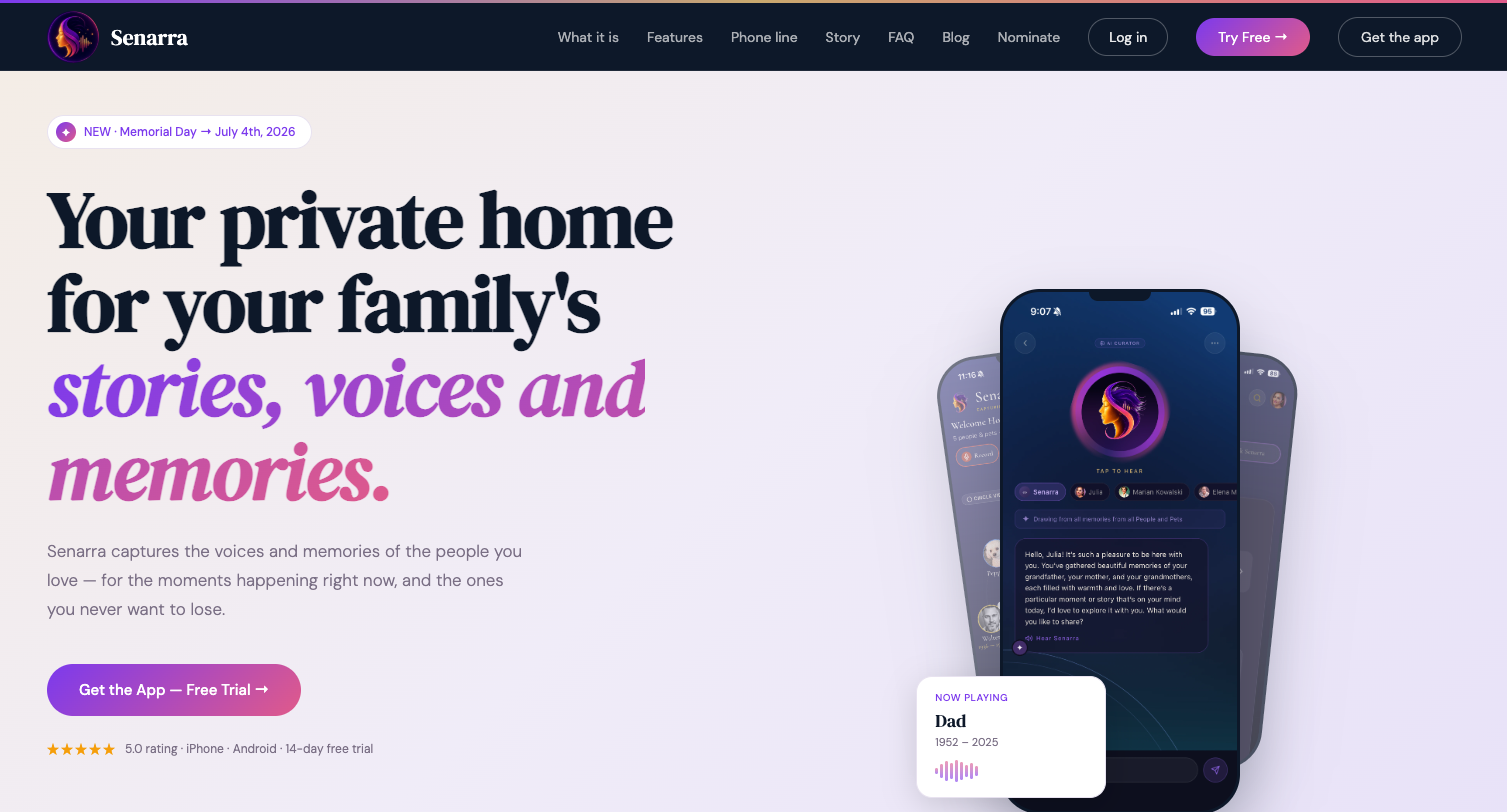
Senarra is built specifically for what this guide describes: capturing the real voice, the real story, and the real person — not a summary, not a scrapbook, but an interactive archive that descendants can actually talk to. Voice cloning preserves how someone sounds. Guided interview prompts handle the "I don't know where to start" problem. Secure sharing and family collaboration tools mean the archive doesn't live on one person's hard drive. And a memory line accessible by phone means a grandchild can call and hear their grandmother's voice years from now.
Senarra is the publisher of this article. Start with a 14-day free trial and see how far one recorded conversation can go.
Sources
- Write your family’s history to make for a better future | Kansas City Star
- The Legacy Project (legacy-intervention study) — PMC
- Frontiers in Psychology — family storytelling as resilience (PDF)
- The psychology of digital legacy: Conceptual transformation, mechanisms, and implications for well-being | Well-Being Sciences Review