Audio memories often outlast photos because a voice encodes meaning, emotional tone, and social context in temporal patterns that trigger what neuroscientists call reinstatement of memory gist far more reliably than a static image can. A 2026 study from Baycrest found that auditory memories rely on reconstructed meaning rather than perceptual detail, which makes them more durable anchors for long-term emotional recall. The difference between audio and photo memories is not just format. It is how deeply the brain commits the experience to storage.
Three mechanisms explain why sounds are memorable in ways photos often are not:
- Emotional anchoring: A voice carries pitch, pace, and warmth that activate the brain's emotional centers during recall, not just during the original experience.
- Temporal and context cues: Audio unfolds in time, embedding ambient sounds, pauses, and conversational rhythm that reconstruct the scene around a memory.
- Everyday authenticity: Recordings capture unposed, candid moments that photos routinely miss, making the memory feel truer to life.
Baycrest (2026): Researchers measured brain-activity reactivation during learning and recall and found that auditory memories weight meaning-based representations more heavily than visual memories, which prioritize perceptual detail. That weighting is what makes a voice clip a stronger long-term cue than a photograph.
Why does the brain hold onto sounds differently than images?
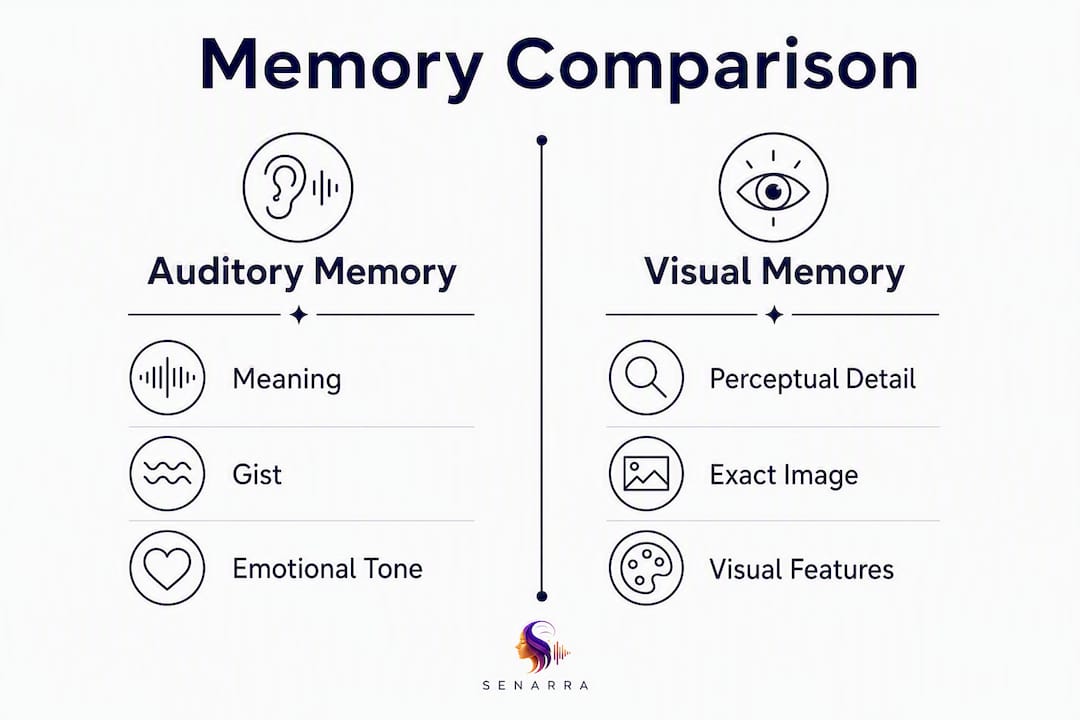
The brain uses overlapping replay systems for sight and sound but emphasizes different information for each. Visual memory tends to preserve perceptual detail: color, shape, spatial arrangement. Auditory memory leans on reconstructed meaning, what the Baycrest study calls gist, and on reinstatement in higher-order sensory regions.
Reinstatement, in plain terms, means the brain re-fires the same neural patterns during recall that it activated during the original experience. For sound, those patterns are tied to meaning and emotion rather than raw sensory data. That is why hearing a loved one's laugh can feel like being transported back into a room, while looking at a photo of the same moment feels more like viewing a record.
| Dimension | Auditory memory | Visual memory |
|---|---|---|
| What's preserved | Meaning, gist, emotional tone | Perceptual detail, color, shape |
| Primary cue type | Temporal pattern, voice quality | Spatial arrangement, visual scene |
| Typical vividness | High emotional vividness | High perceptual clarity |
| Contextual richness | Strong: ambient cues, rhythm, pause | Moderate: frozen moment, no motion |
| Long-term durability | Gist-based encoding favors retention | Detail fades faster without rehearsal |
MedicalXpress coverage of the Baycrest findings highlighted that stronger neural reactivation during recall correlates with more vivid memory, and that auditory memories may carry a structural advantage for long-term retention precisely because gist degrades more slowly than perceptual detail.
Why does hearing a familiar voice feel like presence?
A voice does something a photo cannot: it puts you back inside the relationship. Tone, cadence, and the specific rhythm of how someone says your name carry social and emotional information that the visual system simply does not process the same way. That is why voice playback can feel like presence rather than memory.
The same gap separates a voice from a written record. Linguists call the rhythm, pitch, and pace of speech prosody, and it carries meaning alongside the words. "I'm so proud of you" reads identically whether it was said with warmth or sarcasm; heard, it is unmistakable. Voice also carries laughter, hesitation, breath, accent, and the particular way someone says a grandchild's name. Writing still earns its place: it is searchable and precise for dates, addresses, and legal details. The strongest family archives combine both, text for reference and voice for presence.

Clinically, this matters. Caregivers working with dementia patients report that familiar voices can reduce agitation and reorient someone who no longer recognizes faces. In grief support, hearing a loved one's recorded voice can provide a sense of continuity that static photos do not, because the voice carries the relationship, not just the image of a person.
Hearing a voice after loss is normal
The continuing bonds model, developed by bereavement researchers Klass, Silverman, and Nickman, reframed grief as an ongoing relationship rather than a process of detachment. Keeping a felt connection to the person who died, including through sensory experiences like hearing their voice, is now understood as adaptive rather than pathological for many mourners.
"Hearing, seeing, or sensing someone who has died is a normal part of the grieving process for many people. It can be a comforting experience and a way of maintaining a bond with the person who has died." — Cruse Bereavement Support
A case study in Omega: Journal of Death and Dying documented a bereaved person who regularly heard the voice of the deceased without clinical distress and described the experience as meaningful and sustaining. The researchers argued such experiences belong in bereavement support rather than being pathologized. The recordings you make today may become someone's most important source of comfort later.
For families using Senarra, features like voice cloning and the memory line accessible by phone make this continuity practical. A grandchild can call a number and hear their grandmother's voice answering questions in her own words. For someone recording stories during cognitive decline, capturing voice early means that continuity is preserved before it is lost.
Key therapeutic use cases where audio outperforms photos:
- Dementia care: Familiar voices can reorient and calm; photos often fail to trigger recognition once visual processing is impaired.
- Grief support: Hearing a voice activates emotional memory in ways that reduce the flatness of loss.
- Hospice and end-of-life: Recorded messages give families something to return to, not just look at.
- Intergenerational legacy: Children who never met a great-grandparent can form a genuine emotional connection through voice.
Why imperfect audio often means more than a perfect photo
Here is the paradox: the messiness of audio is exactly what makes it valuable. A posed family photo is curated. A voice recording of someone telling a story while the dog barks in the background, or laughing mid-sentence, is real. That rawness increases perceived authenticity and triggers richer reconstruction when you listen back years later.
CSCW fieldwork on sonic souvenirs found that families' sound collections included mundane and even negative moments that photos routinely omit, and that listening demanded active reconstruction by participants. That reconstruction is not a bug. It is what makes the memory feel alive. The Sonic Gems research found that audio-only recordings often provoked vivid mental imagery and personal reconstruction of events, with participants reporting that audio could be sufficient, and sometimes preferable to visuals, for recreating feelings.
Comparing the two formats honestly:
- Staged photos tend to capture best-dressed moments, forced smiles, and curated settings. They are easy to interpret but often emotionally thin.
- Candid audio captures laughter, argument, ambient noise, and conversational drift. It is harder to interpret but truer to the texture of a life.
Pro Tip: Save short candid clips alongside formal recordings. A 30-second clip of your father ordering coffee, or your mother laughing at her own joke, will carry more emotional weight in ten years than a posed portrait. Tag each clip with a date, location, and one sentence of context while you still remember it.
How to capture audio memories that actually last
Start here: record something today, even if it is imperfect. The biggest risk is waiting for the right moment. A 10-minute conversation about a single memory is worth more than a two-hour interview that never happens.
What to record:
- Life-story prompts: "Tell me about the house you grew up in" or "What was your first job?"
- Milestone stories: weddings, immigrations, career changes, moments of pride
- Recipes and rituals: narrate a dish being cooked, not just the ingredients
- Gratitude messages: what someone wants another person to know while they can still say it
- Everyday voice: voicemails, phone calls, casual conversation
- Pet sounds: a dog's bark, a cat's purr, captured while they are still here
How to set it up:
- Choose the right device. A smartphone with a dedicated voice memo app works well for casual capture. For archival quality, aim for a 44.1 kHz sample rate and 16-bit depth minimum. A simple lapel microphone reduces handling noise significantly.
- Capture context, not just content. Let ambient sound in. The hum of a kitchen, a screen door, background music — these become powerful cues later. Silence everything except the room.
- Name files descriptively. Use a format like
2026-07_GrandmaRose_ChicagoKitchen_PieRecipe.wav. Vague filenames become unidentifiable within months. - Back up in two formats, three places. Keep a lossless master (WAV, or FLAC for smaller files) and export an MP3 for sharing. Follow the 3-2-1 rule: three copies, on two different media types, one stored away from the home. Set a reminder every two years to check the files still open and migrate formats if playback support drops.
- Document consent and provenance. Note who gave permission to record, when, and for what purpose. A simple written note or email thread is enough. This matters especially for AI processing later.
During the session itself: put the phone in airplane mode so notifications don't cut in, hold it 6–8 inches from the speaker, and choose a small, soft-furnished room over an echoing one. Do a 30-second test playback first. Then let silence breathe. The pauses are often where the real stories live. For older relatives, early afternoon tends to work better than evening, and shorter, more frequent sessions beat one long, tiring one.
For organizing a larger collection, the family oral history archive guide on the Senarra blog covers tagging systems and folder structures in practical detail.
Pro Tip: Use open-ended prompts to elicit strong gist-based memories: "Tell me about a time you were really scared" or "What did your mother's kitchen smell like?" Sensory and emotional prompts produce richer, more reconstructable recordings than "tell me about your life." Sit side by side rather than face to face, and open with a story you already know. Familiar ground relaxes the speaker.
What AI can do with voice memories, and what to watch for
AI makes voice memories more accessible and interactive than any filing cabinet ever could. The core capabilities now available to families include:
- Voice cloning: Recreates a person's voice from recordings so it can answer questions or narrate new content in their authentic tone.
- Transcription and semantic search: Converts audio to searchable text so you can find "the story about the 1987 flood" without listening to 40 hours of recordings.
- Automated tagging: Links clips to people, places, and events based on content.
- Conversational memory: Lets family members ask questions and receive answers drawn from actual recorded stories.
The risks are real and worth naming directly. Voice cloning without explicit consent is an ethical violation and, in some U.S. states, a legal one. A practical privacy checklist for U.S. families:
- Get written or recorded verbal consent before cloning anyone's voice.
- Agree as a family on who can access, share, or modify AI-generated voice content.
- Use platforms that offer end-to-end encryption and clear data-deletion policies.
- Keep original, unprocessed recordings separate from any AI-modified versions.
- Make sure the person understands the voice model may be used after their death, and let them hear and approve a sample before consent is final.
- Store the consent with the original audio, not in a separate folder, so whoever inherits the archive finds both together.
A cloned voice is a statistical approximation built from recordings, not the person's actual voice, and it's worth presenting it that way. Settle a few questions as a family in advance: who controls access after the person's death, whether the model can be updated or stays locked to recordings made in their lifetime, and whether there are topics or occasions where using it would feel wrong.
Pro Tip: Before uploading recordings to any AI platform, save a local backup of the originals. AI processing is reversible only if you kept the source files.
How AI captures elder narratives responsibly is covered in depth on the Senarra blog.
How families keep voices part of everyday life
Recordings only matter if someone plays them. Small, repeatable habits keep a voice familiar rather than foreign:
- A weekly listen. Pick one evening a week to play one recording of a grandparent. Children hear the voice often enough that the stories become part of the family's shared vocabulary.
- A holiday story. Before a holiday meal, play a two-minute recording of an ancestor describing what that day meant to them.
- A phone line. Relatives who don't use apps can call a number and hear a recording without any setup on their end.
Not every recording needs to reach everyone. Some stories are for adult children only; some are private messages for one person. Decide that early, before the archive grows large enough to be hard to sort.
For families who want to start before a loved one's health changes, the guide on capturing aging parent memories walks through the first conversation and first recording session in practical terms.
Key Takeaways
Audio memories outlast photos because gist-based auditory encoding degrades more slowly than perceptual visual detail, making voice the more durable long-term cue for emotional recall.
| Point | Details |
|---|---|
| Gist beats detail | Auditory memory encodes meaning and emotion; that gist outlasts the perceptual detail visual memory stores. |
| Voice creates presence | Hearing a familiar voice activates emotional and social memory in ways a photo cannot replicate. |
| Imperfection adds value | Candid, unposed audio captures authentic moments that staged photos omit, increasing sentimental value over time. |
| Capture and consent first | Record in lossless format, tag with context, document consent before any AI processing. |
| Voice supports grief | Bereavement research treats hearing a loved one's voice as a normal, often comforting part of grief. |
Why voice preservation matters more than most people realize
The conventional wisdom is that photos are the gold standard for memory keeping. They are shareable, printable, and immediately legible to anyone who looks at them. Audio feels harder: you need to press play, you need quiet, you need time. That friction is real.
But the friction is also the point. Listening to a voice recording is an active, reconstructive experience. You fill in the room, the relationship, the feeling. A photo hands you an image. A voice hands you back the person.
What gets lost when families skip audio is not a format preference. It is the texture of how someone actually sounded when they were happy, or tired, or telling a story they had told a hundred times. No photograph carries that. The 2026 Baycrest research gives this intuition a neurological foundation: the brain is literally built to hold onto meaning and emotion longer than it holds onto visual detail.
The families who will regret this most are the ones who had the chance to record and did not. The ones who will not regret it are the ones who pressed record on an ordinary Tuesday, in a noisy kitchen, with no plan except to keep the voice.
Senarra makes it easy to start preserving voices today
Most families know they should capture voice memories. The gap is having a place to put them that is organized, private, and actually usable years from now.
Senarra gives you guided interview prompts to draw out the stories that matter, automatic transcription and tagging so nothing gets buried, and a memory line your family can call to hear a loved one's voice on demand. Voice cloning is opt-in only, with original recordings always preserved separately. Family sharing controls let you decide exactly who has access. Every recording is stored securely, exportable in lossless format, and backed by clear consent flows built into the app.
Start a 14-day free trial and record your first five-minute clip today. The best time to capture a voice is before you wish you had.
Sources and further reading
The table below lists the primary research cited in this article.
| Source | What it supports | Published |
|---|---|---|
| Baycrest PubMed study | Core neuroscience: reinstatement, gist vs perceptual detail in auditory vs visual memory | 2026 |
| Baycrest news release | Plain-language summary of the same findings; accessible secondary citation | 2026 |
| MedicalXpress coverage | Highlights reinstatement and possible advantages for aging and rehabilitation | June 2026 |
| CSCW Sonic Souvenirs | Family fieldwork showing audio captures mundane/negative moments photos omit; active reconstruction | 2010 |
| Sonic Gems (EWIC/HCI) | Participants found audio sufficient or preferable to visuals for recreating feelings; vivid mental imagery | 2008 |
| BlackBox: voice vs photo | Emotional immediacy of voice clips; everyday sounds photos miss | Not dated |
| Phenomenology and impact of hallucinations concerning the deceased (Cambridge University Press) | Continuing bonds; sensory experiences of the deceased as adaptive | Not dated |
| Very Present and Very Real (Omega: Journal of Death and Dying) | Case study of regularly hearing the voice of the deceased without distress | Not dated |
| Cruse Bereavement Support | Guidance normalizing hearing or sensing someone who has died | Not dated |
| Narratives of experiences of presence in bereavement | Comfort, ambivalence, and distress in continued-presence experiences | Not dated |