A memory line phone service is an AI-driven, phone-accessible archive that lets families call a dedicated number to hear, interact with, and add to voice-cloned recordings and stored memories of a loved one or pet. If you're planning a legacy, supporting a grieving relative, or simply want your grandchildren to hear your voice decades from now, this technology can help. One firm requirement: explicit consent from the person whose voice is being preserved.
Senarra is one platform built around this idea, combining voice memory preservation with a callable memory line, guided interviews, and secure family sharing.
Key Takeaways
A memory line phone service lets families call to hear and interact with voice-cloned recordings of loved ones, but it only works well when built on explicit consent, quality source audio, and a clear plan for who manages access.
| Point | Details |
|---|---|
| Core definition | A phone-accessible AI archive combining voice cloning, stored recordings, and a callable memory line. |
| Consent is foundational | Document explicit permission from the voice owner and name authorized users in estate paperwork. |
| Pilot metrics set expectations | A 20-participant study reported voice naturalness 4.2/5 and persona consistency 82%; treat these as early signals, not guarantees. |
| Curated beats synthetic | Authentic archived recordings carry more emotional integrity than open-ended AI-generated responses. |
| Senarra | Offers voice cloning, a phone memory line, guided interviews, and secure family sharing with a 14-day free trial. |
What is a memory line phone service, and how does the technology work?
The pipeline has five stages. Voice capture comes first: recordings, voicemails, or guided interviews are imported into the platform. A speaker encoder then converts that audio into a compact voice embedding, essentially a mathematical fingerprint of the person's voice. According to technical overviews of voice cloning, even a few minutes of reference audio can produce a working synthetic voice, though longer samples improve fidelity.
From there, a retrieval-augmented language model pulls relevant stored memories to generate contextually appropriate responses. A neural text-to-speech engine renders those responses in the cloned voice. Finally, a telephony or IVR layer connects the whole system to the public phone network so a family member can call from any device.
The simplified call flow:
- Caller dials the memory line number
- IVR routes the call to the AI layer
- LLM retrieves relevant stored content
- TTS generates audio in the cloned voice
- Audio plays back live or as a prerecorded message
A pilot study of a comparable prototype (20 participants) reported voice naturalness at 4.2/5, persona consistency at 82%, and perceived comfort at 4.1/5. Those numbers are promising, but a 20-person sample is a starting point, not a benchmark.
Pro Tip: Live conversational calls require low-latency audio generation. Platforms that co-locate speech synthesis with carrier infrastructure reduce the perceptible delay. If natural back-and-forth matters to your family, ask providers specifically about their telephony architecture before subscribing.
How families actually use a memory line
The most common starting point is simple playback. An adult child calls on a birthday and hears a recorded greeting in their parent's actual voice. No AI generation involved, just a stored clip delivered over the phone. That alone can be deeply meaningful.
More interactive journeys layer in the AI. A parent records a series of life-lesson conversations through guided interviews, and those get organized so grandchildren can later ask questions and receive synthesized responses drawn from the real recordings. Senarra's guided interview feature is built for exactly this kind of structured elder narrative capture.
A third pattern is ongoing contribution. Family members add new voicemails, photos, or audio clips over time, building an archive that grows richer as the person ages. Pet memories work the same way: short recordings of a pet's sounds, combined with personality notes, create a playful memory line kids can call.

The key distinction families should understand: listening to authentic archived recordings is categorically different from interacting with a synthetic voice model. Both have a place, but they carry different emotional weights and different ethical obligations.
Privacy, consent, and U.S. legal steps you need to take first
Consent is not optional. Before any voice is captured or cloned, the person whose voice it is must give explicit, documented permission. Estate-planning guidance recommends treating a voice model as a digital asset with named authorized users and clearly defined permitted contexts (family-only versus public memorial).
Consent checklist:
- Written or recorded permission from the voice owner, timestamped
- Named list of authorized family members who can access or add to the line
- Defined scope: what the voice model can and cannot be used for
- Documented instructions in estate paperwork (will, advance directive, or letter of instruction)
On recording laws: the U.S. has a patchwork of state statutes governing who must consent to a recording. Some states require only one party's consent; others require all parties. Document consent explicitly rather than assuming your state's rules cover you. Consult an attorney for your specific situation.
Data-handling expectations to demand from any provider:
- Encryption at rest and in transit
- Per-user access controls with audit logs
- Clear deletion and export options
- Written retention policy with no commercial reuse of personal voice data
Pro Tip: Record a short, explicit consent statement in the voice owner's own words and store it alongside the estate documents. A timestamped audio file saying "I, [name], consent to having my voice preserved and shared with [named family members] through [platform]" is far harder to dispute than a checkbox.
Consent isn't a one-time checkbox. It's the ethical foundation the entire memory line rests on. Without it, even the most technically impressive voice model is built on shaky ground. Revisit and reconfirm consent if the scope of use changes.
How to use memory lines without causing emotional harm
The guidance from grief-support experts is consistent: prioritize a curated legacy of authentic recordings over open-ended synthetic recreation. A collection of real stories, greetings, and advice carries more emotional integrity than an AI that improvises responses indefinitely.
Practical rules that reduce harm:
- Limit interactive simulation to topics the person explicitly addressed in recordings
- Label synthetic responses clearly so listeners always know what is generated versus authentic
- Make access opt-in for family members who may not be ready
- Consider a timeline gate: delay interactive access for several months after a death
Pro Tip: Prepare listeners before they call. A brief text or email explaining what the memory line contains, and what it does not, reduces the risk of a jarring experience. Frame it as "you'll hear Dad's recorded stories" rather than "you can talk to Dad."
Research on systems that emulate identifiable individuals recommends watermarking synthetic audio and restricting dynamic emulation in emotionally sensitive contexts. Those safeguards protect both the listener and the integrity of the person being remembered.
Step-by-step setup and daily use
- Create your account and complete the privacy and consent settings
- Capture voice samples: aim for 10–20 minutes of natural speech across varied topics
- Import existing voicemails, audio clips, or video soundtracks
- Set permissions: name authorized callers and define what each can access or add
- Test the memory line with a family member before wider sharing
- Add estate instructions referencing the platform, access credentials, and authorized users
Example guided interview prompts that produce rich, usable audio:
- "Tell me about the day I was born."
- "What's the best advice you ever received?"
- "Describe a place that made you feel at home."
- "What do you want your grandchildren to know about you?"
Daily-use tips for family managers:
- Record in a quiet room with a phone or external microphone held 6–8 inches from the mouth
- Label every clip with the date, topic, and speaker before uploading
- Archive imported voicemails immediately; carrier systems delete them on rolling schedules
- Assign one family member as the primary curator to maintain consistency
What secure data handling should look like
Any platform holding a voice model is holding something irreplaceable. Before committing to a provider, verify:
- AES-256 encryption at rest; TLS 1.2 or higher in transit
- Role-based access controls with individual login credentials for each family member
- Audit logs showing who accessed or modified content and when
- One-click export of all stored audio, transcripts, and metadata
- Documented deletion policy with a defined timeline for data removal after account closure
- No clause permitting commercial reuse of personal voice data for model training
Ask whether the platform has undergone independent security audits. A clear, plain-language privacy policy that explicitly separates personal storage from any commercial use is a minimum standard. Estate planning documents can codify access rules and name a digital executor responsible for managing the account after death.
What memory line services typically cost
Most platforms follow a free trial period followed by a monthly or annual subscription. The free tier or trial usually covers basic storage and playback. Higher tiers unlock voice cloning, live interactive calls, additional family seats, and export tools.
Features that commonly sit behind paid tiers: higher-fidelity voice cloning, unlimited call minutes on the memory line, multi-member family access, and estate export packages. Annual billing typically runs cheaper per month than monthly billing.
Pro Tip: Storage costs compound over years. Before choosing a plan, ask specifically about long-term archival pricing and whether you can export your full archive if you cancel. A platform that locks your family's recordings behind a proprietary format is a liability, not a legacy.
Limitations and risks to understand before you start
Technical limits:
- Short audio samples (under 5 minutes) produce noticeably lower voice fidelity
- Live conversational calls introduce latency that can feel unnatural
- Language models can hallucinate content the person never said
- Accents and speech patterns at the edges of training data reproduce less accurately
Risks:
- Voice fraud: a cloned voice can be used to impersonate someone in financial or legal contexts
- Emotional harm from unexpected or inaccurate synthetic responses
- Unauthorized reuse if access controls are weak
- Regulatory ambiguity: some states are actively legislating AI voice rights
Mitigation steps:
- Document consent and store it with estate paperwork
- Apply watermarking to all synthetic audio output
- Require multi-factor verification before any financial or legal action tied to the voice
- Assign a human family member to review interactive scenarios before broader access
Should your family use a memory line?
Families who benefit most are those with prepared recordings, a willing and consenting voice owner, and a clear plan for who manages access. If you have 10–20 minutes of good-quality audio and a family member who can serve as curator, the technology is ready to be useful.
Delay if: the person whose voice you want to preserve has not yet given consent, or if a family member is in acute grief and may not be emotionally prepared for synthetic interaction.
Next steps:
- Record a consented audio statement today, even if you don't set up a full memory line yet
- Assemble 10–20 minutes of high-quality clips across varied topics
- Evaluate any provider's security and data-export policies before subscribing
- Add voice model instructions and authorized user names to your estate documents
An editorial perspective on what memory lines actually demand of us
The technology works well enough that the hard questions are no longer technical. They're human. The pilot metrics are encouraging, but a 20-person study tells you the system can produce natural-sounding audio. It doesn't tell you how a grieving teenager will feel the first time they hear their grandmother's voice answer a question she never actually answered.
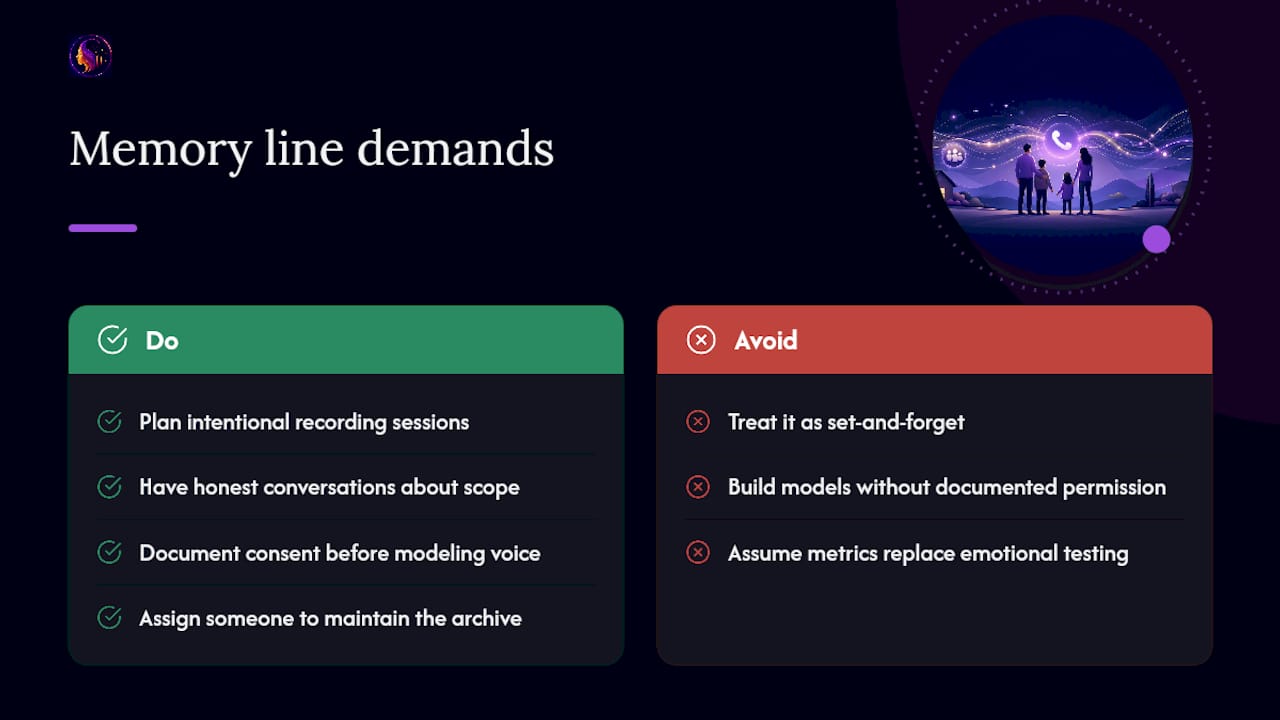
What gets underestimated is the curation burden. Building a memory line that genuinely serves a family requires intentional recording sessions, honest conversations about scope, and someone willing to maintain the archive over years. The families who get the most from this technology are the ones who treat it like an oral history project with a phone interface, not a set-it-and-forget-it service.
The consent-first framing isn't just an ethical nicety. It's also the practical foundation. A voice model built without documented permission is legally and emotionally fragile. One built with care, explicit direction, and good-quality source audio can carry a person's presence forward in a way that photos and text simply cannot.
Senarra gives your family a memory line worth calling
Senarra is built for families who want to do this right: preserve a loved one's voice with intentionality, share it securely, and keep it accessible for generations.
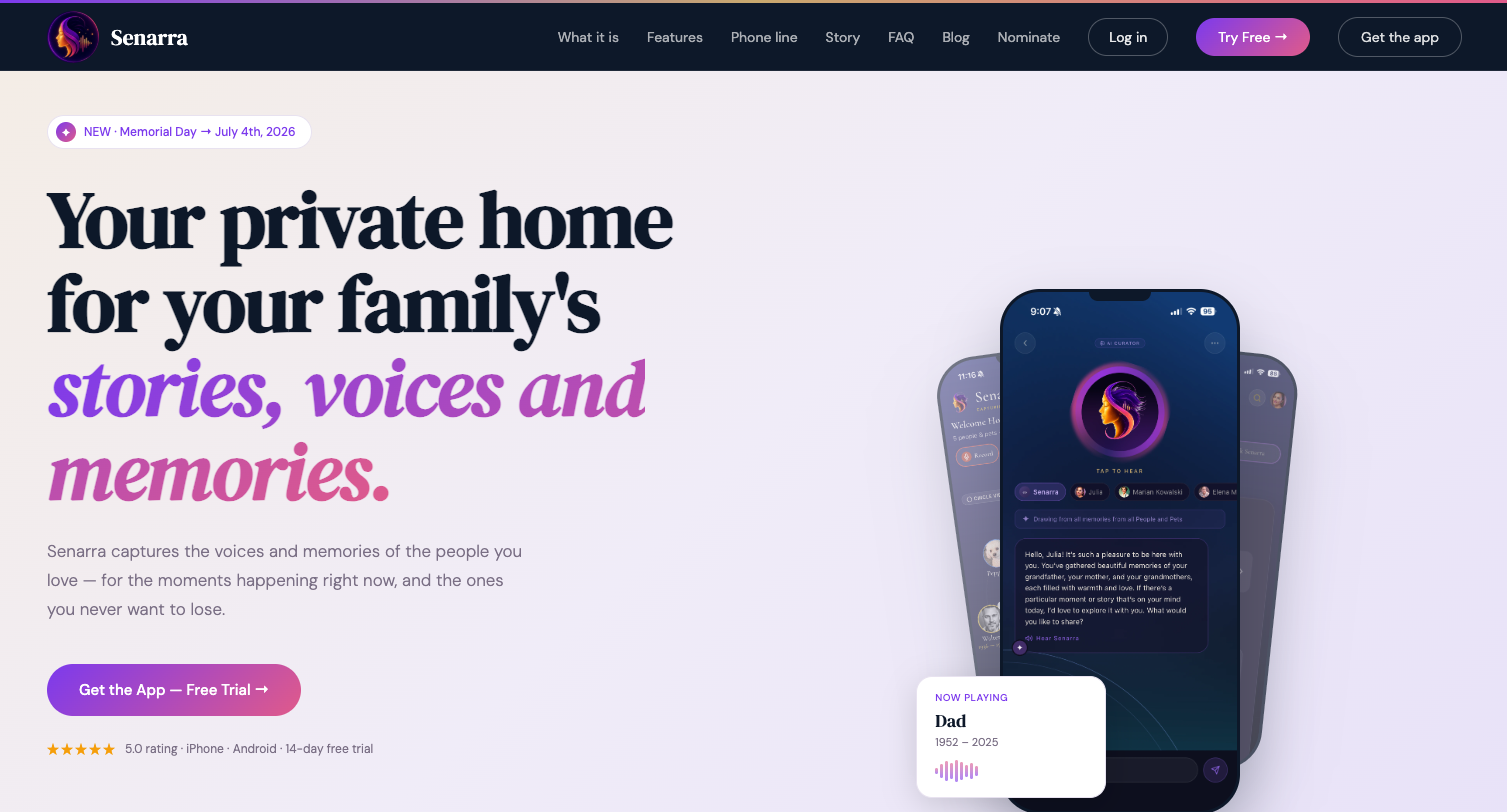
Core features that matter for this use case: voice cloning from existing recordings, a phone-accessible memory line, guided interview prompts, voicemail import and transcription, family collaboration with role-based access, and export tools that keep your archive portable.
- Consent workflows built into the setup process
- Secure sharing with named family members
- Free 14-day trial via in-app purchase
- Pet memories, animated video memories, and AI-powered chat grounded in real recordings
Start your free trial at Senarra and record your first memory today.
Sources
- MemorialBot: Voice Cloning And Personality-Driven Conversational Framework For Post-Humous Digital Interaction And Grief Support
- Funeral
- What is voice cloning? AI voice replication explained — TTS Library
- How Does AI Voice Cloning Actually Work? (2026)
- Systems that Emulate an Identifiable Individual (SEIIs) — Springer
- Sharing Your AI Voice With Loved Ones in Your Estate Plan