
Memory preservation is the active practice of maintaining authentic, detailed personal memories, and it directly reduces regret by preventing the vague, idealized recollections that fuel persistent rumination. When memories stay grounded in real detail, your mind has less room to generate painful "what if" fantasies about the past. Research from behavioral science and a 2026 Stanford study confirms that memory distortion is a primary driver of regret escalation. Platforms like Senarra are built on this exact insight: preserve the real story, and you protect yourself from the stories your imagination invents instead.
How memory preservation reduces regret: the core psychological link
Regret is not simply about bad decisions. It is about unresolved mental narratives. When you cannot clearly recall what happened, your brain fills the gap with idealized alternatives, and those alternatives always feel better than reality. That gap is where regret lives and grows.
Psychologists distinguish between two types of regret, and understanding both is the foundation of any effective memory strategy.
Regrets of action occur when you did something and wish you had not. These tend to fade over time because the outcome is known and finite. Actions produce information that allows your mind to process, learn, and eventually close the loop. A bad conversation, a wrong career move, a failed relationship: each has a clear ending your mind can accept.
Regrets of inaction work very differently. These are the things you never did, the words you never said, the chances you never took. Because no outcome exists, your imagination generates an infinite set of optimistic counterfactuals, each one more appealing than the last. There is no ceiling on how painful inaction regret can become.
The practical implications are significant:
- Inaction regrets intensify over years because imagination has no factual boundary to stop it
- Action regrets diminish because reality, even painful reality, provides closure
- Preserved memories of what actually happened replace imagination with fact
- Specific, dated records of conversations, decisions, and outcomes anchor your mental narrative
- Authentic memory conservation gives inaction regrets a factual context, reducing their emotional grip
This is why the impact of memory on regret is not abstract. It is structural. The more clearly you remember what was real, the less power your imagination has to rewrite it.
How does memory bias distort regret over time?
Your brain does not store memories like a hard drive. It reconstructs them every time you recall them, and that reconstruction process introduces systematic errors that directly affect how much regret you feel.
The most documented of these errors is choice-supportive bias. This is the unconscious tendency to remember your past choices as better than they actually were. Your brain amplifies the positives of what you chose and suppresses the negatives of the alternatives you rejected. The result: your past decisions look smarter in memory than they were in reality.
A 2026 Stanford study of 500 participants found that people selectively forgot unsuccessful guesses within minutes of making them. That is how fast memory editing happens. The study shows this bias is automatic and unconscious, not a deliberate act of self-deception.
This creates two competing problems for regret:
- When bias protects you: Choice-supportive bias can reduce active regret by making past decisions feel justified. This protects self-esteem and prevents unnecessary rumination over choices that cannot be changed.
- When bias harms you: The same bias distorts self-knowledge and blocks genuine learning. If your memory edits out the real reasons a decision failed, you are more likely to repeat the same mistake and feel deeper regret later.
- When selective forgetting compounds regret: Forgetting the specific details of what went wrong leaves you with a vague sense of failure but no clear lesson. Vague failure is harder to accept than specific failure.
- When preserved detail breaks the cycle: Retaining names, dates, and concrete outcomes gives your mind a factual record to return to, which stops the reconstruction process from drifting toward distortion.
Pro Tip: Write down the specific outcome of a major decision within 48 hours of making it. Include what you expected, what actually happened, and how you felt. This single habit interrupts choice-supportive bias before it rewrites the record.
The importance of memory in decision making is not just about the future. It is about protecting the accuracy of your past so that regret cannot grow in the gaps.
Why authentic memory preservation prevents regret from escalating
Not all memory preservation is equal. Preserving a curated, flattering version of the past is not preservation. It is a different kind of distortion, and it carries its own regret risk.
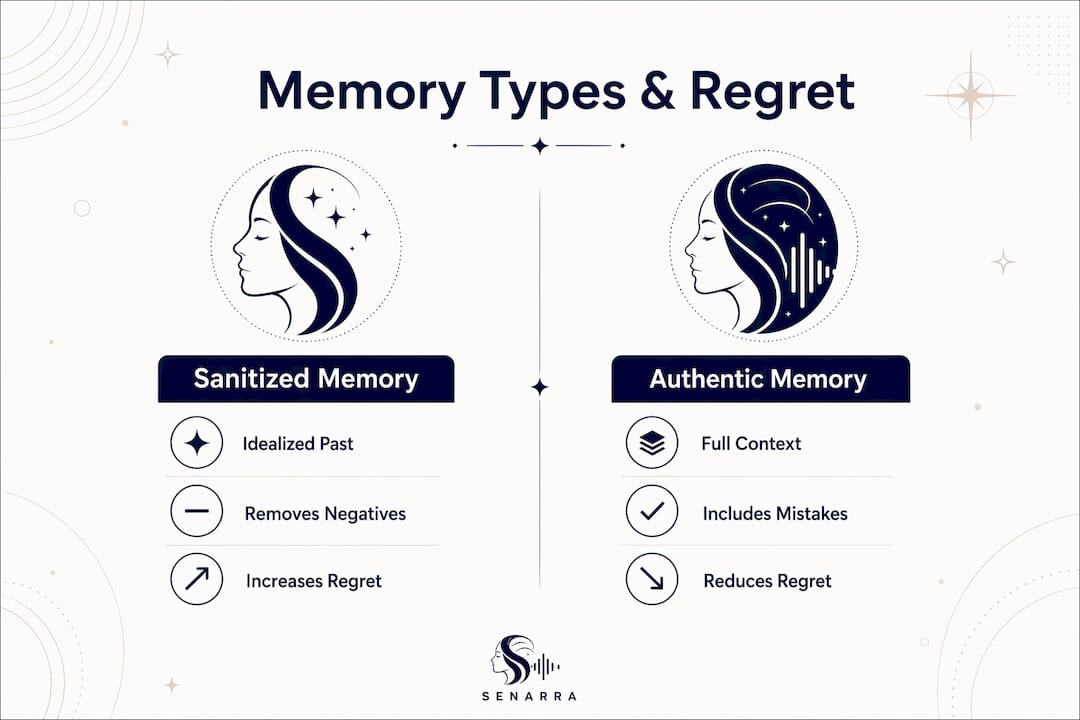
Authentic memory preservation means retaining the full context of an experience, including the mistakes, the uncertainty, and the outcomes you did not want. Practitioners in behavioral science describe this as treating memory as a trust boundary: a record you can rely on because it has not been filtered for comfort. When your memory record is trustworthy, your mind does not need to fill gaps with imagination.
| Memory type | Effect on regret |
|---|---|
| Sanitized memory | Removes negative context, creates idealized past, increases regret risk |
| Authentic memory | Retains full context, anchors reality, reduces idealized counterfactuals |
| Vague memory | Leaves gaps for imagination, fuels rumination and "what if" thinking |
| Detailed memory | Provides closure through specificity, supports acceptance and learning |
The contrast is stark. A sanitized memory of a lost relationship remembers only warmth and misses the friction. Over time, that filtered version becomes an impossible standard that makes every present relationship feel inadequate. An authentic memory, including the arguments and the incompatibilities, gives your mind a complete picture it can accept and move past.
Retaining specific, measurable details is the practical key. Names, dates, exact words spoken, and concrete outcomes prevent the precision loss that turns real memories into idealized myths. Memory compression that removes these details does not save space in your mind. It creates regret.

Pro Tip: When preserving a memory of a significant life event, record at least three specific sensory or factual details: a name, a date, and one concrete outcome. These anchors make the memory resistant to later distortion.
This is why reducing regret through nostalgia only works when the nostalgia is grounded in reality. Romanticized nostalgia amplifies regret. Authentic nostalgia resolves it.
What are the most effective ways to preserve memories?
Practical memory conservation techniques fall into four categories, and the most effective approaches combine more than one.
Digital tools and voice recordings are the most durable form of memory preservation. Voice recordings capture tone, emotion, and exact phrasing that written summaries cannot replicate. Senarra's voice cloning and memory line features are built specifically for this purpose, allowing families to preserve the actual voice of a loved one rather than a written approximation of what they said.
Structured journaling works best when it follows a consistent format. Record the date, the decision or event, your emotional state at the time, and the specific outcome. Avoid summarizing. Summaries compress detail and introduce the same precision loss that fuels regret. Write what actually happened, not what it meant.
Narrative reframing is a psychological technique that addresses the ways to preserve memories emotionally rather than just factually. Research shows that redirecting regret energy into present meaningful action is more effective than rumination. Narrative reframing means consciously writing a story in which past experiences, including failures, are part of a continuous growth arc rather than a set of lost chances.
Psychological closure through commitment is the final piece. Studies show that regret is more about unfinished mental processes than bad decisions. Prolonged deliberation over alternatives keeps the mental loop open. Committing to a decision and documenting why you made it closes that loop. The documented record becomes the closure.
Practical steps to apply these techniques:
- Record voice memos immediately after significant conversations or decisions
- Keep a dated journal with specific outcomes, not general impressions
- Use photo archives with written captions that include context, not just names
- Practice narrative reframing by writing one paragraph connecting a past regret to a present strength
- Avoid editing old journal entries or photos to remove unflattering details
The goal of memory conservation techniques is not to build a highlight reel. It is to build a reliable record that your mind can trust when imagination tries to rewrite history.
Key takeaways
Memory preservation reduces regret by replacing imagination's distorted "what ifs" with authentic, detailed records that anchor the mind in reality and provide genuine psychological closure.
| Point | Details |
|---|---|
| Inaction regrets are the most dangerous | Without a known outcome, imagination generates endless painful alternatives that worsen over time. |
| Memory bias distorts regret | Choice-supportive bias edits memories unconsciously, protecting self-esteem but blocking real learning. |
| Authentic detail prevents escalation | Preserving specific names, dates, and outcomes stops precision loss that turns memory into myth. |
| Closure requires commitment | Documenting why you made a decision closes the mental loop that keeps regret alive. |
| Narrative reframing redirects regret | Connecting past experiences to present growth replaces rumination with forward momentum. |
What I've learned about memory, regret, and the stories we tell ourselves
Most people approach memory preservation as a sentimental act. They save photos, write occasional journal entries, and assume the record will hold. What I have come to understand is that preservation without authenticity is not preservation at all. It is a slow rewrite.
The hardest part of this work is resisting the urge to clean things up. We want our memories of people we have lost to be warm and uncomplicated. We want our memories of our own decisions to show us as wiser than we were. That impulse is human. It is also the exact mechanism that turns ordinary regret into something that follows you for decades.
The memories that have given me the most peace are the ones I recorded honestly, including the awkward parts, the wrong calls, and the conversations that did not go the way I hoped. Those records do not make the past better. They make it real. And real is something your mind can finally accept.
The one thing I would push back on in most advice about regret is the idea that you should focus on moving forward and stop looking back. Looking back is not the problem. Looking back at a distorted version of the past is the problem. Preserve the real version, and looking back becomes a source of clarity rather than pain.
— Bryan
How Senarra helps you preserve memories that actually reduce regret

Senarra is built for exactly the kind of authentic, detailed memory preservation that behavioral science identifies as the most effective way to reduce regret. The platform captures the actual voices and stories of the people and pets you love, preserving tone, phrasing, and personality that written summaries cannot hold. Its voice cloning and memory line features mean you can return to a real conversation, not a reconstruction of one.
For families reflecting on legacy, and for anyone who wants to stop imagination from rewriting the past, Senarra's memory preservation app offers a practical, personal way to build a record you can trust. Authentic memory is the foundation of a life with less regret. Senarra helps you build it.
FAQ
What is memory preservation and why does it reduce regret?
Memory preservation is the active practice of maintaining authentic, detailed records of personal experiences. It reduces regret by replacing vague, idealized recollections with factual anchors that prevent imagination from generating painful "what if" alternatives.
Why do regrets of inaction hurt more than regrets of action?
Regrets of inaction lack a known outcome, so imagination generates an infinite set of optimistic alternatives with no ceiling on intensity. Regrets of action fade because the outcome is finite and the mind can achieve closure.
How does choice-supportive bias affect regret?
Choice-supportive bias automatically edits memories to favor past decisions, suppressing negatives and amplifying positives. This protects self-esteem short-term but distorts self-knowledge and can deepen regret when the same mistakes recur.
What details should I preserve to reduce regret most effectively?
Preserve specific names, dates, exact outcomes, and your emotional state at the time. Retaining measurable details prevents the precision loss that allows memory to drift toward idealization over time.
Can nostalgia reduce regret, or does it make it worse?
Nostalgia reduces regret only when it is grounded in authentic memory. Romanticized nostalgia amplifies regret by creating an idealized past that the present cannot match. Accurate, detailed recollection turns nostalgia into a source of acceptance rather than longing.